
“English Teacher” Attempts to Capture Our Times and Fails to Commit to a Strong Vision
America’s classrooms have become a battlefield. The issue of the day changes, but the conflict remains. FX’s “English Teacher” bravely entered the fractured cultural landscape last year with a buzzy first season that satirized the public school teacher’s plight through beleaguered English instructor Evan Marquez, played by creator Brian Jordan Alvarez.
In some ways, the second season, released on Hulu on Thursday, Sept. 10, is more of the same. Evan and his colleagues; history teacher and best friend Gwen (Stephanie Koenig), beleaguered principal Grant (Enrico Colantoni), business-minded guidance counselor Rick (Carmen Christopher), and gruff gym coach Markie (Sean Patton); are still navigating how to teach their sensitive, tech-addled, no-longer-woke Gen Z pupils. It expands on the teachers’ lives outside of the classroom, especially Evan’s newly rekindled but quickly failing relationship with his boyfriend Malcom (Jordan Firstman) and Markie’s unrequited crush on Gwen.
But politics seem to have been sacrificed in the show’s second iteration.
The first season wore its politics on its sleeve. Trixie Mattel played a drag queen whom Evan brings in to teach the football team the intricacies of makeup and costuming for an event, a student gun club ignites controversy, and Evan’s sexual orientation makes him a target for parent complaints. A flashy issue was exaggerated, Evan would launch a humorous over-prescribed crusade to fix it, and by the end of twenty minutes, the school would be on the right side of history, or at least one step closer.
The first episode of season two, “Covid in America,” immediately eschews any thoughtfulness or even relevance and, unfortunately, sets the tone for the season. The episode’s premise of a misguided student-led production is not a bad one, but the students of Morrison-Hensley High School’s gripes feel uniquely divorced from reality for a show that just last year noticed that “the kids this year are being less woke…they circled back around,” before hand-wringing about the Gen Z shift towards conservatism hit the mainstream.
The students don’t want to perform Tony Kushner’s “Angels in America” (which they chose) because they don’t know what AIDS is, don’t know who Roy Cohn was, and don’t care. Instead, they want to write a version about COVID. Evan chafes against this until he concludes, with the help of his fellow teachers, that the students don’t need to know about AIDS and are entitled to make bad art.
To my knowledge, theater kids are still a fairly progressive demographic. If anything, they would likely have more issues with the musical the students performed, which reduced COVID to “Tiger King” and toilet paper, with little regard for the pandemic’s impact on anything that wasn’t a meme. The show was received warmly by the audience, and Evan even finds it to be moving, if poorly made.
The change of heart is easy for him since his principled stand against the change was actually rooted in his own regrettable foray into high school theater. He, like his students, does not care about AIDS. Not that it’s an important political litmus test, but it begs the question: Why? The episode follows the basic structure of one about the town challenging a show, similar to a book-banning plotline from season one, but instead mostly mocks the one person interested in platforming marginalized voices, until he is revealed to be a fraud.
“Covid in America” is not the only time an issue is warped for humor, with the side effect of becoming confusing and pointless. The show also avoids reckoning with phones in classrooms in the sixth episode, “Recruiter.” In an episode about an overzealous Army recruiter (Ben Bondurant) who must win over the skeptical Evan, Gwen tries to enforce a phone cubby before she is ultimately made a fool of when the lack of phones fails to reveal anything nefarious about the recruiter. Instead of going into the line of fire, “English Teacher” pokes at it lamely. It feels lazy and confusing, unlike the show’s previous ethos, which was praised for “probing different points of view, then drily undercutting expected sympathies.” The cleverness is no longer there, leaving audiences aimless as issues are presented and then shoved under a rug.
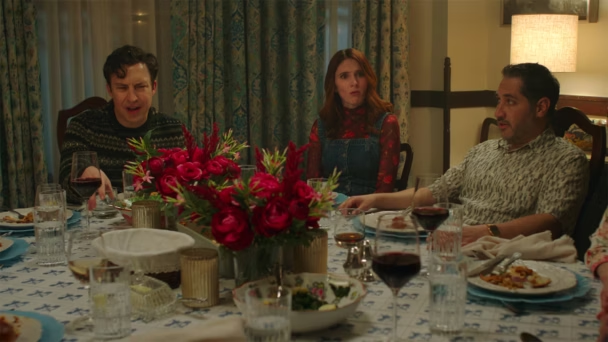
A similar noncommitment to making a point appears outside the classroom in the third episode, “Grant’s Dinner Party.” In a rare full episode set outside the school, Evan faces the challenge of not outing his boss’s daughter’s flamboyant fiancé. The fiancé (Micah Stock) explains that he is “80-20 gay-bi,” but that does not stop Evan from attempting to break the couple apart. While the criticism of biphobia works, the plotline does not serve to bridge a divide outside of Evan’s personal belief that the man is gay. Evan has turned paranoid in this season, quick to see homophobia where there isn’t any, and it is clear that he is making problems for himself. Yet in season one, his identity in the classroom was challenged; his fights, though sometimes misguided and overzealous, stem from real issues. The naive Evan has turned foolish, and the show’s politics are now confusing. He has turned hysterical, a boy crying wolf for oppression.
Maybe this makes for passable comedy, but it dulls the show’s bite at a moment when it is desperately needed. In the fictional high school’s home state of Texas, school curricula are being revamped to infuse the humanities with lessons about Christianity, part of a larger red-state trend of hollowing out public education. If there was ever a time to examine the state of education in America, it’s now. But the once-sharp “English Teacher” is not willing to do it.
Abby Slap can be reached at aslap@wesleyan.edu.





Leave a Reply