
Spike Tape’s “House of Stars” Redefines Trans Tragedy
When Anastasia Zhu ’29 began writing “House of Stars,” she didn’t just want to do what others had and “[give] ourselves pats on the back for writing a trans story, writing representation.”
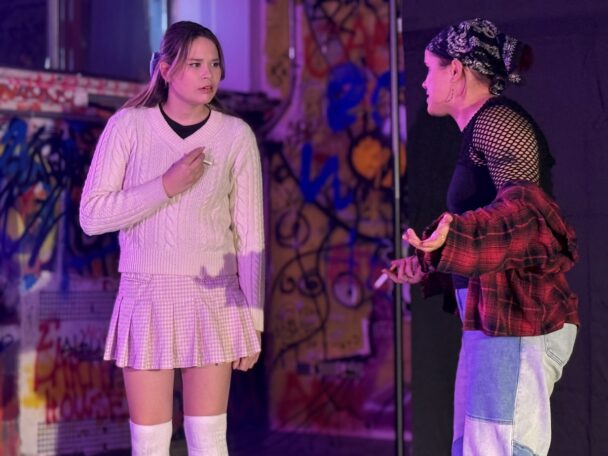
The playwright and director’s latest play, “House of Stars,” which ran from Friday, Nov. 13 to Saturday, Nov. 14 in WestCo Cafe, follows five unhoused trans women who inherit a house from Venus, a beloved trans elder (a delightfully maternal Nathaniel Marinari-Ferenchak ’29). The aspiring writer April (Nora McTeigue ’30), internet-minded Evie (Viv Orthwein ’27), witchy Beatrix (Sage Barry ’29), and cynical Genevieve (Emma Somol ’27) are all hardened by years on the street. Roxie (Cary Tran-Trong ’29) is their foil in pastel pink, a seemingly naive teenager taken in by Venus when her parents evict her.
Much of the first act follows the women’s struggles to pay the mortgage for their newfound home: a monthly money crisis which is always solved instantly by a roll of cash procured through sketchy means. Debates over issues like exploring dating while transgender and acquiring hormones through illicit distributors are carried out as the women hope to help Roxie build a life far better than theirs.
“In the eyes of her sisters, Roxie is the perfect trans girl, one that wasn’t corrupted by the world in the same way they were,” Tran-Trong said.
In a stunning monologue, Roxie burns this premise to the ground at the end of Act 1. Roxie is revealed to be a smoker, a sex worker, an imperfect victim for whom, Tran-Trong said, “Her sex work and self-hatred aren’t what lead to her end; it’s trying to be the symbol that her sisters need that seals her fate.” Roxie says, “Maybe I’m one of those girls who loves too much,” which is “a dangerous thing for a girl like [her].”
She kills herself, and then pointedly positions herself in a crucifixion pose against projections of Notre Dame ablaze (thanks to lighting designer Cosimo Decoster-Pacetta ’30).
But when audiences filed back into the graffitied basement for Act 2, they met with Roxie once again. She isn’t a ghost, but seemingly willed back into existence by her housemates. The rest of Act 2 follows Roxie and the girls in the house, in some sort of alternate timeline in which she did not kill herself. The timeline, and reality itself, are left up to interpretation.
This time we see her hard edges as she staggers into the night with shiny heels, but also meet her lovable boyfriend Noah (Isabella Steenstrup ’29), a wholesome New Jerseyan. April, who gave a gut-wrenching account of her journey from college student to an unhoused middle-aged woman who feels her experiences disqualify her from writing the next great American novel in Act 1, also comes into sharper focus. Her true role, as the writer of Roxie’s tragedy, is revealed through a projection of her laptop screen. Through April’s role, Zhu externalizes her own anxieties about writing a trans tragedy.
“Roxie is based on a lot of people I knew, and all the characters are in some parts people I knew or me myself,” Zhu said. “It’s devastating to me because that’s who we have to be thinking about when we’re writing a respectable trans tragedy or respectable tragedy of that kind. You have to treat the people like people.”
The play’s cast is one of its greatest assets in humanizing the characters. While all the women are distinct and intentionally grounded in stereotypes, their chemistry and rapport shine in the play’s lighter moments. For Tran-Trong, this was a function of the production’s nature.
“Since this is a student-written piece, this was the first time these characters were being brought to life,” Tran-Trong said. “This meant we had only the script and our director/playwright to guide us, and so I think we had more influence on how they ended up than we would have otherwise.”
Zhu based many of the play’s lighter moments on shows like Seinfeld, with references to Larry David jokes that few understood, but those who did had almost violently positive reactions. Someone in front of me nearly leaped out of his seat at each.
Many of Zhu’s references seemed to be on an if-you-know-you-know basis, heavily imbued with online trans culture. She said that this was partly a function of how, “because of isolation and ostracization, there’s a [tendency] for trans youth to find community online.” As a result, controversial online trans figures like ContraPoints, Blaire White, and Brianna Wu are mentioned in the characters’ winding, stream-of-consciousness monologues. Evie, however, is the most representative of online trans culture; she codes a game called BrickLife, scrolls on insular internet forums, and makes a living partially through prediction markets.
“There are so many hyper-specific references that you need to have spent an incredibly long amount of time online to be able to understand, but that’s the point,” stage and production manager Orion Kolek ’29 said of an internet-imbued monologue from Roxie. “Personally, I don’t think you are supposed to understand this scene, and if you don’t, then we did our job correctly.”
Despite the occasional laugh line, the play’s emotional weight is never fully alleviated. Zhu keeps the women’s reality at the forefront, such as when they giddily shower for seemingly the first time in a while at their new home. She centered the play around trans materialism: a theoretical approach to transgender politics that prioritizes the fight for material survival over identity politics.
“At the end of the day, we’re seeing attacks on not just trans people’s validity,” Zhu said. “We’re seeing attacks from our political climate very much on trans people’s survival. I personally had histories within that tradition [of struggle], and have known a lot of people who were in that tradition of struggle, and felt firsthand and secondhand the impact, and how people really weren’t as propaganda would have painted.”
Contrary to some popular portrayals of trans people in media, Zhu said, “We weren’t snowflakes asking for pronouns in emails. We wanted to live.”
The play’s program featured Audre Lorde’s “A Litany for Survival,” which closes with the lines “So it is better to speak / remembering / we were never meant to survive.” And speak these women do. “House of Stars” dared us to listen, even when it was hard.
Abby Slap can be reached at aslap@wesleyan.edu.


Leave a Reply