
Endless Interpretations and Limited Time: Cardinal Pictures’ 48 Hour Film Festival
The audience’s murmurs fell silent as the lights dimmed, and the projector in room A102 of the Casper Life Sciences Building lit the screen, finally debuting students’ hard work. After just two days of writing, filming, and editing, participants in Cardinal Pictures’ annual 48-hour film festival gathered to showcase the films they had created in a single weekend.
Cardinal Pictures, a student-run production house, organizes the 48-hour film festival each year, where students in groups of two to four sign up and are challenged to film a short movie in two days using only one phone and a tripod.
This year, Cardinal Pictures announced the theme “Endless” at noon on Friday, Nov. 13. Students picked up their tripods at 5 p.m. that day, and had to submit their final movies by 5 p.m. on Sunday, Nov. 15. The submitted films were screened shortly thereafter, at 7:30 p.m.
The theme “Endless” is undoubtedly broad, and teams took full creative advantage of it. The screening featured 10 films, each offering its own take on the theme: “South Pole Santa,” “Slurp,” “Who is Jude?,” “Unheimlich,” “Endless Date,” “Studyrooms,” “Breathwork,” “Guten Tag, I Still Love You,” “To-Do,” and “Endless Orgasm.” Going into the screening, I would have never expected to watch a film about a man diagnosed with spontaneous five-hour-long orgasms or a Santa who talks like he’s from the Deep South.
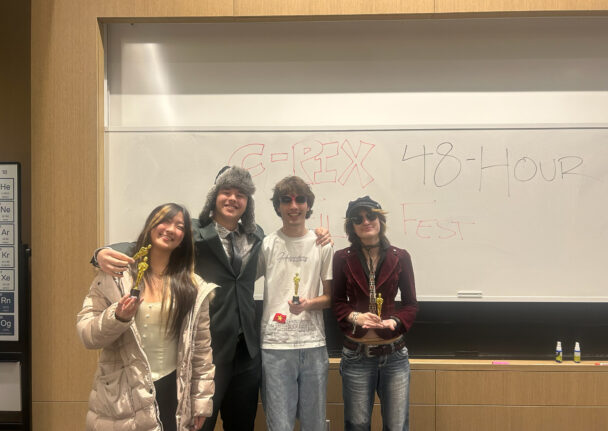
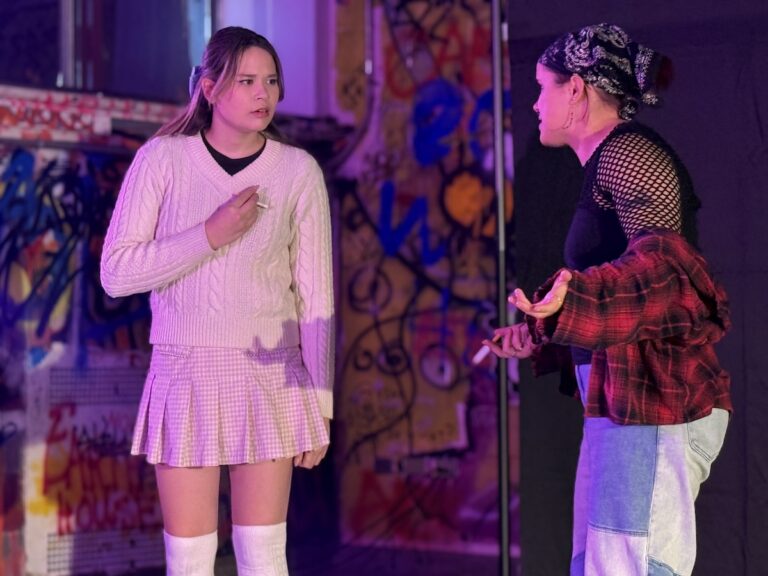
I found it fascinating how “Endless Date,” which follows a first date at WesWings, felt endless but wasn’t. It begins with a slow pan towards a table where a girl and a guy sit opposite each other. We are immediately introduced to the girl’s interiority as she tries to convince herself that agreeing to this date was a good decision; the camera then cuts to the guy opposite her, downing a large platter of wings with sauce smeared across his face. The director seamlessly represented the passage of time through sped-up shots of the restaurant’s clock. At the same time, the guy cycled through increasingly absurd activities, such as playing the guitar and reciting sections from a book, which felt very characteristic of campus culture. These exaggerated moments capture how even a short period, like a date, can feel endless when you’re desperately waiting for it to end. The ending was especially witty: The protagonist asks her date if she can play his guitar, and she whacks him over the head with it. The film won a well-deserved award for best acting.
“Slurp,” the winner for best cinematography, mirrored “Endless Date” with its horror-comedy genre. It features a boy doomscrolling on TikTok who comes across an AI-generated video of a woman claiming that the more you eat these special infinite noodles, the more your desires will come true. I enjoyed how the boy is introduced in a dark room, his face lit by his phone, foreshadowing how the video’s concept has already consumed him. He receives a call from his friend asking him where he is, since he is supposed to be the best man at his wedding. On his way out, he sees a bowl of noodles in the Butterfields’ common room and starts eating it until he chokes. Then another person comes by and starts eating the noodles, repeating the cycle. Unlike “Endless Date,” “Slurp” presents endlessness as a literal, almost parasitic cycle of consumption. The noodles initially seem to offer an escape from the limitations of everyday life, promising a vessel to fulfill anyone’s desires. However, this promise takes a dark turn when the character becomes consumed by their own greed, shrugging people off as they try to stop him. The passage of time in the common room is filmed as if you are walking past the window throughout the day. It feels like something you could stumble upon on your way back to your dorm, which makes the absurdity even more amusing. This film was an especially clever interpretation of the theme, and the directors did a fantastic job at transforming something as mundane as eating noodles into a seemingly inescapable cycle.
Alexander Papp ’30, a co-director of “Slurp,” said the time pressure forced him and his co-director, Kalin Huang ’30, to practice planning and editing efficiently.
“Even if you move backward, it’s still actually progress as opposed to not doing anything at all,” Papp said.
Despite being limited to a tripod and phone, his team executed the cinematography by using certain qualities of the phone.
“iPhones have gotten really, really good with autofocus and other stuff like that,” Papp said. “We used the phone’s lighting and then boosted the exposure in editing to make it look more cinematic. We used that to our advantage because we didn’t have any like professional equipment or lighting.”
“Endless Orgasm,” the winner for best concept, stunned me. The film’s mockumentary style added to the concept’s absolute ridiculousness. It features a guy discussing his niche condition: He suffers from endless orgasms that are prompted by the most random things, from eating good food in Usdan to seeing couples interact around campus. Like “Slurp,” the film took full advantage of the University campus, making it even more engaging because the settings were recognizable. The mockumentary format made the premise feel almost believable, especially as the protagonist described his circumstances so matter-of-factly, treating something so outrageous with such seriousness. It was one of the films that prompted the loudest reaction, with giggles filling the room in every scene. Its unapologetic treatment of a taboo subject was somewhat uncomfortable but also refreshing. The film embraces the comedic potential of taking something fleeting and making it constant.
The Cardinal Pictures’ 48 Hour Film Festival was a wonderful opportunity for students to showcase their filmmaking skills and express their creativity through the open-ended theme of endlessness. If you entered this screening with no context, you would never have guessed these films were filmed in just 48 hours.
Ailish Herrmann can be reached at aherrmann@wesleyan.edu.



Leave a Reply