
“Fjord” Student Roundtable Illuminates the Award-Winning Film
Intolerance can be found anywhere, even in the idyllic-yet-icy progressive Norwegian village in Romanian filmmaker Cristian Mungiu’s film “Fjord” (2026), which was awarded the Cannes Film Festival’s highest honor, the Palme d’Or.
In the midst of an undeniably hectic press cycle—the kind bestowed upon Academy Award hopefuls—Mungiu took the time to sit down with student journalists from across the country to discuss this powerhouse addition to his filmography. Thanks to distributor NEON’s relationship with college campuses and our very own NEON campus ambassador, Gryphon Magnus ’28, I was fortunate to watch the film early and join a wide-ranging discussion of its conception, production, and themes.
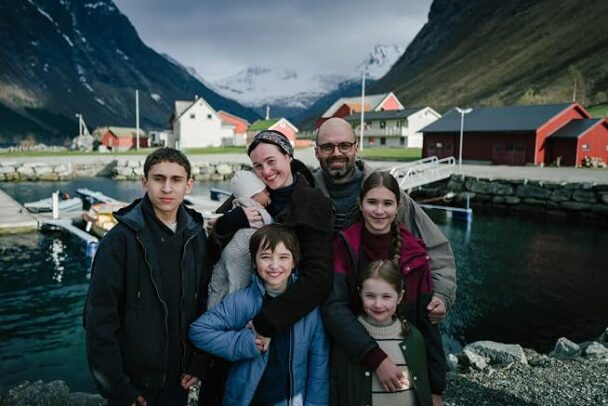
“Fjord” follows the Gheorghius, a devout Christian family of seven who just relocated from Romania, where the father (Sebastian Stan) and children have spent their lives, to the mother’s (Renate Reinsve) native Norway. As they attempt to make friends with their neighbors, the family’s unwavering commitment to Bible study, discipline, and a screen-free lifestyle marks them as undeniably other. Cultural differences come to a boiling point after the parents are accused of physical abuse and the children are taken by Norwegian Child Welfare Services. Based loosely on a real incident, the contentious legal battle and personal fallout make for a gripping drama, as customs, morality, and religion are invoked in a display of our seemingly never-ending culture wars.
Mungiu understands the toxicity of conservative cultures, having examined racial tensions in Transylvania in 2022’s critically acclaimed “R.M.N.” But what struck him when considering the child protection case “Fjord” was based on, he said during the roundtable, was how “the world has become way more illiberal in the last 10–15 years since I was following this case…as a result of how these very good, progressive views were implemented in society.” The Gheorghius’ Norwegian neighbors seemingly live by their values, cultivating an environment many would consider accepting. Mungiu understands that many viewers, the hyper-educated Western elite who are drawn to subtitled Cannes Film Festival darlings, will feel kinship with them. But, he said, “we need to start to initiate some sort of a dialogue.” In the search for this dialogue, easy conclusions are hard to come by. The Gheorghius are good neighbors. Reinsve’s character is not only a devoted mother but also a nurse, and she helps her neighbor care for an ill family member on top of her many familial responsibilities. Stan, meanwhile, plays a patriarch who finds himself lost in a society that no longer wants men like him. The couple’s Christ-like devotion can be admirable at times, even if their beliefs, such as teaching their young children that lesbians are Hell-bound, are not.
“Fjord” treats its heavy subjects with a light hand. Mungiu said, “I’m not this naive to believe that with films, or with narration in general, that you can change people’s opinions for good in two hours.”
After talking to the family, lawyers, and outside groups involved in the real-life inspiration for the film, Mungiu said, “I couldn’t tell what happened in the family; I couldn’t tell what’s the truth, what’s the degree, for example, of violence in this family.” The alleged incidents of abuse occur offscreen, manifesting instead as bruises (which coincide with a wrestling unit in gym class), testimony from the children in shaky Norwegian, and the parroting of their parents’ hardline views.
The resulting ambiguity defines the experience of viewing “Fjord.” Although Mungiu feels that “we shouldn’t just be doing entertainment with cinema,” the movie makes for an intellectual joyride. “What’s important to me about this film is that I’m using the freedom that I have as a filmmaker not only to do an entertaining film, but to bring something forward that would make people think.”
While that may not sound exciting, Mungiu said that he wanted “to show that it’s possible to make a film which can be enjoyable, and have a lot of thrills, and tension, but at the same time it allows people to use their critical spirit to analyze some facts happening in front of them.” This quality makes “Fjord” a film best followed by a long, sprawling, perhaps personal conversation. I found myself itching for my friends to have watched it too, and was stuck trying to explain as much as possible so we could untangle it together. Listening to Mungiu felt like an extension of “Fjord” itself, a discussion in which, no matter how much we as student journalists pried, he said, “I wish I could share what the truth is.”
A special pre-release screening of “Fjord” will be showing in the Goldsmith Family Cinema at 8 p.m. on Thursday, Oct. 8, as part of the Wesleyan Film Series.
Abby Slap can be reached at aslap@wesleyan.edu.

Leave a Reply