
Writer Alice Mattison on Poetry, Prose, Scholarship, and Looking for the Right Glasses
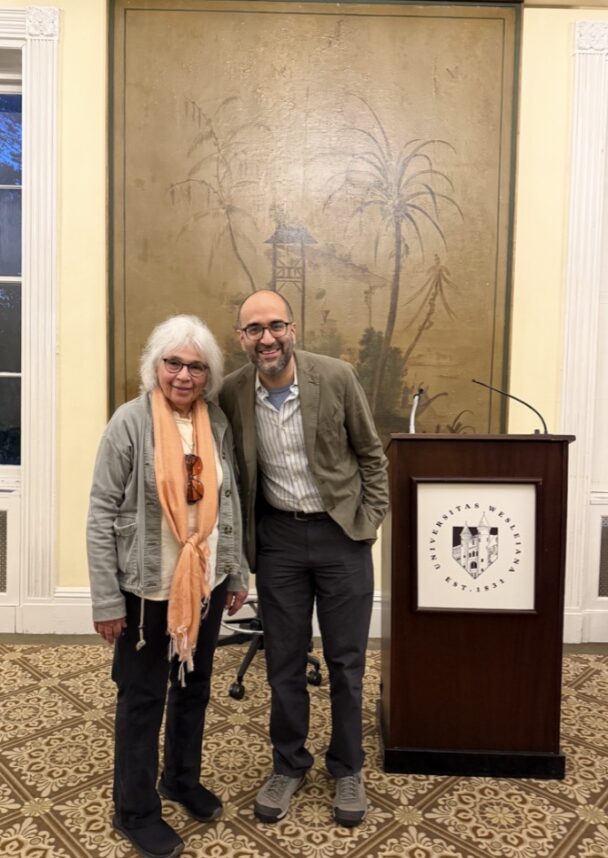
On Wednesday, Sept. 23, Russell House, with the help of Associate Professor of English Hirsh Sawhney, hosted its first event in its “Russell House Reading Series,” featuring writer Alice Mattison, the distinguished author of seven novels, four story collections, and a collection of poems. The reading began with a sentimental foreword from Shawhney, in which he outlined Mattison’s expansive collection of work while reflecting on their relationship with the author, as neighbors and writers. Sawhney described Mattison’s fiction work as composed of “horrible, abusive characters to shed light on how confusing it can be for ordinary humans to understand.”
Mattison read an excerpt of her upcoming memoir “Eye Trouble” that has not been read in public or published yet. Back in 2018, Mattison published a personal essay with the same title, which she then attributed to her current memoir, saying that the story had grown and changed from that point. Mattison described this memoir as “not about anything. It’s about me.”
Within these few chapters, Mattison expertly tied her journey as not only a writer, but a scholar, advocate, mother, wife, and teacher as she dealt with her developing sight problems. After numerous visits to different retina specialists, she eventually discovered that she has “Macular Dystrophy: the disintegration of a tiny spot at the center of the retina that is responsible for fine vision.”
However, within the memoir, Mattison’s impaired vision does not take center stage as one might expect from the title. We learn about Mattison’s time at Harvard University, including how she thought she got into Harvard simply because she liked to read a lot. We learn she was originally a poet, and about how she learned the craft of short story writing from a friend who was taking a writing course, and while they discussed their writing, the two women checked their little children’s heads for lice on their front porches. As Mattison herself put it, “Whatever happens changes life…but ordinary life continues.” Her rare genetic disorder, despite being described as a burden, existed alongside her teaching, motherhood, friendships, marriage, and life.
During the question and answer portion of the reading, Mattison shared some of her expertise cultivated over years of writing and teaching. When asked about when her writing is good enough for her, Mattison’s response was, like many writers might say, almost never. “Revise, revise, revise,” Mattison said. Her process tends to go as such: Type, print out the page, scribble in the margins until there is absolutely no more room, then re-type and do it over again until there are not so many scribbles. Mattison describes the “need to write as a disability; sometimes you just have to do it.” Perfection is not necessarily the goal; rather, it is continuous revisions until reaching a point of presentation and pride.
When asked if her eyesight lent an urgency to her writing process, Mattison said she became a better fiction writer as a result of her experiences. She had come up against something challenging, an obstacle between her and her writing (she had described when answering an earlier question that she had become “more allergic than [she] used to be to writing that is longer than it needs to be”), and yet, is that not what makes us better writers? Her disease forced a “need to write more and maybe even [the ability] to write more.”
Mattison, like in much of her work, does not frame her eye disease in either a negative or positive light, but rather as a complex, nuanced challenge she’s had to live with and adapt to. She sums up this stark and raw theme in the very last line she read to the captivated audience of Russell House: “Much of life was consumed by looking for the right pair of glasses.”
Avital Kessner can be reached at akessner@wesleyan.edu.
Leave a Reply