
The Magazine Symposium Highlights the Value of Community in Journalism
A magazine is a container for taste. A document of the fleeting present. It gives form to our experiences.
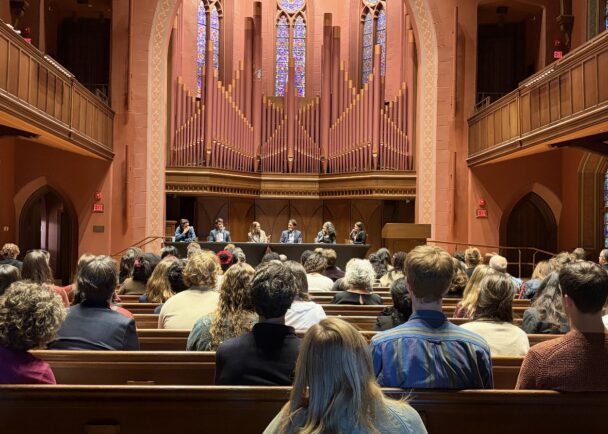
These aphoristic perspectives are merely a snippet of the wisdom editors from leading publications, including The New York Review of Books and The Yale Review, shared at Wesleyan University’s very first Magazine Symposium on Thursday, Oct. 29 and Friday, Oct. 30.
The impressive event was founded by Director of Shapiro Writing Center and Shapiro-Silverberg University Professor of Creative Writing and Criticism Merve Emre and Mia Foster ’25, previously Wesleyan’s Kim-Frank Fellow for Creative Writing and now an assistant editor at The Atlantic. Inspired by the changing media landscape, they discussed the possibility of a magazine festival during which prominent members of the industry could come together and share ideas.
From the rise of AI to shrinking personal and cultural attention spans, today’s era of rapid transformation calls into question the future of magazines and public-facing writing.
“Many editors were receiving AI-edited or generated pitches for the first time; literary prizes were receiving entries completely written by chatbots, the whole industry has been pivoting to video,” Foster explains. “The whole industry has been pivoting to video. The intersection of internet culture and cultural coverage has changed what editors are tracking and the kinds of stories major magazines are writing.”
The Symposium gave those in the publication world a unique opportunity to gather and discuss those big questions.
“What better way to think through the seismic changes in the world of writing and publishing right now…. than to bring a big group of magazine staffers together to talk?” Postdoctoral Fellow in Criticism and Interim Director of the Shapiro Writing Center Zachary Fine said. “The Symposium [is] a chance to celebrate magazines, to workshop problems they share in common, and to reflect on their future.”
At a panel on Friday, “Gen-Z and the Future of Magazines,” young editors from a variety of publications examined the costs and benefits of writing in the digitized world. Speakers criticized the assumption that Gen-Z lacks the attention span for longer pieces, noting that what matters is how compelling the piece is from the get-go. Platforms like Substack make publishing accessible to the general public, and for better or for worse, the convenience of content allows us to consume more of it than ever before. As Charlotte Klein ’19, features writer and media columnist at New York Magazine, pointed out, this development has made quality field reporting even more valuable.
The discourse of the event proved to be helpful not only for the speakers, but for the many guests, some of whom had their transportation and stay organized by the Shapiro Writing Center. With discussions on skills such as the art of freelancing and finding an audience, the insights speakers shared were incredibly helpful for anyone looking to break into the business or gain new insight into their own work. One panel, “Fact Checking Masterclass,” taught by Head Research Editor at The New Yorker Fergus McIntosh, allowed a curious and lively crowd of editors to learn from a leader in their field.
Indeed, the Magazine Symposium hosted a spectacular group of leaders in different corners of the published world. Speakers included writers and editors from The Drift, Granta, The Believer, The Point, The New York Times Magazine, n+1, The New Yorker, The Paris Review, Harper’s Magazine, The Yale Review, and The New York Review of Books, among others.
While the Magazine Symposium was no doubt its most ambitious project, the Shapiro Center has brought in numerous writers, critics, editors, and publishers to speak to students since Emre took over. The Center also offers internships for Wesleyan students in a variety of journalistic fields.
“All of the initiatives of the Center aim to give students better insight into what forging a career in a literary industry looks like,” Foster said.
Over the course of nine months, the Symposium was meticulously planned and executed through the hard work of those at the Center. The small team, led by Emre, included Foster, Fine, Maisie Wrubel ’26 (the current Kim-Frank Fellow), Administrative Assistant the Shapiro Center Catherine Con Morse, and Michele Moses (producer and editor of the podcast “The Critic and Her Publics” and an editor at The Yale Review).
“Putting the event together took an enormous amount of work and wouldn’t have been possible without Heather Fox, the Director of Events & Conferences; James Sims, Imelda Mongillo, and Kevin Maher from University Communications; Roger Grant, the Dean of the Arts and Humanities; as well as the support of Michael Roth and the Office of the President,” Fine said.
The Symposium gave us all a unique opportunity to physically gather and discuss the value and state of writing for ourselves and for each other. As Wrubel put it, it was extremely rewarding “seeing how such a small team of people could so successfully fulfill this incredible vision and seeing all the people who—in the face of our contemporary cultural landscape—still believe so deeply in magazines and what they have to offer.”
Katherine Emmer an be reached at kemmer@wesleyan.edu.

Leave a Reply