
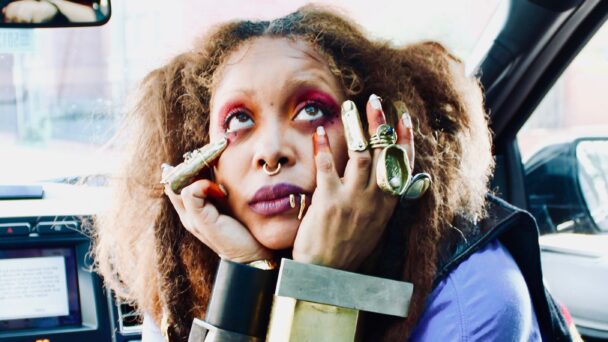
Erykah Badu Presents Her Own Radical Musical Vision
From the moment Erykah Badu, the queen of neo soul, first stepped onto the scene with the earthy introduction of “Rimshot (Intro),” she represented a radically different vision for music. With her signature head wrap and ankh jewelry, burning incense between her fingers and sipping tea, she not only defied systemic barriers of music genres but challenged the power and practice of music itself, and what it means to be an artist. Often seen in large, oversized clothing with melodic accessories such as ankle bells (which are apparently good for the chakras), Badu’s artistry has an enigmatic quality, mixing urban streetwear, the African diaspora, and diverse musical references that mark her ingenuity.
From the start of her career, Erykah Badu wasn’t limited by sonic expectations. Her freshmen album Baduizm, released in 1997, introduced a new term for a groovy, minimalist, socially-conscious style of soul. Coined by label executive Kedar Massenburg after hearing Badu’s freshmen album, neo soul describes a blend of hip-hop, jazz, soul, and funk that counters the more radio-friendly, maximalist, 90s R&B, valuing creative artistry over broad commercial reach. Despite the genre’s emphasis on self-exploration, neo soul achieved widespread commercial success with albums such as Voodoo by the late D’Angelo, The Miseducation of Lauryn Hill by Lauryn Hill, Jill Scott’s Words and Sounds anthology, and Maxwell’s Urban Hang Suite by Maxwell.
Specifically, Badu’s minimalist yet melodically demanding aesthetic is marked by an unorthodox approach to sonic arrangement, forming an addictive groove from a small number of instruments, mostly a bass riff and natural, acoustic drums. The genre’s core comprises classic seventh, ninth, and diminished chords. With lyrical themes that explore diverse spiritual beliefs deriving from ancient Egyptian religion and the Nation of Gods and Earths, Badu’s music rests in a political and cultural ethos that explores the Black female experience. When reflecting on her own musical singularity, Badu recounts that the late 90s were a time when music was “going through a rebirthing process, and [she] found [herself] being one of the midwives.”
The title of her first studio album, Baduizm, is a portmanteau of references, the first of which connects to her creative surname Badu. The name originates from her favorite jazz scat, and the -izm is slang for weed. The album, as Badu describes it, is meant to elevate one’s consciousness, to evolve, to get high from the music.
“Oh, my, my, my / I’m feeling high / My money’s gone / I’m all alone,” Badu sings in “On & On,” whose intoxicating vocals were instantly compared to the jazz icon Billie Holiday.
Even as Baduizm—which infused elements of African culture with a touch of Middle Eastern vocal arrangement—received commercial and critical acclaim, Badu remained singular, refusing to be constrained by audience expectations or genre limits, and her music would increasingly trace the politics of the Black American identity.
In her sophomore album Mama’s Gun, Badu explores direct vulnerability, no longer concealed under previous religious imagery, while investigating themes of heartbreak, politics, race, gender, and motherhood.
Notably, the 10-minute masterpiece “Green Eyes” explores the five stages of grief through unique musical sections that evolve sonically through decades of Black musical styles, beginning with a distorted radio sound reminiscent of 20s scat jazz and later evolving into a maximalist soul composition that Badu layers with her impeccable, pleading vocals. On “A.D. 2000,” which was inspired by the 1999 murder of Amadou Diallo by the New York City Police Department, Badu grounds a direct call for political and racial reckoning over intimate sustained guitar chords.
“No you won’t be name’n no buildings after me / To go down dilapidated, ooh / No you won’t be name’n no buildings after me / My name will be misstated, surely,” Badu sings hypnotically.
Yet what makes her artistry so significant is her unrelenting commitment to her singular voice. While Mama’s Gun featured more accessible lyrical explorations, her later albums—Worldwide Underground and New Amerykah Part One (4th World War)—would expand its political ethos and sonic experimentation. In “The Healer,” Badu defiantly shouts “hip-hop is bigger than the government,” elevating popular Black culture to a force capable of competing against formal institutions. Badu popularized the word woke, using the phrase “I stay woke” in her song “Master Teacher,” pleading for a new global consciousness and formal liberation, which later became weaponized by U.S. political institutions. In contrast, her 2010 album New Amerykah Part Two (Return of the Ankh) offered unprecedented accessibility to her music that still explores central political themes. The album’s single “Window Seats,” with simple themes of love and heartbreak, features a music video in which Badu goes fully nude publicly in front of the location where President John F. Kennedy was assassinated. Despite this controversy, her 2010 album produced many successful singles, often at the expense of her sonic originality as she explored a funkier melodic groove.
While Erykah Badu continued to perform, she stopped recording music for a decade and a half. The one exception was her 2015 EP But You Caint Use My Phone, which interpolated Drake’s hit “Hotline Bling” and explored themes of digital communication and technological reliance. Fans were reacquainted with her signature sound in August, when, in collaboration with underground hip-hop legend The Alchemist, they released Before the World Blows, a joint album featuring both artists at their strongest, with the Alchemist’s sample-heavy blueprint and Badu’s enchanting melodies perfectly intermingling.
In the album’s opener, “Echos,” Badu recounts “Cause they didn’t believe that we’d break the chains / And we couldn’t be programmed and we all the same / And we know the truth that you trying to separate us / We are no robots,” in a powerful dialogue, promising commitment to her ancestors: “And I put that on Odessa / And I put that on Rebecca / And I put that on Viola.” This grounds the album’s fierce political values. Badu explores technological dependencies in “Black Box” (“Phone call, liberation or entrapment?”), structural violence in “They Ain’t You” (“I cleaned out my storage, been rich and been poorest / I’ve seen enough death to know peace and what war is”), and antisemitism in “Witch Doctor” (“You believe it ’cause you need it / And they bank on it, Anne Frank on it / And you eat it up (Up), what they feedin’ you”).
With an unconventional musical approach, Badu bolsters her audacious claim to individuality, and her recent album reintroduces the singer to her strongest impulses: refusing to follow any given artistic pathway. Instead, Badu shapes her own destiny.
Carter Appleyard can be reached at cappleyard@wesleyan.edu.


Leave a Reply