
Trump Administration Continues to Delay “DEI” Research Grants, STEM Professors Talk Impacts
The University receives roughly 52% of its research funding from federal government grants, according to reports by the National Science Foundation (NSF), despite not being a public institution. These grants come from federal agencies such as the National Institutes of Health (NIH), NSF, and NASA, to name a few.
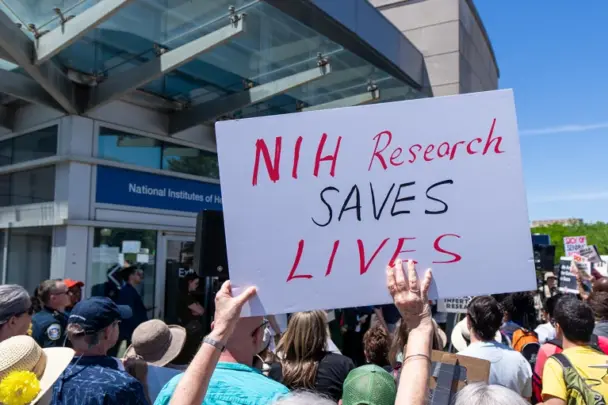
This year, the Trump administration has requested cutting the NIH budget by 41%. The proposal would cut research to about $27.9 billion.
Congress blocked these cuts and enacted the default NIH budget of around $48.5 billion. Still, the second Trump administration has seen changes to grant policies, processes, and the total number of grants awarded by federal agencies. Some policy changes made by the NIH in response are in an effort to save costs and provide budget flexibility as grantmakers are uncertain about how the budget will look in the future.
Grant Changes Under the Second Trump Administration
Funding has always been a concern for the heads of University research laboratories, also known as Principal Investigators (PIs), who are appointed by the University to conduct research and often teach as well. Not only are those in this position responsible for designing, leading, and reporting on their research, but they are also expected to obtain funding to support it. Without sufficient grant money, research projects will stall or stop altogether.
Assistant Professor of Neuroscience and Behavior Alison O’Neil is one of the University’s many PIs overseeing a lab. The goal of her research is to determine how the structure of protein aggregates affects the cellular outcomes of neurodegenerative disease. O’Neil has experienced challenges in acquiring new grants as hers begins to run out.
“We haven’t had any of our funding taken away, but it is slim pickings to find new [funding],” O’Neil wrote in an email to The Argus.
Part of this is due to the NIH changing its policies to award grants on a multi-year basis, rather than annually. Beginning in 2025, the NIH has begun to award grant funds up front for all years of the project period, rather than providing a smaller sum of money each year.
In both 2025 and 2026, the NIH was reported to have awarded grants more gradually. According to NPR, last year, the NIH’s grant awarding ran roughly 44 days slower on average. Through early July 2026, it ran 42 days behind. As the NIH runs behind schedule in awarding grants, fewer new grants are currently being reviewed at board meetings.
“Instead of discussing the top 50% of grant proposals, like we used to, now we only talk about the top 30%,” O’Neil wrote. “So, there’s this whole 70% of grant proposals that don’t even get discussed at these [NIH] meetings.”
The number of new grants awarded has also declined, with NIH application success rates down to 13%, contributing to a 24% decline in new grants awarded in the 2025 fiscal year.
The Administration’s Cuts to Programs Dubbed “DEI”
Along with the number of grants awarded, the research topics that are funded are also changing. Federal agencies are making policy shifts under the second Trump administration to realign “NIH’s grants portfolio with the Administration’s overall policy objectives.”
These shifts were made following a January 2025 executive order attempting to decrease the amount of funding for programs labeled as “DEI programs” and instead prioritize research on AI and chronic disease. In practice, this new grant policy allows agencies to flag and deny research grants with “DEI” terms such as “diversity,” “climate change,” and “gender ideology.”
These shifts are especially relevant for Assistant Professor of Biology and of Integrative Sciences Boris Tezak. His research lab focuses on temperature-dependent sex determination in reptiles and germ cell biology. Naturally, his grant proposals contain words like “sex,” “chromosomes,” and “climate change.” Thus, he’s had to alter the terminology and scope of his research when applying for funding.
“I submitted [a grant] with a collaborator in Florida…through the university in Florida,” Tezak said. “It got sent back to us because…it flagged a bunch of terminology that we couldn’t use, so we had to change the word ‘females’ to something else, and we [had] to change the word ‘climate change’ to something else.”
In response to the uncertainty of research grants in the U.S., professors now often look to other countries for grants, or shift their research field altogether. For Tezak, he has had to shift the focus of his research away from climate impacts and conservation toward germ-cell research.
“In terms of my own research, I have been focusing a lot more on understanding [the] impacts that temperature can have on fertility [and] the health of the germ cells,” Tezak said.
In April 2026, as grantmaking had already slowed, the Trump administration abruptly removed all members of the board of advisers that oversees the NSF. According to the Library of Congress, at the same time, federal science agencies lost 117,840 employees from September 2024 to February 2026, creating instability across universities, nonprofits, and companies. Additionally, the grants funded by the NSF followed the national trend of decreasing the amount of money they gave to potentially conserve the budget.
While NSF grants are diminishing, Tezak has been requesting funding from the NIH.
“Our main big funding agency is the National Science Foundation,” Tezak said. “That is changing right now because of the current funding situation. It has also forced me to kind of rethink the type of research that we can do in the lab, or maybe how we frame that research.”
O’Neil considers herself lucky given that her research, which focuses on Alzheimer’s disease, hasn’t been targeted.
“I’m feeling lucky that our research is very translational and disease research focused, because that money isn’t being targeted as much,” O’Neil said. “Alzheimer’s is not as controversial a research topic as climate change.”
An Uncertain Future for Research
Even as the current administration shifts funds away from climate research, University students within the Environmental Science and Biology fields hold out hope that the grant restrictions are only temporary.
“It’s hard, because I try not to discourage students from pursuing their passion,” Tezak said. “So if they’re really interested in this research, I hope they feel like they can still pursue it. But it is something that we can’t ignore, and it is something that we have to think about when we’re making those decisions to go into academia.”
Still, the administration’s swift changes to the way grants are allocated is altering academia in the long run. A large factor that determines a professor’s eligibility for tenure is the amount of grant money that they are able to secure for their research. In the past few years, the declining rate of grants awarded has made it harder to get funded, especially for research that the administration has dubbed as “DEI.” It is uncertain whether this obstacle to obtaining research funding will be weighed in when administrators make tenure decisions in the future.
Lily Liu ’29 is involved in an environmental studies lab at the University, and works at nature conservancies that struggle to receive federal funding.
“It does not discourage me because you still need people to do research on climate change, and maybe the administration will be different in the future,” Liu said. “Funding might come back. We should wait it out.”
Claire Farina can be reached at cfarina@wesleyan.edu.




Leave a Reply