
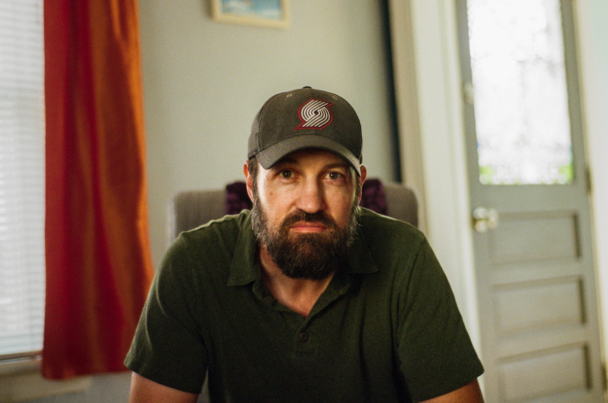
Office Hours: Sam Anderson on His Mystical Intuition, Red Book Moments, and Writing as Rebellion
Welcome back to Office Hours, a series brought to you by the Features section! In these articles, Argus writers speak to faculty, staff, and members of the administration about their interests, classes, and lives on and off campus.
From Dwayne Johnson’s carefully crafted wrestling punch, to the last two northern white rhinos on Earth, award-winning author, journalist, and critic Sam Anderson has covered a remarkably wide range of subjects. Anderson came to the University from The New York Times Magazine where he works as a staff writer. This semester, as the Fall 2026 Master Class instructor at the Shapiro Center for Creative Writing and Criticism, Anderson shared his approach to the celebrity profile as a pursuit that goes beyond the traditional notion of celebrity. The Argus sat down with Anderson to discuss his unconventional approach to writing, the art of reading people, and voicey writing as an act of rebellion.
The Argus: What sparked your interest in writing?
Sam Anderson: I always loved reading as a kid. My parents read to me and told me lots of stories. My interest in writing probably came from that. When I was a teenager, I wrote a lot of pretentious, horrible stuff until I found my actual writing voice.
I wrote for a newspaper in college. I tried to write short fiction and submit my stories for publication. I got rejected a lot at first, and then I fell in love with essays, the personal essay in particular.
A: You began your career as a book critic at The New York Magazine before joining the Times Magazine in 2011. How did the transition from criticism to long-form magazine journalism change the way you thought about writing?
SA: For me, criticism is entangled with other kinds of journalism. When I was a book critic, I wrote longer essays and reports on the side. I used to sneak personal essays into my book reviews all the time. I was always blending those genres.
A: You write about a wide range of subjects. How do you decide when a story is worth pursuing? Is there a particular feeling or moment when you recognize that you’ve found something interesting?
SA: There’s a gut feeling to it. If it’s not there, I don’t do it. Which is helpful, because when editors come to me wanting me to do something and I don’t have that gut feeling, I can just tell them ‘I’m sorry, I literally cannot do that.’ It’s a feeling I recognize when there’s something I can’t stop thinking about and seems to have a lot of levels to it. It’s a mystical, almost inexpressible feeling that sticks with me for weeks or months.
Like I was saying before, it’s so often personal, and I’ve never written journalism where I’m not part out of the story and I’m not doing any evaluation or assessment. So my work tends to be full of jokes, ideas, and stories within stories, and also reveals myself as a kind of character within my writing. If I don’t feel like I can do all of that, then I don’t want to write the piece.
A: How do you balance following your intuition and considering the wants of readers?
SA: For better or for worse, I feel the same way toward readers as I feel toward editors. I’m sorry if you’re not interested in this, but I can’t write about anything else.
For instance, I wrote a whole book about Oklahoma City, which is a place I’m not from, have no connection to, and nobody cares about. No offense to Oklahoma, but outside of Oklahoma City, people don’t care about it. And yet, once I was assigned to write about this basketball team out there, I went and I checked it out, read a little history of the place, and I just knew almost instantly: I’m going to write a book about this. I think I still have some adolescent impulse to make people care about things that they don’t naturally care about. I have a bit of an impulse to show off. Even if people don’t think they’re interested, I’ll make them interested in the subject. Read the first sentence and you won’t stop.
A: Where does that creative impulse come from?
SA: Very late in life, I was diagnosed with ADHD which I did not know I had. That explained a lot about me, and one of the things that I attribute to my ADHD is that creative sort of thinking. They call it divergent thinking, thinking that goes off in unexpected directions. I’m great at making creative leaps, and I get bored easily. I have zero interest in writing a straightforward profile. So I need to find creative leaps that keep me interested.

A: How do you take those creative leaps while making your writing easy for readers to follow?
SA: That’s the trillion dollar question I wish I could solve. The process can become really unraveled because I’m looking at a million different creative, unusual, and unpredictable roads. Of course, I can’t use them all. With writing, everything comes down to the time you spend with a work, thinking about it and feeling it out, and reading what you’ve written as an outside reader. Knowing if you’re on the right track or not becomes a gut feeling again. But it can definitely get unwieldy. That’s my biggest problem, coming up with a coherent through line for a story while still keeping it interesting.
A: Can you talk about the master class you are currently teaching on writing celebrity profiles? What about the celebrity profile is meaningful to you?
SA: I did not get into magazine writing because I wanted to hang out with famous people and write about them. Celebrities are not something I get that excited about. It’s fun to be able to sit down with someone and engage with them as a real human being, regardless of their fame status. But I think everybody is worth that kind of attention. So I would have done it with anybody, but obviously with celebrities, people get excited because they’re famous. It’s fun to humanize somebody as famous as Dwayne “the Rock” Johnson. And even for me, as someone who tries to play it cool and act like I don’t care about a celebrity, there is a thrill in just being around somebody that you’ve seen on screens and billboards your whole life.
A: Why is your intention going into a celebrity profile to humanize the celebrity?
SA: I’m fascinated by the distance between the image of someone that we see on a screen versus what it’s like to sit in a room with them. It’s not just the things that they say, but the way that you can just see them being a human. The little things they do, the places they take you, what they want to show you, their verbal ticks, everything you would notice in a regular person. It’s fun to watch. Everything becomes meaningful, everything becomes interesting.
A: Can you talk about the term “red book moment?”
SA: It came from when I was in college, looking through the library for voices of writers that excited me. I started reading Joan Didion, and I came across this little essay in her non-fiction essay collection “Slouching Toward Bethlehem.” In the piece, she described an interview she had with this closed-off, paranoid intellectual. He had a small book of Mao’s poetry, and the whole time they talked, he was absent-mindedly lining it up at the edge of the table horizontally and then vertically, over and over. She said that to understand this guy, you have to understand that kind of compulsion, and that blew my mind because you don’t have to wait for someone to give you a quote to understand something about them. Everything around us has meaning. Any little tiny thing can unlock a person. Ever since then, I’ve been looking for those moments when I sit with someone, even in regular life.
The “red book moment” is a little nonverbal thing that unlocks a deeper level of someone’s personality that they maybe don’t even know they’re showing. It’s a way to honor the other person as a writer because you’re really paying attention in a deep sense. When you’re just sitting at a desk and only official things are allowed, it’s like you’re closing off a lot of humanity on both sides. When red book moments are allowed, you’re fully present as a human, and you’re registering them as a human too.
A: Do you have a favorite or most interesting person that you’ve interviewed?
SA: One that leaps to mind is Dwayne Johnson, and this moment when he got so excited about breaking down the technique of his wrestling punch for me, specifically the difference between a bad fake punch and a good fake punch. It came up in conversation and I said ‘can you show me the difference?’ He asked ‘Wait, you mean right now?’ and he just shot off the couch. I saw his obsessive level of artistry and technique in a way you can’t get in a Q&A, and the amount of thought he had put into this little tiny thing. I saw instantly what an athlete he was through the way he moved.
So that was a really fun moment. When you tap into someone’s enthusiasm like that, it breaks the ice, and then they’re just with you.
A: What advice would you give to writers who want to improve?
SA: Reading, reading, reading. Reading is the cure to everything in life. If you’re feeling uninspired, sit down with some writer whose voice you love. Annie Dillard, Anne Carson, and Dorothy Parker will do it for me. It’s getting permission, you see someone do things on a page and realize that you can do it, too.
A: Do you have any recommendations for people trying to break into the business?
SA: The writing industry has changed so much. I weep internally for young little Sam Anderson, who came to New York desperate to be a writer, and believed and tried so hard. The opportunities have shrunk so much since then. I don’t want to be pessimistic, but magazines have straight-up died. If you pick up a physical New York Times magazine from 15 years ago, it feels like a bigger, thicker, more luxurious object. If you go pick up a Life magazine or a Time magazine from the ’50s or the ’60s, and feels like being inside of a poster, and the pages are so thick and luxurious, and you just flip one open, and it just feels like a whole different relationship to time, to being human.
A: How does writing give someone a different relationship to time?
SA: Literature, reading, and writing are time rebels. We are rebelling against the dominant cultural relationship to time right now. When you ask someone to read a paragraph, you’re asking them to do something very, very different than the culture is asking them to do. One of the absolute best things humans can do with their minds is to sit down and read a paragraph. As AI swallows everything and human writing disappears, I don’t think the special, voicey, individual writing I love, that is intentionally done, is threatened because it’s unique to the human who makes it. You can’t fake it. Readers connect to it in a special way, so I think it will survive. The writing I love touches a religious level of human culture that I don’t think AI can get to.
This interview has been edited for length and clarity.
Katherine Emmer can be reached at kemmer@wesleyan.edu.
Beth Huggins can be reached at bhuggins@wesleyan.edu.



Leave a Reply