
From the Argives: Sex, Purity, and LGBTQ Activism from November 10 Editions Over the Years
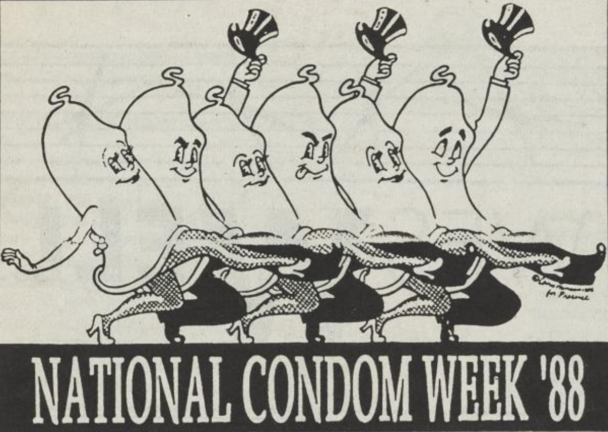
Although Nov. 10th is not a major date on the academic calendar, editions published on this day from the 1960s to the 1980s happen to record candid student perspectives on health and identity, prompting a closer look over the perspectives juxtaposed therein. Three Nov. 10th issues of The Argus capture shifting sexual morals and LGBTQ activism across three decades, providing a window into campus life during the sexual revolution, the gay liberation movement, and the AIDS crisis.
1964: Priest Accuses Professor of Promoting Premarital Sex
Sixty-three years ago today, on Nov. 10, 1964, Tim Walton ’66 covered student pushback against Father McLaughlin, a visiting Catholic priest who delivered a campus lecture series titled “Sexual Control.” During his talk, McLaughlin publicly criticized Associate Professor of Psychology Richard DeBold over statements DeBold had made in an interview with The Argus, published on Oct. 30, regarding cultural guilt and sexual behavior.
In that original Oct. 30 interview, titled “Bell, Book and Candle,” DeBold disagreed with McLaughlin’s assertion that premarital sex denigrates women, rejecting the framing of a woman as a passive “vessel” and instead suggesting that older generations project their values in an emotionally enflamed, domineering manner. According to Walton’s Nov. 10 article, McLaughlin was outraged by DeBold’s earlier interview, believing that DeBold had encouraged students to have sex and downplaying the consequences of failure to adhere to abstinence. Following McLaughlin’s critique, Walton and other undergraduates published responses in the Nov. 10 issue to clarify DeBold’s position and address the priest’s remarks.
In the opening of his article “Sex Series: Misinterpretation,” Walton addressed McLaughlin’s reaction to the interview.
“We may forgive the good Father for taking that interview in an improper spirit,” Walton wrote. “Certainly nothing like that has ever appeared in ‘Playboy,’ and he may have been somewhat at a loss to handle its tone properly.”
Walton further displayed McLaughlin’s misinterpretation of DeBold’s work, in which he asserted that DeBold promoted promiscuity; Walton quoted DeBold’s explanation of social control directly.
“Western cultures have depended on fear and guilt as the techniques for controlling behavior,” he wrote. “The concept of sin and evil is closely allied with guilt and fear.”
Walton explained that DeBold was analyzing cultural pressures rather than recommending fornication. He noted that DeBold’s warning was actually an admonition against recklessness, writing that DeBold “warns against anybody’s thinking himself to be so liberated from his culture that he can fly guilt-free off into the rosy heavens of expressed sexuality.”
In a separate letter to the editor titled “Humility and Dialogue,” published in the same Nov. 10, 1964 edition, Larry Carver ’66 critiqued the polemical format of McLaughlin’s lecture.
“First of all, Father McLaughlin’s presentation was not dialogue—skillful oratory perhaps—but not dialogue,” Carver wrote.
Carver also criticized McLaughlin’s decision to attack DeBold from the stage.
“This attack, far from being dialogue, was at most anemic one-upmanship and ill-considered debate; it was an exercise in poor taste,” he wrote.
1970: Gay Liberation Front Links Chauvinism and Homophobia
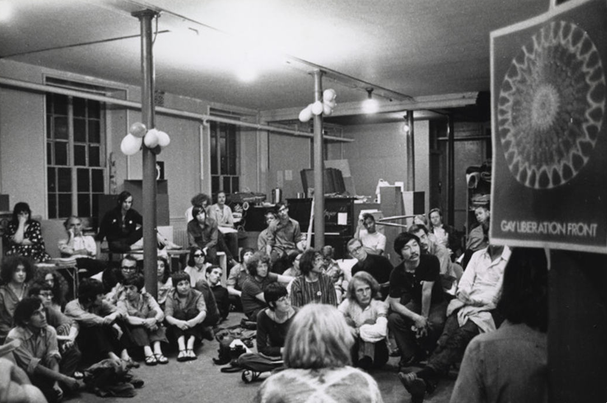
On Nov. 10, 1970, The Argus published “GLF at Bard,” an article by John A. Tessitore ’73 about an Oct. 27 meeting where seven Wesleyan Gay Liberation Front (GLF) members attended a joint gathering at Bard College. The article documented small group discussions, the group’s goals, personal experiences, and coalition building with feminist groups.
Tessitore summarized the opening talk on the movement’s goals.
“The meeting itself was opened with a general explanation of what GLF was and its goals,” he wrote. “They include the elimination of all forms of oppression, with particular reference to sexism, male chauvinistic domination and anti-homosexuality.”
He also detailed the small group discussion sessions.
“The meeting then broke up into smaller consciousness-raising sessions in which personal contact with homosexuality was discussed and examined,” Tessitore wrote. “The gamut of subjects discussed in the sessions was broad—personal experience with homosexuality, attitudes toward homosexuality, sexual fantasies, women in respect to Gay Liberation and the place of GLF in the revolutionary liberation movement.”
“[From] the large number of women in attendance much was learned by everyone in regard to the relationship of Gay Liberation to Women’s Liberation and Radical Lesbianism, ” Tessitore said by way of reporting on joint discussions between attending groups.
Summarizing an unnamed professor’s comments at the event, Tessitore wrote that the professor concluded movements like GLF were necessary because “the political revolution can proceed only out of the attitudinal revolution.”
1987: Official AIDS Committee Collapses, WestCo Sets Up “Safe Sex Hall”
On Nov. 10, 1987, The Argus published “Few Knew It Was AIDS Month at Wesleyan” by Kirsten Delegard ’90. The report explained how budget cuts and the collapse of the official Student Committee on AIDS reduced university health outreach, prompting students living on the first floor of Foss One in West College to set up their own health information display along their hallway.
Student Events Committee member Andrew Borsanyi ’90 explained how budget reductions affected planned events.
“I certainly didn’t feel like my awareness was raised during AIDS month,” Borsanyi said. “[When] our budget came through, we didn’t have as much money as we planned on.”
Former committee member David Milch ’89 described the status of the formal campus group.
“The Student Committee on AIDS…has disbanded due to lack of student initiative,” he said. “It’s very upsetting.”
Delegard described the displays created by the dorm residents.
“One West College hall is creating its own awareness about AIDS,” Delegard wrote. “Residents of downstairs Foss One have unofficially designated the corridor ‘Safe Sex Hall,’ and have covered a wall with information and homemade computer posters that promote cautious sexual practices.”
Dorm resident Glenn Michaud ’91 explained why the residents put up the display.
“The greater portion of us got together and did this,” he said. “We decided that the one poster [that a health advisor had put up] wasn’t enough. We were just expressing ourselves creatively and having fun.”
Resident Peter Gorgone ’91 also commented on designated awareness months.
“I honestly didn’t know it was AIDS month,” he said. “To be fair, since I’ve been here I’ve gained a lot of information about AIDS. There is really no need to give information in just one month.”
Sharing only a Nov. 10 publication date, these three articles cannot offer a complete timeline of the University’s views on sexual purity or LGBTQ rights, nor do they attempt to. Yet by anchoring major social movements—namely, the sexual revolution, gay liberation, and the AIDS crisis—in personal experiences, they remain relevant and resonant for an Argus audience looking back on today.
Hope Cognata can be reached at hcognata@wesleyan.edu.
“From the Argives” is a column that explores The Argus’ archives (Argives) and any interesting, topical, poignant, or comical stories that have been published in the past. Given The Argus’ long history on campus and the ever-shifting viewpoints of its student body, the material, subject matter, and perspectives expressed in the archived article may be insensitive or outdated, and do not reflect the views of any current member of The Argus. If you have any questions about the original article or its publication, please contact Head Archivist Hope Cognata at hcognata@wesleyan.edu.


Leave a Reply