
Drawn Between the Lines: Artistic Expression Within Incarceration
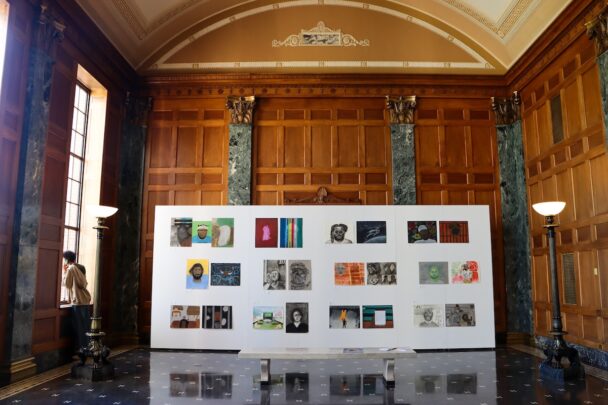
“Drawn Between the Lines” is a new exhibition showcasing works by students enrolled in “Drawing I,” a course Associate Professor of Art Julia Randall teaches at the Cheshire Correctional Institution, made possible through the University’s Center for Prison Education. Randall also curated the exhibition with help from Teaching Assistant Coline McEachern ’26.
Split across three parts of Olin Memorial Library, the exhibition highlights the works of incarcerated students, created through a curriculum very similar to one students on campus might take in the University’s “Drawing I” (ARST131) course. The three chronological sections, “Sketchbook,” “Observation and Study,” and the final project, “Self Portrait as Diptych,” give us insight into each student’s artistic progression through the course.
The exhibition begins on the ground floor of Olin with “Sketchbook.” Three times a week, students were asked to portray aspects of their lives in their sketchbooks. The assignment was open-ended, allowing them to depict either their material reality or their internal observations over the semester.
“Some students chose to work observationally and captured the reality of daily life by drawing the space, people, and activities around them, while others explored their internal lives, depicting a range of memories, fantasies, and dreams,” the gallery pamphlet reads.
The results included detailed observational studies of common objects and spaces, such as water bottles and views from across a prison cell. Other students chose to depict their internal lives. Veronica-May Clark depicts the body using kaleidoscopic, vibrant color, while Jose Cordero draws narrative scenes of political satire. The resulting collection invites us to consider not just the banal routine of incarcerated life, but also the often-ignored diversity of thought and expression that can stem from it.
On the second-floor balcony, “Observation and Study” explores materiality, perspective, and color through drawings that stem from quotidian elements of life.
“To study color in an environment defined by cinderblock and tan scrubs, to create depth and practice perspective in spaces limited and monotonously familiar, required looking anew,” the gallery pamphlet reads.
The resulting works line the wall of Olin’s balcony. Repeating forms of gourds, faces, seashells, and flowers exhibit exercises in technique, as well as each student’s unique way of interpreting and drawing the object.
The final assignment of the course, “Self Portrait as Diptych,” is showcased in the Olin lobby. As the pamphlet explains, “At the prison, the only mirrors available to students were the two-by-four inch flexible safety mirrors sold on commissary, presenting a layer of challenge to the initial objective observation. The self-image reflected back in these mirrors is slightly distorted, dulled, and partial. Through the diptych, student-artists brought specular clarity and sharpness to their own image while also thinking creatively about how to represent the complexity of who they are—not just how they appear.”
The works included realistic self-portraits, anthropomorphic visualizations, depictions of memory, time, and aspects of the self, and the impact of incarceration, with the diptych’s structure allowing multiple complex depictions to coexist. Jory Strizich depicts himself not only as a prisoner in body, but a prisoner in mind, drawing his face as a mask that can be removed to reveal a jail cell inside. Vaughn Walker depicts himself crowned between two figures, a human with black wings and a lion with white wings, creating imagery of duality.
For the students, drawing was not just a skill to improve, but a therapeutic and self-expressive process.
“It’s a peace of mind. When we drawing, it’s an escape from all this for a moment. Most of them may not realize it, but in that moment, we were in the moment,” Kunta Soyini ’25 said.
Practicing at the technical level helped students to express themselves in ways they felt they couldn’t.
“I’m already incarcerated, but I feel like I’m incarcerated twice because I have a lot of information in my head that I want to draw,” Jose Cordero said. “If I had the capacity to draw what was inside my head, I would draw nonstop.”
“Drawn Between the Lines” shows the individuality and creative expression that can flourish within the confines of incarceration. Take a break from your Olin study session and check out this exhibition before it closes on December 5th, 2026!
Katerina Vasyukevich can be reached at kvasyukevich@wesleyan.edu.
Leave a Reply