
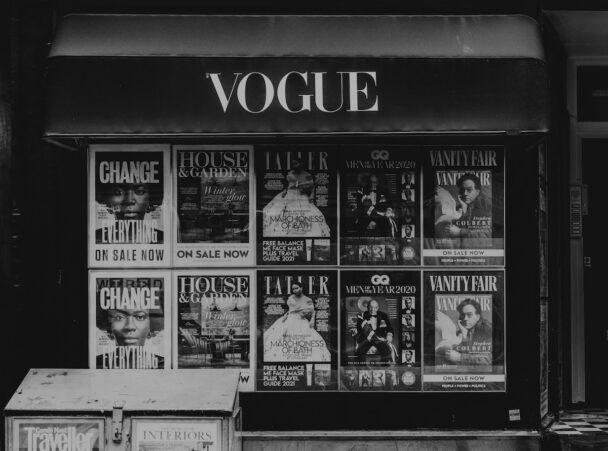
The Rise and Fall of the Fashion Magazine: An Analysis of Female Consumer Culture
Last Sunday, I rewatched one of my favorite movies, “The Devil Wears Prada.” The iconic 2000s film follows a seemingly unfashionable girl, Andy, who gets a job as an assistant to the vicious editor-in-chief (an Anna Wintour proxy) of a fashion magazine called “Runway.” There was a time when having the job of an editor or even an assistant at a fashion magazine was extremely glamorous. Even now, on TikTok and other social media platforms, many young girls idolize Andy’s life and her job. The era of print magazines is long gone, as most brands now advertise through the internet. As social media becomes increasingly dull and repetitive, Gen Z seemingly craves physical media and the glossy surface of an authentic ’90s fashion magazine.
To truly grasp the current state of the fashion magazine, it’s important to understand its rise to fame and notoriety. From the 14th century to the early 19th century, fashion news was spread by fashion dolls, also called “poupée de mode.” The 20-inch paper dolls came with full wardrobes, complete with hairstyles and accessories representative of current styles. They were shipped from Paris, the fashion capital of the world, to aristocrats across Europe. As consumer goods became more accessible, fashion evolved as a way for wealthy elites to showcase their superiority, thus making the dolls important enough to be granted safe passage overseas during wartime. However, Napoleon put an end to the safe passage of pandora dolls; consequently, the popularity of the dolls dwindled. But despite dolls not being an essential part of fashion news, they remain important as canvases for seamstresses and toys for children.
In the late seventeenth century, during the reign of Louis XIV, fashion plates rose in popularity. These were hand-colored, engraved copper plates depicting women, and occasionally men, dressed in the latest trends. Plates could only produce a few images, as the hand-coloring and limited number of plates made them incredibly costly to produce and expensive to procure. They were reserved for members of the aristocracy and the bourgeoisie classes. These plates were purchased in sets and used by dressmakers to design new garments. The earliest examples of fashion plates can be found in journals such as “Le Mercure Galant,” which is widely considered to be the first fashion magazine ever made.
Despite this label, “Le Mercure Galant” was not entirely dedicated to fashion, often prioritizing the coverage of social events. The magazine first launched in 1672, but did not publish a fashion issue until 1678 under the guidance of its founder, Jean Donneau de Vise. “Le Mercure Galant” marked a divergence from previous publications as it focused more on everyday wear than on aristocratic fashions. The 1800s were when the fashion magazine industry saw exponential growth. The Industrial Revolution allowed for the mass production and printing of magazines, as well as clothing. Unfortunately, many of the immigrants, women, and children who produced these items were forced to work in unsafe garment factories and weren’t paid a living wage. It was their exploitation that allowed the clothes hawked by mainstream magazines to be produced cheaply. This issue persists into the modern day, as workers in garment factories are still experiencing prolonged exposure to dust particles of cotton, raw materials, and other chemicals, which lead to autoimmune and musculoskeletal disorders as well as depression and anxiety. Nevertheless, the magazine’s growth continued through the 1800s into the 1940s.
It was also during the late 19th century when fashion magazines became part of a feminized consumer culture, as women were expected to use fashion to communicate their place in the public world as well as the status of their families. Women also began to contribute to magazines as writers, and created specialized magazines for the common woman. Soon enough, department stores and magazines became goldmines for advertisers. Dressmaking also began to lose its appeal as designer labels—particularly Parisian designers—became sought after as symbols of wealth. By the 20th century, Americans had more leisure time and disposable income, which meant that the fashion magazine became more prolific and specialized. For example, in 1944, the first magazine for teenage girls, “Seventeen,” was created.
Women also began to take larger roles as writers and editors for magazines. Joan Didion, Gloria Steinem, Susan Sontag, and other renowned female authors frequently wrote for fashion magazines like “Vogue,” “Elle,” “Seventeen,” and “Glamour.” In the ’80s and ’90s, fashion magazines reached the peak of their popularity as cultural communicators. They could make or break an editor’s career and completely alter the current state of fashion. This is the era of fashion magazines that we see in 2000s movies like “The Devil Wears Prada” and “How to Lose a Guy in 10 Days.” However, the industry’s glamour concealed several issues regarding toxic beauty standards, poor working conditions, and the objectification of female models and consumers.
In the following years, the internet brought about a democratization of fashion. Today, anyone with a phone can just find the latest runway show or designer collection online. The information provided by fashion magazines is no longer exclusive, as brands have direct communication with consumers. As a result, they have lost prestige, and many publications have stopped printing altogether, moving to internet exclusives and social media posts. This has led to a growing fatigue within audiences as fashion becomes increasingly curated and controlled by algorithms with the intent of maximizing profit.
This has given way to a new trend that imitates or reinterprets older styles of fashion. People are craving analog media and consulting fashion magazines once more. Styles from the ’90s and 2000s are popular again, and brands are even starting to reference their older collections on the runway. Nostalgia is a common reaction to political and social turmoil, as the past has always been romanticized. However, people fail to realize that fashion magazines have always been a manufactured part of consumer culture. Even the trend of Y2K nostalgia is a result of the algorithm collecting data on people’s online activity and pushing out popular posts. We think that this is a decision that we’re making, a bold reclamation of autonomy through fashion, but everything was already decided for us.
Fashion magazines have always maintained a social hierarchy and prioritized profit. However, this does not mean that they are inherently bad, or that they cannot be comforting or inspiring. It’s larger publications like “Vogue” and “Elle” that allow artists to reach wider audiences and hone their craft—even if it is for profit. Fashion is the art we wear every day, whether or not we consciously know it. Fashion magazines and publications therefore shape our every decision and perceptions of what to wear. They aren’t inherently good or bad, but are important, and at the crux of many modern social, political, and cultural issues.
Isha Bhandari can be reached at ibhandari@wesleyan.edu.



Leave a Reply