
“The Accidental Death of an Anarchist”: An Interactive and Intellectual Experience
On Saturday, Nov. 7, some of us may have watched the Cards football team beat Williams, while others of us—myself included—attended the 1 p.m. showing of Spike Tape’s “The Accidental Death of an Anarchist” at Russell House.
When I arrived, there was already a fully formed crowd made up of students, parents, grandparents, and siblings, all anxiously waiting to grab the best seat in the house, or in this case, the best seat in the Millett Room where the production took place.
“The Accidental Death of an Anarchist” is a political farce play, written in 1970 by Italian playwright Dario Fo. It’s based on the real death of an Italian railroad worker and anarchist named Giuseppe Pinelli. According to historical accounts, he died after “having a fit” and throwing himself out of a window at a police station. The play uses tactics like comedy, chaos, and fast-paced dialogue to mock and criticize political systems.
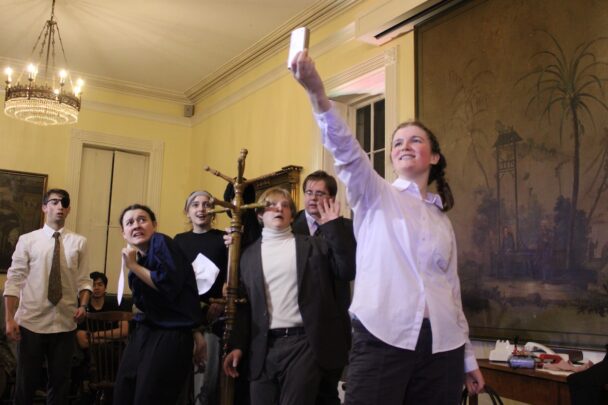
Throughout the play, the Suspect (Ruth Siviglia ’29), conducts his own investigation in different disguises. While impersonating a high-ranking judge, the Suspect tricks two officers responsible for the anarchist’s death into acting out the scene of the crime. Through this investigation, we find out that the “accidental” death wasn’t much of an accident at all.
After bravely taking my seat in the front row, I was asked, along with the other audience members in the front row, not to stretch my arms or legs out too much, as the actors would be using the space directly in front of me often. I quickly learned the usher was completely right: This show involved plentiful audience interaction and close proximity between the actors and the audience. For example, Siviglia stole an audience member’s glasses, and Ace Howell ’30 did the worm right in front of the first-row audience.
Siviglia perfectly embodied the craziness, animation, and chaos of her character. During her long monologues, she did everything you could imagine and more. She crawled on the table, danced all around the room, interacted with the audience, and even barked like a dog, all while perfectly executing her hundreds of lines. The Suspect is what I believe ADHD would look like if it became human, and Siviglia captured this perfectly through dramatic changes in topics and tones.
Another character in the play that you can’t help but love is the Sporty Inspector (Howell). After only a few minutes, we quickly learned that Sporty Inspector tries to act like a scary guy, but he’s really just a short-tempered, kind-of-stupid scaredy-cat on the inside. Howell told the story perfectly, and never once lost character on stage, even when his boss, the Commissioner (Zeke Allman ’27), screamed at Howell so loudly that he fell onto the table and knocked all of the papers off of the desk. If anyone in the audience was even a bit distracted, I can promise you that Allman’s scream caught their attention.
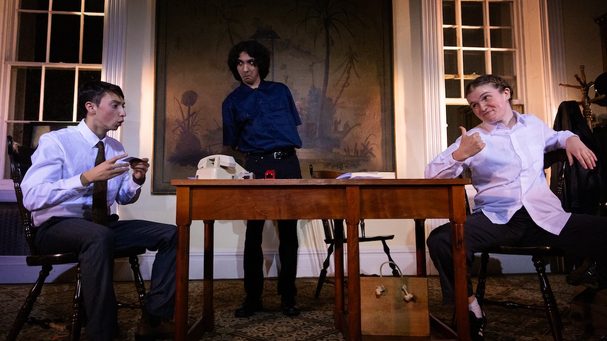
The fast-paced and witty dialogue made the two hours and fifteen minutes go by quickly. The cast’s stamina throughout the very long scenes was particularly impressive. There wasn’t one moment of unscripted silence, which kept the audience engaged.
When I spoke with director Har-El Shrem ’29 during the intermission, he told me that one of the biggest factors he and his collaborators focused on while casting the play was “what people can bring to the table before they’re given any direction.” Each member of this particular cast brought their own flair to the role, and occasionally, even their own bits of improvised dialogue. During the scene where the Suspect accused both the Commissioner and the Sporty Inspector of causing the anarchist’s death, an ambulance drove by on High Street, siren wailing. Instead of waiting until the ambulance passed, Siviglia took the opportunity. She said, “Hear them? They’re coming for you.” The audience erupted with laughs and cheers.
After leaving the show, a few things stuck with me. Yes, the acting was phenomenal, and the way they used every inch of that small space was extremely creative. But there is a bigger message in the play, which, as Shrem said, is very relevant today. As Spike Tape’s website says in the show description, the play “poses important questions about the lengths those in authority will go to in order to maintain their version of the truth.” When I asked Shrem what he wanted the audience to take away from the production, he said, “It’s so easy to look at the people in power and call them corrupt, but it’s also important to look at ourselves and ask, ‘What are the actions we do that also contribute to this corrupt machine?’”
On its surface, the play is hilarious, finding comedic relief in its charged subject matter. While it is extremely funny, Shrem’s question sticks with the audience well after the show. “The Accidental Death of an Anarchist” not only poses questions about corruption and the people we put in power, but it also makes you rethink your own free will in this “corrupt machine.”
Genevieve Eisner can be reached at geisner@wesleyan.edu.
Leave a Reply