
“The Storm Play” Blows Audiences Away
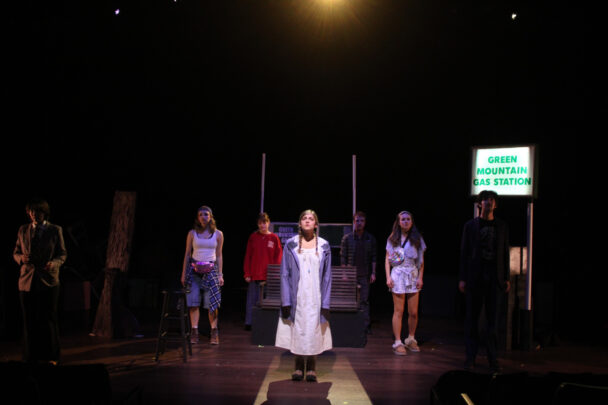
Anticipation brewed as students shuffled into the Patricelli ’92 Theater to be met with a minimal, almost barren set; an old bench sat in the middle and to its right, a decrepit sign with green neon text reading “Green Mountain Gas Station.” To its left stood an old oak tree; in front of it, a stool. On the evening of Oct. 22, the play began.
“If you are reading this in your seat in the ’92 Theater before the show has begun, you are all about to enter a world that you have never entered before,” Director and Writer Freya Grant ’29 wrote in her director’s statement in the playbill.
As the lights went down, we felt that world take hold of us almost immediately. Woodward, Vt., a town small in size, but steeped in outrageous characters. A young woman has just gone missing: Angeline Lynne Christakis. Her best friend, Ilia Janet Stowe, played by Gabriella Reiss ’28, reported her missing, and she was last seen around Mount Killington at about 8 p.m.. A violent storm is rocking the town, the most violent in at least a thousand years. Katherine, given a tenebrous performance by Maeve Kennedy ’29, is the first person we see on stage. Her character, like the play, is rooted in ambiguity, but her beautiful dialogue entrances us and enriches the play’s atmosphere. Is she a ghost? An angel? A memory? Something more? “The Storm Play,” here as elsewhere, keeps us guessing. As she changes her radio, we meet Sal Soot, played by Ivy Stinson ’28, the town’s radio anchor who is the narrative anchor for most of the play.
The plot is set, and we finally meet the show’s two protagonists: Otto Andrews, played by Simon Holland ’28, a lonely convenience store employee, and Ilia Stowe herself, who has become a singular, enigmatic figure. She claims to be 77 but looks more like a teenager.
“I use Retinol,” she quips in one of the play’s many witty lines that still pack a punch within the show’s overall dramatic tone. Reiss and Holland play these two lead roles, and they seem so in tune with their characters, and Grant’s delicately realistic dialogue, that it felt like we were watching the lives of two real people unravel. Ilia and Otto, kindred spirits, know that in this world, a storm is not just a storm. The audience is treated to insightful, intelligent dialogue on serious questions without being left behind by metaphor and symbolism: “The Storm Play” is deep, but also deeply accessible. Grant can write about the nature of faith, the power of desire, and the beauty (and pain) of human interaction with an enviable delicacy and profundity. Otto and Ilia go from strangers to fast friends, to inseparable fellow dreamers, to theologians in schism over the course of the play, and still stay true to the layered, complex characters they are; their sparring elevates the play.
And we can’t ignore our other supporting players. James Joan Jacob Jameson, played by Matthew Brooks ’29, brings chaos and energy as one of the witnesses to the storm’s many mysteries. Dana Porterfield and Mallory Smith, played by Ivy Lee ’28 and Audrey Murdock ’30 respectively, are wonderfully hilarious and bizarre as the “proud members of the restroom nation”: you have to see them to believe them.
Of course, none of these characters could shine without the excellent direction of Grant, the incredible assistant directing and sound directing by Izzy Haick ’29, and the ravishing lighting design by Noah Huckman ’29. The costumes and props, designed by Abigail Grauer ’27 and Rachel Duan ’29, were wonderfully Vermont-esque and fit the play’s mysterious tone to a tee. Luckily, veteran Spike-Tape photographer Elijah Philip ’28 captured all these beautiful visual elements in wonderful quality. Jules Feit ’28 handled the play’s technical direction flawlessly, and the scenic design of Simon Maldonado ’29 and Ember Mahnke ’29 was eye candy. The stage and production managers, Mahnke and Har-El Shrem ’29, clearly devoted enormous, well-spent effort to the production.
“It was really interesting to direct a play I wrote because I had so much time to think about the characters, and I guess I technically had so much control over them, but at a certain point when I was writing it, I felt like I had to just kind of let them be who they were,” Grant said. “So it was really fun to direct these characters that I had thought so much about and that had become their own people, and then see them really, really, really come to life with actors who got to form their own opinions entirely.”
“The Storm Play” finished after a tight and tantalizing runtime of about one hour. Audiences exited their seats, some with their mouths agape, others shaking. “The Storm Play” was a truly transcendental, unforgettable experience and a wonderful, unique addition to this year’s Spike Tape season.
Brendan Kelso can be reached at bkelso@welseyan.edu.
Ezra Cooper can be reached at emcooper@wesleyan.edu.


Leave a Reply