
“Virtual Insanity”: Why Are We Relinquishing Our Meaning to AI?
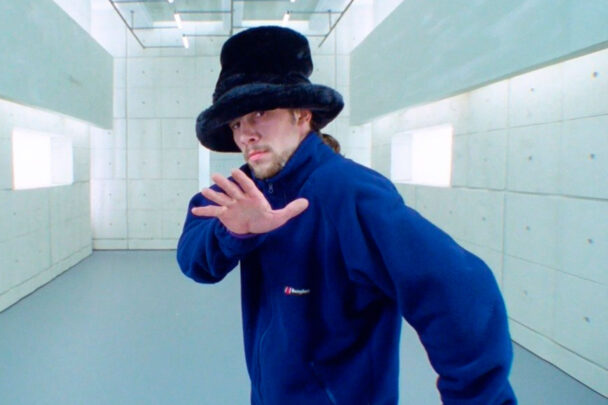
Thirty years ago, the British funk band Jamiroquai released “Virtual Insanity,” a song warning of a future increasingly dominated by technology. It peaked at No. 3 in the United Kingdom, an impressive but hardly generational feat, and yet it remains integral to modern culture. Even if you’re unfamiliar with the song, you almost certainly know the image of a man in an oversized fur hat sliding across a slick grey floor and moving furniture with his mind. If that doesn’t ring a bell, the parody done in “Family Guy” might, in which Carter Pewterschmidt mimics frontman Jay Kay’s lyrics and movement, certainly will. Just this year, the newest season of “Always Sunny in Philadelphia” devoted a whole episode to the gang’s trip to a Jamiroquai concert. Even at the University, you may have even seen a student or two dressed as Jay Kay this past Halloween weekend.
The band marked the track’s anniversary and sustained popularity with a transparent yellow 12-inch reissue on June 19. In an Instagram post, they said, “It’s a crazy world we’re livin’ in… even still 30 years later!” That’s a nice line, but it raises a question. Is “Virtual Insanity” relevant in 2026, or just comfortably nostalgic?
The “Always Sunny” episode points to an answer. In “2026: A Virtual Insanity,” Dennis and Charlie weigh humanity against technology by using Jamiroquai’s lyrics to debate whether they should abandon civilized society for a screen-free life in a roadside encampment before being swept away by a robotic taxi. That debate, while offensive and ridiculous, is a surprisingly faithful reading of the song’s argument, delivered by two characters not known for their media literacy (or general literacy in Charlie’s case). Jay Kay wrestles with whether our love for new technology is slowly costing us our connection to each other and the planet, whether we end up governed by the things we build rather than the other way around. If only Jamiroquai had known what technology awaited us.
Now, modern technology is more dangerous than what he warned us about. Suno, software that turns a typed prompt into a finished song, recently raised funding at a $5.4 billion valuation. In June, the French music streaming service Deezer reported that more than half of new uploads to its platform are AI generated. Fully synthetic acts have charted: Xania Monet appeared on Billboard’s R&B charts, and the Velvet Sundown racked up millions of Spotify streams before revealing they had used AI. Even well-established musicians such as Tyga have released AI-assisted albums. This naturally leads to the question: Will AI overtake human artists in popularity, or at least hamper creatives in their pursuit of the arts?
So far, the answer is not quite, though the damage to creatives is already visible. Earlier Deezer estimates suggested AI tracks made up a growing share of uploads, but at least for now, they encompass only a tiny share of streams. The industry’s response to this growing threat has been mixed. The major record labels initially sued popular music generators Suno and Udio. Warner has since settled with Suno, and Universal with Udio, while Sony keeps fighting.
Initially, this seemed like a united front between artists and the industry. However, Spotify is now building an AI remix-and-cover tool with Universal. Meanwhile, more than 1,800 independent artists have backed class-action suits against Suno and Udio. The very corporations that sued these AI companies are now embracing it, while independent artists are left fighting in court. Jay Kay saw a version of this coming. He said that his 2017 album Automaton was inspired by the rise of AI and how humans are beginning to forget simpler, more pleasant things. We are slowly outsourcing our creativity.
Underneath all this is a much older question: What are we for? If software can outsource human input, what is left for people to do? Is our purpose just to finish tasks as efficiently as possible? For much of Western philosophy, the answer to this was no. Aristotle held that a good life meant exercising capacities that are distinctively human, such as reasoning, making things, and living among other people. He called the result eudaimonia, a flourishing. Purpose was believed to be found in activity itself. A life spent using and honing our abilities is a life worth living. A person who never exercises those capacities, even one who lives incredibly comfortably, can never flourish and would be missing the very things that make humans whole.
After surviving the Holocaust, Viktor Frankl argued that meaning comes from creating something, loving someone, and how we face suffering we can’t avoid. None of those experiences are reliant on the most efficient output. They only happen to a person through doing. A song written badly by someone who went through the process of writing it matters more than a flawless one that appears in seconds.
The existential threat of an AI-generated song isn’t only that it might outsell a human one. It’s that nobody gets to have the experience of writing it. As AI allows us to skip the doing, we lose the purpose that defines us. Self-lobotomized, we become subservient, having forfeited our human meaning to the very automatons Jay Kay imagined.
So, is “Virtual Insanity” still relevant? Yes, but not just because of humorous references. Its real insight is that when we keep reaching for the newest, most efficient tool, we sacrifice the meaning of mundane processes. In a 2017 interview with Highsnobiety, when asked about the most and least challenging parts of creating his new album, Jay Kay said, “You continue to do it because you love doing it and you love creating music.” That love, not the commercial output of a popular song, is what no prompt box can produce.
Charles Hirsch can be reached at chirsch@wesleyan.edu.





Leave a Reply