
From the Argives: Tracing the History of Wesleyan Through Song
Long before the University’s celebrated Zonker Harris Day and a capella kegcerts united students in song, Glee Club opera concerts and inter-fraternity singing competitions were the campus’s ultimate source of school spirit and pride, dating back to 1846. In fact, these groups’ fame was not limited to Middletown, Conn. In the late 19th and early 20th centuries, University singers went on national tours, filled opera houses, and garnered national recognition from Presidents McKinley and Coolidge. The University’s singing clubs reached their pinnacle in 1926 and 1927, when the Glee Club won the National Intercollegiate Glee Club Championship, formally establishing Wesleyan as “The Singing College.”
This week, the Argives team pored through the archives to assemble a brief history of the University through song.
The 1860s
The University’s musical past can be traced back to its Methodist roots, a religious tradition which valued music for its theological teaching and community building. However, the increase in popularity of collegiate singing began as the Civil War ravaged the nation, enhancing a sense of school spirit and campus identity. During this time, the Wesleyan Glee Club began performing across the Northeast, striving to promote camaraderie and patriotism.
In the summer of 1862, the Glee Club walked 241 miles (90 hours by foot on Google Maps) from Middletown, Conn., to Mt. Washington, N.H., stopping in various towns along the way to raise their voices in song. After ascending Mt. Washington, they performed the tour’s final concert at its peak.
The Argus recalls the singing travelers in a 1931 article as follows: “…composed of ten rollicking musical vagabonds, bent upon praising their alma mater, walked between towns in the mornings and in the afternoons sauntered about whenever they were billed, dressed in peculiar uniforms consisting of light, wide-brimmed hats, blue flannel shirts and trousers, with bright cardinal red sashes at the vest. Their concerts were usually given in churches or barns. Often the latter would turn out to be their sleeping quarters.”
Traveling by foot across New England before interstates or automobiles was no small feat. In an interview with Winslow-Kaplan Professor of Music, Emeritus Mark Slobin, author of “Music at Wesleyan: From Glee Club to Gamelan,” describes the “…heartfelt patriotism that was incumbent on everybody in the United States [during the Civil War]… So the singing groups used that as one of the cards they play[ed].”
Singing became a part of the national identity during wartime, yet the exercise of such patriotism while less privileged men had to bear arms was perceived by some, such as Slobin, as “class hypocrisy.”
In 1869, the University found itself in a friendly choral rivalry with Yale’s Glee Club, which cemented singing as a “part of the currency of college life,” according to Slobin. The two schools faced off in the “Grand Union Concert.” According to an 1873 Meriden newspaper quoted in The Argus, Wesleyan emerged victorious: “We were somewhat disappointed at the singing of the Yale club, though in their college songs (their legitimate music) they did fairly. According to our humble judgment, the ‘Wesleyans’ of Middletown far surpass them.”
Furthermore, the Glee Club’s popularity funded other programs at the University, namely athletics. In his book, Slobin wrote, “Such was the power of Glee Clubs, that part of the profits from their tours went to support athletic programs, an unthinkable system given today’s primacy of athletics on American college campuses.”
As recorded in an article from an 1887 volume of The Argus titled “Varsity vs. Glee Club,” the Glee Club faced off against the varsity baseball team in a “willow-wielding contest,” otherwise known as a baseball game. The excitement of this event was at “fever heat,” and the Glee Club undoubtedly put on a show. “[Theodore] Richards [class of 1888], captain of the Glee Club, pranced about second, clad in a full dress coat and expansive smile, and in the excitement of the moment failed to establish connections with a couple of pop-up flies.” The Glee Club’s participation in this event speaks to its social influence at the University. In an era before modern sports culture, it fell on the Glee Club to represent the Cardinal spirit.
The 1890s
In 1899, the Glee Club, along with the Mandolin Club, two clubs that often traveled together, took their talents around the country, expanding the club’s status to become nationally celebrated entertainers. Slobin cites the Jan. 11, 1899 issue of The Argus, discussing the twenty-five students who traveled to New Jersey, Pennsylvania, West Virginia, and Washington, D.C. “The trip covered in all about nineteen hundred miles, and the clubs traveled the entire route in a private [train] car,” The Argus wrote. “The first concert was given in the YMCA Hall, Philadelphia, before an audience of over thirteen hundred,” Slobin wrote.
After a series of fabulous nights spent singing in opera houses, dining with alumni at social clubs, and attending dances thrown in their honor, the Glee and Mandolin Clubs arrived at the White House for their final concert. “[25th U.S. President William McKinley] received the clubs informally in the cabinet room for a few moments, shaking hands with each man,” The Argus wrote.“That night the club sang to a large and fine audience at the Metropolitan church, of which Mr. McKinley is a member.” President McKinley also asked the Glee Club back to perform in 1901.
The 1920s
The Glee Club’s success continued into the 20th Century with the club averaging “about twenty concerts a year during their Christmas and Easter trips,” according to The Argus.
Then, in the 1920s, the Glee Club gained ultimate recognition, winning back-to-back national titles in 1926 and 1927.
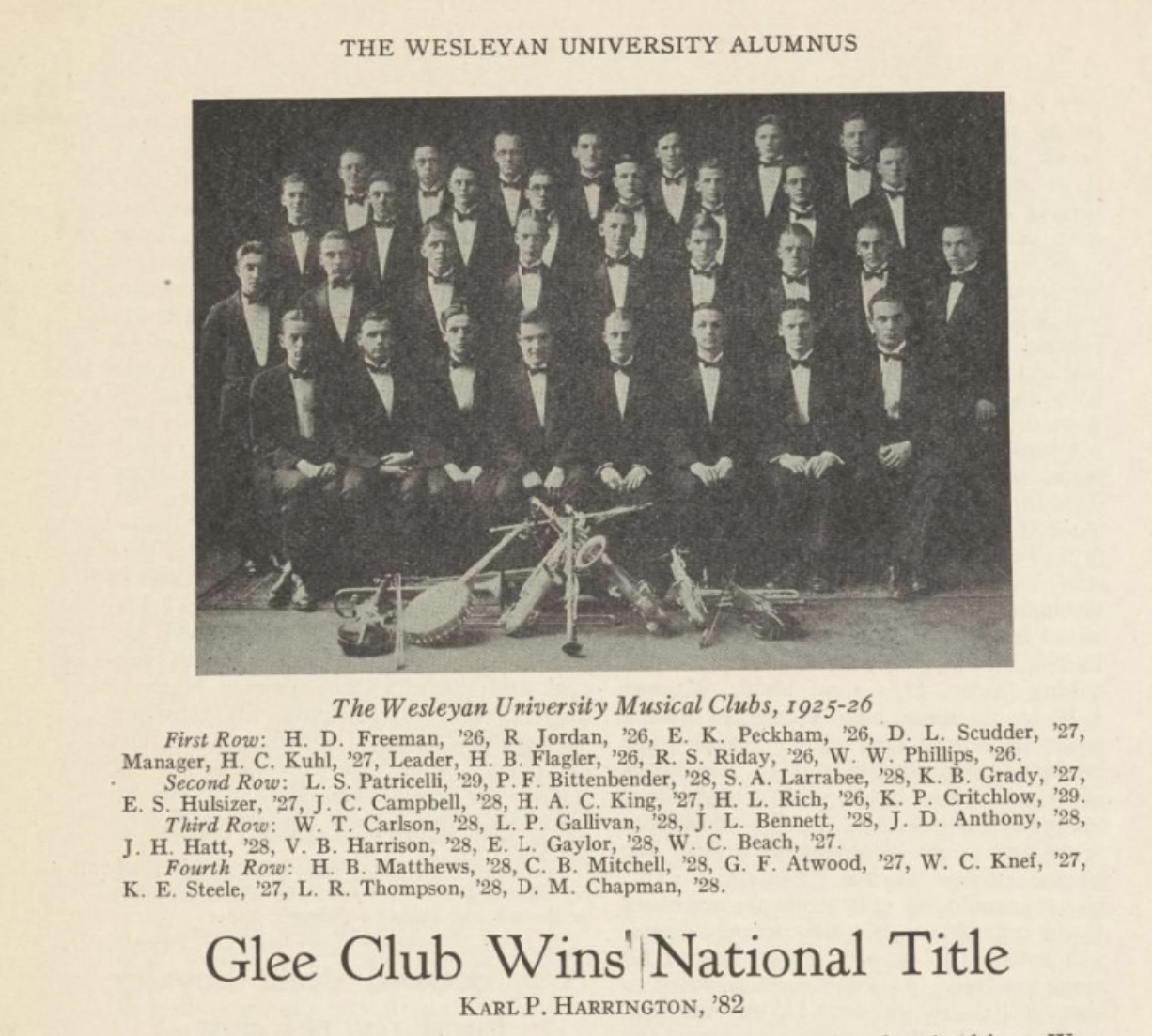
“In 1926, after placing first among nine contestants in a sectional contest held in Boston, Wesleyan won the national crown in New York [City’s Carnegie Hall],” wrote The Argus. “The following year the club once more affirmed Wesleyan’s position as ‘The Singing College of America’ by again placing first at the national competition.”
As the Glee Club traveled far and wide, fraternities kept melody alive on campus. In 1925, the tradition of interfraternity singing contests began, “not only to increase interest in the group singing for which Wesleyan has long been noted, but also to strengthen interfraternity relations,” The Argus wrote. According to the front page of the April 2, 1925 edition, “Ten fraternities were represented in the competition, each singing one fraternity song and the Alma Mater.” The singing took place in the Memorial Chapel, and fraternity Delta Tau Delta was victorious, winning the “silver loving cup.”
The 1930s
Notably, the University did not host an Interfraternity Sing contest between 1930 and 1936. When the Sing was revived in May of 1936, The Argus detailed that “Each fraternity marched from the Squash Building [where Boger Hall now stands] to the steps [of North College] singing a marching song and then followed with a selection given from the steps. At the close of the competition, the whole college body joined in song under the direction of Edward Pope, the Glee Club leader.”
In 1938, the number of participating fraternities jumped from six to twelve. Though the number of Greek life organizations competing fluctuated throughout the years, Interfraternity Sing events occurred practically every year from 1936 into the 1960s.
The 1940s
Supplementing the presence of a formal Interfraternity Sing was Eclectic’s annual Spring Sing, a party for faculty and students alike. This popular event, which began in 1948, included performances by musical groups such as the Cardinals, the Jibers, and Eclectic’s own Spooky Seven. This last name may bring to mind one of the University’s best-known secret societies, the Mystical Seven, who are noted to have a close relationship with Eclectic Society. Although there is no explicit proof that ties these two groups together, it is possible the secret society also had a similar secret inclination for singing.
The 1950s
Continuing into the ’50s, the annual gathering of the Spring Sing was a highly anticipated event across campus. The Argus’ warning to students in 1953 about expected overcrowding demonstrates this excitement: “When a capacity crowd has been reached we will have to close the doors. We are sorry that this is necessary, but we feel it will be in the best interest of both the audience and the performers.” The larger campus community was invited to this party, including faculty “with their wives,” and it was followed by an “informal singing and a beer party” to round out the evening festivities.
Throughout the years, nearby colleges were invited to join the event. In 1953, female singing groups from Wellesley and Pembroke Colleges were included, though seemingly out of an obligation to abide by growing gender integration pressures rather than anything else. “Adding the necessary female touch to the occasion will be the Wellesley ‘widows’ and the Pembroke College ‘PDQ’s,’” an Argus article deliberately remarks. In the last mention of the Spring Sing in 1964, the event appealed to an even wider audience, including a variety of local colleges and a professional folksong group from Hartford called the “Guardsmen.”
The 1960s
“The early 1960s saw a radical revolution in music that paralleled Wesleyan’s opening from men’s college to diverse university,” Slobin wrote in the author’s note of “From Glee Club to Gamelan.” The admission of African American students (the first Vanguard Class enrolled in 1965) and female students (exchange and transfer students in 1968 and first-years in 1970), coupled with anti-war protests against the Vietnam War, and the spread of a larger national counterculture transformed the University. These widespread changes coincided with the end of the University’s prevalent singing tradition.
In 1962, The Argus reported that “only four other fraternities participated in the [interfraternity singing] contest: Delta Tau Delta, Eclectic, Gamma Psi and Kappa Nu Kappa.” Slobin felt that the “lack of participation is a symptom of something quite general and not having specifically to do with the music.”
Just three years later, in 1965, it seemed the University had forgotten about the tradition altogether. An article in the April 30, 1965 edition of The Argus examined the University’s creativity, mentioning “When [John] Hoy [’55] was here, there was an interfraternity sing which everyone was involved, and a lot of original music was written.” This article is the last entry in the archives mentioning Interfraternity Sing. Between 1962–65, this singing tradition, which stood for 40 years (and almost 30 consecutively), was completely eradicated.
Present Day
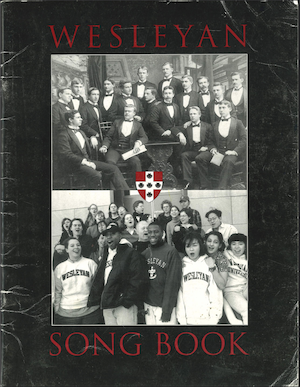
Although the University no longer holds the title of “The Singing College,” the songs that were performed for thousands across the country are carefully recorded in Wesleyan’s Song Books. The first book was created in the year 1900 in an effort to preserve the rich history of original music at the University. In a 1901 article, The Argus notes that “Wesleyan now has her song treasures gathered in a form that will preserve them from oblivion.” These books include original Wesleyan standards as well as popular music enjoyed across the campus throughout the century. Prominent songs include “Secrets,” “The Red and Black,” “Old Eli’s Sons,” “Song Memories,” and “Mrs. Winslow’s Soothing Syrup.”
In 2001, to honor the first edition of the Song Book, a new edition was published under an editorial committee chaired by John Spencer Camp Professor of Music Neely Bruce.
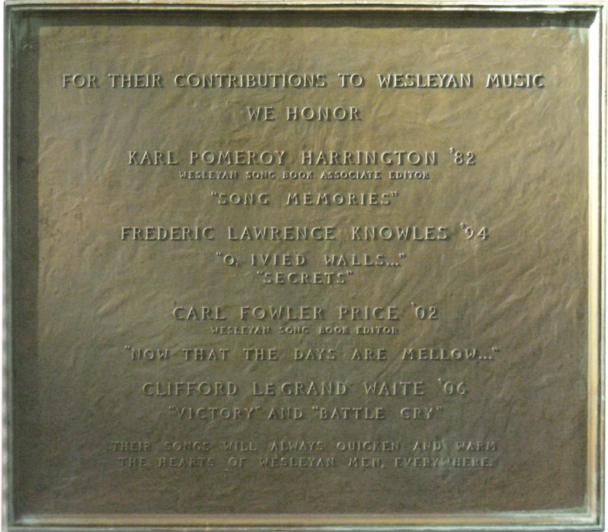
Yet, the rich history of the University’s singing is forever preserved by a plaque on the steps of North College, commemorating the vibrant traditions that once filled campus with song.
Beth Huggins can be reached at bhuggins@wesleyan.edu.
Jade Acker can be reached at jacker01@wesleyan.edu.

Leave a Reply