
The Small Liberal Arts University: Community Responds to Rising STEM Resources and Life Sciences Building
Known for its open curriculum and strong creative arts department, the University is home to some of the most prominent scholars and academics in the world, ranging in specialties from Theater and Film to American Studies and Sociology. For someone unfamiliar with the University, it may seem that the sciences are lost in the current of the arts and humanities.
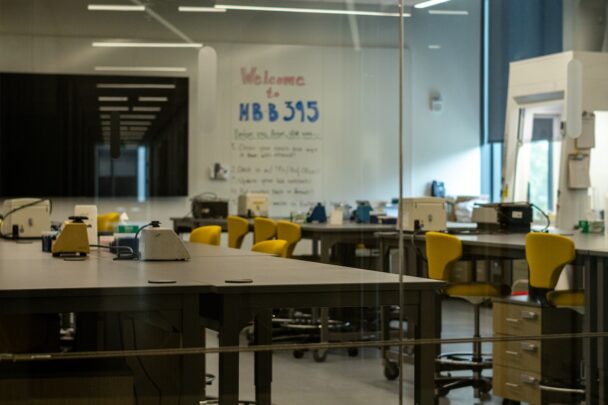
To many members of the campus community, the grand opening of the Casper Life Sciences Building this fall signified the University’s dedication to the natural sciences.
Conceived in 2019 and staying true to its name, the building is to be the center of the the Departments of Biology, Chemistry, and Molecular Biology and Biochemistry. The Departments of the Earth and Environmental Sciences, Math and Computer Sciences, and College of Design and Engineering all remain in Exley Science Center.
Although the University is grouped with other smaller institutions and colleges, and as a part of the NESCAC schools, it is a university and not a college. There is a graduate presence, albeit small, that often goes unnoticed. In 2019, 23 students were enrolled in the University’s BA/MA program in life sciences, and 14 students were pursuing PhDs in the subject. These students are not only conducting their own research, but are also a resource for undergraduate STEM majors on campus, shining a light on the unique approach the University has to graduate studies.
In an interview with The Argus, Dean of the Natural Sciences and Mathematics Martha Gilmore spoke on the exceptional role that the sciences play at the University. Gilmore states that she feels she has more time to complete her own research in addition to teaching.
“From the faculty perspective, we are in between [a college and a university] because [professors] teach less than liberal arts schools do, the typical four-year schools, which allows our research profile to be higher,” Gilmore said. “Research is encouraged for our evaluation, for our success.”
Working in a smaller environment as opposed to a larger research institution allows for students at the University to hone connections with their professors and creates a very specialized setting for research. Undergrads are working alongside graduates and post-doctorates. This distinctive experience has been amplified by the design of the new Life Sciences Building.
“It’s built to be a very collaborative environment, physically,” Gilmore said. “It facilitates students working together and being comfortable, and you can see and share amongst those lab spaces in a way that you couldn’t do in Exley or in Hall-Atwater.”
Abisola Akinbo, a PhD candidate in Cell and Developmental Biology, adds to this sentiment, stating that “Because the community is smaller, people know each other across labs and departments more easily. [Students] can ask someone a question in the hallway, talk to a professor outside [their] own lab, or get feedback from people who work on very different systems.”
Instead of the overwhelming nature of lab work and research that is present at many other institutions, the University fosters close working relationships between undergrads, graduate students, and faculty alike.
These factors contribute to the intellectually progressive environment at the University.
“The LSB is much more open and visible. There is a lot of glass throughout the building, so you can see what is happening in other labs and people walking around can also see research taking place,” Akinbo said. “I think that design can encourage interaction and make science feel less closed off.”
Claire Farina ’29, a Features Editor on The Argus and biology student, feels that the Life Sciences Building makes it easier to find opportunities to learn from her older peers.
“There are a lot of great labs at [the University], but before the Life Sciences Building was built, I didn’t run into [graduate students] much in Hall-Atwater and Shanklin,” Farina said. “The Life Science Building definitely makes it easier to stop by the professors’ and graduate students’ labs after classes and take advantage of the opportunities to learn from them.”
In addition to the collaborative space for the science community that the Life Sciences Building has brought, there have also been significant updates to the equipment and spaces available.
Built between 1965 and 1970, Exley and Hall-Atwater have become limited in terms of what kinds of instruments their infrastructure can support. With new modern technologies and developments, the older science buildings aren’t as adept at housing new tools for science majors to use.
“Anytime you bring in a new instrument, you have to develop the infrastructure for it,” Gilmore said. “We have a new instrument in the [Exley] basement right now that we’re building a whole new suite for.”
While the older science buildings are sufficient in supporting new tools for research, the Life Science Building was designed with some of these specific tools in mind.
“It’s easier to support the instrument [in LSB] because the ancillary systems that feed it are better and were designed for that instrument,” Gilmore said. “We knew what was going in there before it was being built, so [we said] in this room, we’re gonna put this instrument, build what is the state of the art to support that instrument.”
In her research on cell shape and tissue architecture during Drosophila eye development, Akinbo confirms that the new equipment that the Life Science Building offers is allowing her to conduct her research in more detail.
“[Having] access to a new spinning-disk microscope allows us to capture images faster and reduce phototoxicity during live imaging,” Akinbo said. “[And] the new Imaris software gives us better ways to visualize and analyze data.” A spinning-disk microscope allows many points of a cell to be illuminated, being able to see images faster and in more clarity, while Imaris is a software application that helps to visualize microscopy data. These factors together allow for better interpretations of data.
Additionally, the new machinery and spaces in the Life Science Building enable students to research with greater depth and detail than was formerly possible.
“In Hall-Atwater, some labs had much larger spaces than others,” Akinbo said. “In the LSB, the lab spaces are more similar, so it feels like everyone has a more comparable place to work. The biggest difference is that the LSB gives us a more modern space to work in and better access to shared resources. That does not change the main questions I am asking, but it gives me more support to explore them in greater detail. So I would say the LSB has expanded what is possible for my research more than it has changed the fundamental way I approach it.”
Undergraduate students have also voiced the benefits of LSB’s design and organization in comparison to Hall-Atwater’s disorienting layout.
“It’s a lot easier to find classes in the LSB,” Farina said. “I used to be wandering around Hall-Atwater trying to find my classes. I still don’t know the point where Shanklin becomes Hall-Atwater. In my experience, the LSB classrooms are also a little bigger than the Exley classrooms, which is nice.”
As education continues to stratify classes between the humanities and STEM, the construction of the LSB symbolizes a tangible bridge between them.
“When you walk around campus, you can see that the arts are an important part of [the University’s] identity,” Akinbo said. “I think the LSB gives the sciences that kind of physical presence as well. [LSB] is a large, modern building devoted to science and there is something meaningful about walking through campus and seeing that science has a clear place here.”
With a strong emphasis on creativity and the importance of discovering new ways of critical thinking, the University attempts to nurture interdisciplinary passions and combine personal interests in new and profound ways. Having a sleek, state-of-the-art science facility such as the Life Science Building is helping the centuries-old goals of the University thrive.
“Science does not exist separately from society,” Akinbo said. “Students who can connect scientific questions to communication, ethics and public policy, or creative ways of thinking can become more thoughtful about the implications of their work, including how scientific and technological advances affect society. I think that mix is one of the things that makes [the University] different.”
Farina, who came to the University as an English major, is now additionally pursuing biology. This further highlights the interdisciplinary opportunities available through the expansive nature of the academics at the University. She spoke about how humanities-centered buildings feel spread out, and how the LSB, in contrast, is assisting in streamlining STEM interests across campus.
“Most of my humanities classes take place in older buildings in smaller rooms that only fit around 12 students,” Farina said. “In comparison, I really like that the life-sciences department has a large, localized space. It’s a great space, and with the glass doors to classrooms, I get to see what people are learning in other classes.”
The construction of the Life Sciences Building gives undergraduate students the resources and community to explore opportunities in STEM, ushering in a new relationship between the sciences and arts.
“What [LSB] can do is make science more approachable,” Akinbo said. “It is not about STEM competing with the arts or humanities. It is about showing that both are important parts of what Wesleyan is.”
Chloe Rappaport Crowther can be reached at crappaportcr@gmail.com.
Claire Farina is a Head Features Editor and can be reached at cfarina@wesleyan.edu.



Leave a Reply