
Students Groups Memorialize October 7
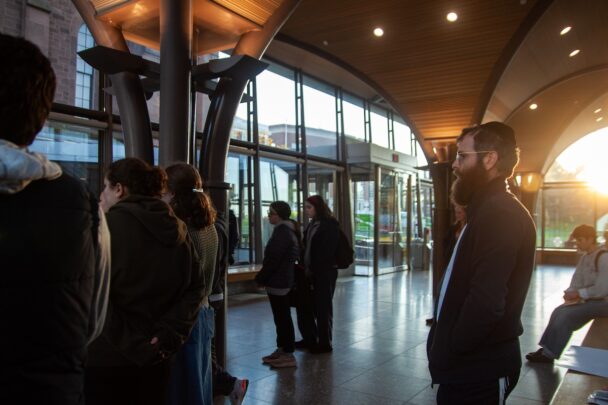
On Wednesday, Oct. 7, the University’s chapters of Students Supporting Israel (SSI) and J Street hosted a memorial at the Zelnick Pavilion. The event was held to commemorate the lives lost in the Oct. 7, 2023 terrorist attack on Israel by Hamas forces.
Around 20 people attended the event, including members of Chabad, a Jewish organization on campus led by Rabbi Levi Schectman. Rabbi Schectman was present at the event, alongside Director of Religious and Spiritual Life and University Jewish Chaplain Rabbi David Leipziger Teva.
The groups came together this week seeking to hold an event primarily focused on the events of Oct. 7, not the years of violence that followed. J Street President Sofía Wollheim-Martínez ’28, who helped to introduce the event, noted that over 1,200 Israelis were killed on Oct. 7. Over 73,000 Palestinians and nearly 1,000 Israelis have been killed in the military effort since.
In December 2025, a fragile ceasefire was brokered by the U.S. followed by the freeing of hostages by both Hamas and Israel.
“Behind every one of those numbers is a person: someone’s parent, child, friend, neighbor,” Wollheim-Martínez said. “Tonight, you want to remember them as people.”
Gaby Sorin ’27, co-president of SSI alongside Aviva Schnitzer ’28, shared that while they had worries about working with J Street to hold the event, their primary aim was to remember the Israeli lives lost in the attack.
“SSI was initially hesitant about collaborating on a day that is deeply painful for Jews in the diaspora and especially for Israelis,” Sorin wrote in an email to The Argus. “Because of the significance of the day, we wanted to be very careful that the memorial remained focused on remembering the victims of October 7. For this event specifically, our intention is very simple: to come together as a community and mourn the Israeli lives that were lost during the October 7 massacre. We do not want the memorial to be provocative, and we are not trying to use it to make a political statement. It is a memorial.”
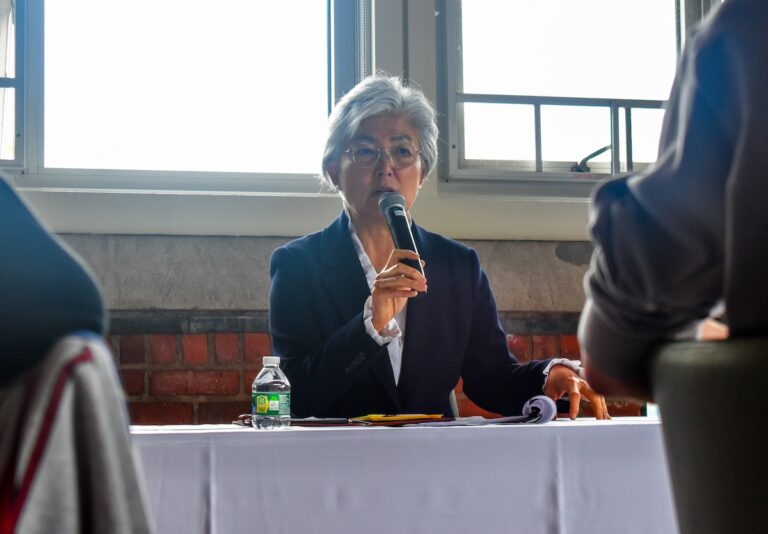
The memorial consisted of three speeches by Wollheim-Martínez, Alana Slade ’29, and Ella Schulman ’30. Rabbi Teva then asked attendees to share a name of someone they are keeping in their prayers.
“We’re not asking anyone here to agree on how to feel about this day,” Wollheim-Martínez said in her speech. “We are asking something that is smaller and maybe harder, which is to spend the next 30 minutes with people who lived through that day and with people who didn’t, and to really listen to each other and breathe.”
As one of the speakers, Slade shared a personal anecdote from the 2023 attack, which occurred while she was studying abroad in Israel. She described the fear she felt in the bomb shelter, and the shift she felt in her world view thereafter.
“I went to Israel to escape antisemitism, and then I came home to so much more,” Slade said. “Hamas took a lot of my life, or the way that I experienced life, away from me.”
Sorin and other students also shared their hopes that this collaboration would mark the beginning of continued dialogue across organizations associated with Israel, Palestine, and Jewish identity on campus.
“Our collaboration with J Street for the October 7 memorial is actually the first time another student organization on campus has been willing to meaningfully engage with SSI,” Sorin wrote. “We do have differences with J Street, and we had to work through those differences carefully while planning this event….We hope this can be the beginning of more relationships and dialogue with other organizations on campus.”
The collaboration of the two groups is striking. The organizations are fundamentally opposed on several hot-button policy positions: SSI’s website denies that Israel’s occupation and annexation of the West Bank and the Golan Heights are illegal, despite broad international consensus; J Street describes both as violating international law. SSI’s website vehemently denies the accusation that Israel has committed genocide in Gaza, while the University’s J Street chapter has categorized the ongoing Israeli military effort as such. However, the organizations converge on many fundamental beliefs, including a core premise of Zionism: that the Jewish people have a right to self-determination in Israel.
Both organizations have large national networks. While SSI is primarily student-driven, J Street operates a significant lobbying and fundraising operation alongside its campus branch (called J Street U), posing itself as a progressive alternative to the American Israel Public Affairs Committee on Capitol Hill. SSI has received almost half a million dollars in contributions from the Adelson Family Foundation, led by prominent Trump backer Miriam Adelson, while the J Street website’s fundraising ask boasts a lack of reliance on conservative super-donors.
On the same day as the memorial hosted by SSI and J Street, Wesleyan Students for Justice in Palestine (SJP) erected a large art piece on the lawn of College Row. It was not clear if the piece was meant specifically to honor the Palestinian lives lost since Oct. 7, as SJP declined coverage from The Argus. However, the organization posted some details about the event on their public Instagram:
“We will create an art structure honoring Palestinian life, dignity, and resistance,” the post read. “There will be paper, pens, markers, paint, and other supplies for folks to write notes or letters and draw pictures.”
SJP, the University’s largest pro-Palestinian organization, diverges sharply from the stances of both SSI and J Street. The organization strongly opposes the state of Israel, describing Israel’s conduct in Gaza as a genocide and advocating for a Palestinian right of return to Israel. In April 2024, SJP and other aligned organizations established an encampment outside of the University’s North College as part of a nationwide wave of pro-Palestinian protest.
Students in attendance at the SSI/J Street memorial shared their thoughts on the possibility of expanding dialogue between their organization and SJP.
“I deeply disagree with the SJP’s approach to activism,” Wollheim-Martínez said. “However, we both agree on the fact that it is necessary to be doing a lot of activism for Palestinians.”
SJP declined to comment.
Members of the organizations in attendance also shared their opinions on the University’s response to student activism surrounding Israel and Palestine.
“I guess with the University as an entity, I don’t know what to expect from them,” Eli Goldman ’29 said. “I feel, certainly, the environment on campus as a whole is not so warm and welcoming to us.”
Students also expressed their concerns over their safety when hosting and attending events. Goldman pointed out that SSI doesn’t disclose the location of its events unless students sign up through a Google form, due to alleged safety concerns. Sorin also critiqued what she perceives as a blurred line between reasonable discourse and inflammatory behavior on campus.
“I think the University has a responsibility to distinguish between legitimate protest and behavior that prevents other students from participating in campus life or expressing their own views,” Sorin wrote. “Students should be able to strongly disagree with SSI, protest our events, and criticize Israel,” Sorin wrote. “But SSI students should also be able to table, hold events, and express our views without being intimidated or personally targeted.”
Both the SSI/J Street memorial and the SJP event were held without any visible protest or opposition, although both were sparsely attended.
“It was obviously not the turnout that we would have expected or hoped for,” Goldman said. “But [it was] certainly a nice overlapping of different sects of Judaism on campus here coming together in a way that was lovely. I feel like 90% of this campus has never heard anything like any of the stories that all three of [the speakers] told, and I just wish people could listen.”
The event concluded with Acheinu, a Jewish prayer for those in captivity or distress.
Miles Pinsof-Berlowitz contributed reporting and can be reached at mpinsofberlo@wesleyan.edu.
Akari Ikeda can be reached at aikeda@wesleyan.edu.
Finn Feldman can be reached at ffeldman@wesleyan.edu.

Leave a Reply