

Administrators Give Different Explanations on the JCCP Cutting Ties With SJP
The Jewett Center for Community Partnerships (JCCP) cut ties with Students for Justice in Palestine (SJP) starting Fall 2026, including a position held by a student on work-study. The JCCP, the Office of Student Involvement (OSI), and President Michael Roth ’78 offered contradictory explanations for the decision.
Prior to this year’s disaffiliation, SJP had a longstanding relationship with the JCCP, which a SJP member characterized as positive. The JCCP, which supports community engagement initiatives, had paid positions available for members of SJP and other student groups, such as the Wesleyan Period Coalition, most of which remain.
The cessation of affiliation is currently only affecting one student, who was conducting programming work for SJP through the JCCP and whose work-study position was cancelled. No other student groups offered support by the JCCP are impacted by the decision.
The work-study student’s position is one of two cancelled. An event coordinator position posted in April 2026 was removed from the University’s job posting site Handshake the same month.
According to an email thread obtained by The Argus, SJP reached out to JCCP Assistant Director for Operations and Programming Sonya Hadley regarding a student taking on the Event Coordinator position, to which Hadley responded that no one had applied to the role.
SJP members contested Hadley’s assertion, saying that they did not have an adequate chance to apply. It is unclear whether the cancellation of the Event Coordinator position last spring is derivative of this semester’s separation of the JCCP and SJP. Hadley did not respond to a request for comment.
A SJP member, who is not the work-study student, stated that the affected student did not have an official job title for their work done as part of their SJP position. The position included “political education, organizing talks and scheduling workshops, working on the Oct. 7 memorial, [and] planning Israeli Apartheid week.” The member described this work as the same as conducted by all SJP members.
Members of SJP only agreed to speak to The Argus on the condition of anonymity.
Last spring, leadership from the Office of Academic Affairs and the Albritton Center for the Study of Public Life considered whether SJP should be exclusively associated with OSI, rather than the JCCP.
“For several years, JCCP supported Students for Justice, which later became Students for Justice in Palestine (SJP), through paid positions and other resources,” the University stated. According to the University, leaders in the two offices “began discussing whether SJP, as a student organizing group, would be more appropriately supported by Student Involvement.”
“Student political and advocacy organizations, such as the Wesleyan Democrats, are generally supported through [OSI] and the WSA,” the University said.
Watson met with both SJP’s faculty advisor and OSI, and JCCP leadership informed the group’s executive leadership of the change.
The SJP student member characterized the club’s past relationship with the JCCP as positive.
According to the member, SJP has previously received the Political Engagement Fund, which is partly funded by the JCCP, and that there “are resources SJP can still access.”
Membership in SJP does not affect the work-study eligibility of any student.
“The change in location from JCCP to the Office of Student Involvement for SJP does not affect any student’s work-study eligibility or ability to pursue other paid opportunities on campus,” the University told The Argus.
Eligible work study recipients receive $1,375 each semester or $2,750 per year in either federal or institutional work study. The University received $625,771 in federal work-study funding this year. Students on financial aid may receive a combination of institutional work-study and federal work-study.
The reason that the work-study position was cancelled, according to SJP, was a University directive delivered to the affected work-study student over a call by JCCP Director Clifton Watson on Sept. 1. Members say that Watson stated on the call with SJP that he received a directive from Provost and Senior Vice President for Academic Affairs Nicole Stanton, and that the decision was due to federal pressure.
In an email to The Argus, Watson echoed his statement. Watson said that federal work study funding can no longer be used to support political advocacy efforts, including that of SJP, due to “changing government policies.”
“We were already prepared for them to end their partnership, we just didn’t know what they would name as their reason,” the member of SJP said.
The University states that, prior to the call, Watson met with the group’s faculty advisor and the Office of Student Involvement to discuss options. SJP’s faculty advisor, Resource Center Director Demetrius Colvin, did not respond to a request for comment.
OSI substantiated SJP’s claim. OSI Director Jen Cheng stated that OSI was “made aware that the change was due to a new federal policy.”
Cheng stated that the JCCP met with an OSI staff member to share the update. The Argus was unable to obtain written confirmation of a directive.
However, SJP expressed doubt over the rationale in the alleged directive, releasing a statement on their Instagram account calling for transparency regarding the decision.
“We are suspicious of the University’s claim of ‘losing federal funding,’” they wrote, encouraging students to contact Roth, Stanton, and Watson.
The timing of the directive coincides with HR-4795, the “Protect Economic And Academic Freedom Act Of 2026.” The bill, which was passed by the U.S. House of Representatives this summer, targets federal student aid funds, prohibiting higher education institutions that “participate in federal student aid programs” from financially boycotting Israel. While the bill does not have language expressly stipulating that the actions of the student organization specifically should be considered as part of any boycott, it does state that “certain funds” are subject to withholding. The bill has not been passed in the Senate.
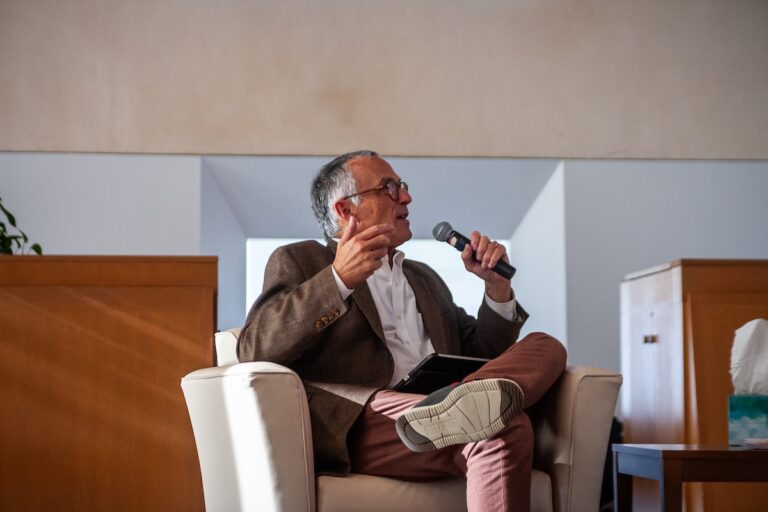
Although he did not speak to the existence of the directive, Roth vehemently denied the allegation that federal pressure accounted for the JCCP’s separation with SJP. “There’s no federal pressure,” he said.
Though the University responded to questions about JCCP and SJP’s relationship, neither Watson, Stanton, or other members of the JCCP responded to questions regarding the existence of the directive or its specific contents.
When asked for clarification on the existence of a directive, the University stated that “our original statement on the matter stands.”
Roth stated that activism-focused clubs should not be eligible for paid positions on campus.
“I have no trouble with people wanting to be activists, but wanting to be paid to be an activist seems to me the worst example of coddled culture masquerading as radicalism,” Roth said.
The impacted student has yet to secure a new campus job.
Aarushi Bahadur can be reached at abahadur@wesleyan.edu.
Anabel Goode contributed to reporting and can be reached at agoode@wesleyan.edu.


Leave a Reply