
Office Hours: Singer on Bugs, and Plants, and Food Webs. Oh My!
Welcome back to Office Hours, a series brought to you by the Features section! In these articles, Argus writers speak to faculty, staff, and members of the administration about their interests, classes, and lives on and off campus.
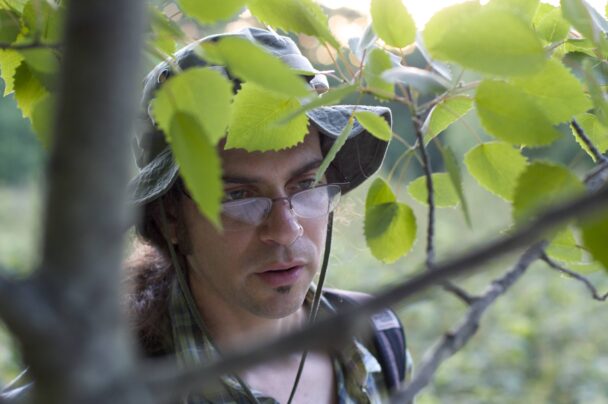
Michael Singer is a professor of biology and Environmental Studies at the University. His interests are centered on insects and plants, especially interactions between all levels of the food chain including plants, bugs, and their predators. One of his current labs conducts research on local species, focusing on these ecological interactions in the Middletown area. The Argus sat down with Singer to discuss this research project, his appreciation for his new office in the Casper Life Sciences Building, and a fascination with natural history.
The Argus: What research are you currently conducting?
Michael Singer: My lab is investigating a hypothesis that we’ve developed called “plants anticipating help.” We think plants can anticipate when predators might help them by hunting the herbivores that eat them. This hypothesis follows from an established hypothesis in my field of study, which is called the “crying for help hypothesis.” Basically, when a plant is getting eaten by an herbivore, the plant emits chemical signals into the air, and predators of the herbivore can smell those chemicals in the air. They can use them to find the herbivore feeding on the plant and therefore protect the plant. That idea has been around for a long time, and it holds up pretty well. We use the same language with our hypothesis: that maybe plants can anticipate help from these so-called bodyguards.
Our hypothesis was inspired by fieldwork that we do around here in the forests, where we look at caterpillars feeding on oak trees and various predators of the caterpillars that can protect the tree. That work led us to hypothesize that birds and ants might be the bodyguards that the oak trees are anticipating help from.
A: How do you split your time between field work and work on campus?
MS: We do field work during the University’s summer break. That’s when all of these interactions that we’re studying are taking place. During the school year, we are not able to run those kinds of experiments, but we are still dealing with this research in various ways. We do a lot of data analysis and write manuscripts for publication during the off-season. Sometimes we find old data that we just hadn’t really looked at that can be analyzed. So there are various things that keep us occupied as a lab during the academic year, but we’re not doing the field experiments themselves.
A: What aspects of the research are most rewarding for you?
MS: I find the research very exciting. We call these kinds of interactions between plants, herbivores, and predators tri-trophic interactions, which refers to the three different trophic levels in a food web. We have plants, herbivores, and predators in food web ecology. I’ve been interested in these tri-trophic interactions throughout my whole research career, and even before that. Before I became a researcher, I was very interested in these interactions, just as a hobbyist. I’ve always been interested in observing the natural world around me, so I started paying attention to insects and plants pretty early on, and my interest kind of developed from there. That interest ended up becoming a lot more analytical as I became a researcher.
A: On that note, could you speak a bit more about your academic journey?
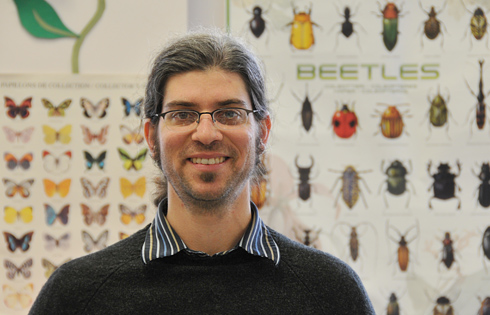
MS: I’ve been at the University for 22 and a half years. I started in January of 2004, and I came from postdoctoral work I was doing at the University of Arizona in Tucson. I had been working there on tri-trophic interactions and that work really landed me the job here. At the time, the Biology Department was looking for an ecologist who could also teach conservation biology, and I had the background to do that. They were looking for someone who would also do research in ecology and related fields. My research is really at the interface between what’s called “evolutionary ecology” and “community ecology,” which appealed to the department.
A: What courses are you teaching this semester?
MS: I teach “Ecology” (BIOL216), “Conservation Biology” (BIOL220), and an upper-level course called “Plant-Animal Interactions” (BIOL516).
A: Which is your favorite to teach?
MS: I have to say I really like “Plant-Animal Interactions,” because, for one, that course is closest to my research area. Also, I like that it’s based on reading scientific papers as the primary research literature, and it’s a small class. It’s usually 15 or fewer students, so we get to have a lot of discussions, and that’s really fun. I think when you imagine what a small college class at a school like this would be, it’s that kind of a class.
A: How do you differentiate your role in teaching and research?
MS: Teaching and research definitely influence each other. In teaching, I try to bring in some of my research because I have a lot of experience with the content, and it’s sort of fun for me to share that. On the other hand, I think when you teach at the University, you teach outside of your specialty. We have to cover more ground as instructors, so when I teach general ecology, the vast majority of that course is not in my research area. I find that thinking more broadly about these fields is helpful for my research because it helps me put my research in context. Sometimes I make new connections that I just didn’t see, because it wasn’t part of the thinking in my specific field. A lot of times, new developments in a field come from ideas from other fields, so once you’re more aware of those things, you can be more innovative within your own field.
A: Do you have a preference between research and teaching?
MS: I think it depends on the moment. I love doing research; it’s a long-term passion. For those of us who have PhDs, we have to be motivated by the research to get the degree, and that’s what lands you the job as a professor. On the other hand, research is challenging. It has its ups and downs, and sometimes, in the down parts, I’ve really relished teaching and found that to be very satisfying. For the research, my favorite part is doing the fieldwork, and then for teaching, I think it’s interacting with the students.
A: How does your approach differ when leading student researchers as opposed to the students in your courses?
MS: At a school like this, our research groups are small enough that you interact one on one with each other, and that means that you really get to know people as individuals, and I enjoy that a lot. I like it when I can do that in teaching as well, but it just depends on the type of course. If I’m teaching my small “Plant-Animal Interactions” course, I can get to know everyone pretty well.
A: Pivoting a bit: Over the summer the University opened the Casper Life Sciences Building. How has this affected your research and courses? What benefits and challenges have you noticed?
MS: There are definitely more benefits than challenges. It’s a great building, and I’m very pleased with it. I actually had one of my lab rooms in Hall-Atwater and another in Shanklin, so I was familiar with both parts of the old building. It was challenging because it was old even when I started more than 20 years ago, and that whole time we had problems with climate control, which made it difficult to do experiments in the laboratory.
The designers of Hall-Atwater and Shanklin did not really think about the full picture: how we interact with students, and how they interact with each other. It was really just corridors, offices, and labs with no common space. The Casper Life Sciences Building has so much common space. There are places to study or to just have lunch and to interact with people informally. It really helps the culture to have that kind of space. I was also concerned about the air quality that I was breathing every day in the old building. Sometimes debris and dead flies would come out through the vent. So the Casper Life Sciences Building was very much needed, and the fact that they built such a beautiful building makes it so much more pleasant to be in.
A: Do you have access to any new lab equipment in the Life Sciences Building?
MS: Yes, that’s been a huge part of this new building. The University was very generous in giving us an equipment fund for the new building, so we could really update major equipment, and that’s been heavily used. We have gotten some really nice, expensive pieces of equipment as part of this. Because of the research I do, I don’t really take advantage of that equipment, but that has been a transformative thing for most of my colleagues’ research.
A: What are your hobbies outside of research?
MS: It might not surprise you to learn that some of my hobbies are pretty closely related to my research. For example, I really enjoy native plant gardening and growing plants to attract insects and other wildlife. I enjoy hiking and the outdoors and just doing natural history observations for fun.
A: Do you have a favorite natural organism living on campus?
MS: When I walk around campus these days, I see that some of these newer buildings have landscaping that uses a lot of native plants, and I really enjoy that. I like to see whether there are any insects going to the native plants. I am also a big fan of the big, old trees on or around campus.
This interview has been edited for length and clarity.
Leah Ziskin can be reached at lziskin@wesleyan.edu.

Leave a Reply