
From the Argives: When the Computer Came to Campus
Wesleyan’s computer science department, with over 40 years to its name, can trace its wide-reaching roots back to a single machine in the basement of the Van Vleck Observatory (VVO). When the computer came to campus, Wesleyan’s electronic enthusiasm swiftly overshadowed its capacity, a familiar pattern. The Argus put together a timeline of Wesleyan’s first reckoning with a revolutionary digital technology, in accordance with patterns and parallels present in current discourse.
Professors John Mauchly and J. Presper Eckert at the University of Pennsylvania’s Moore School of Electrical Engineering began designing the first all-electronic, general-purpose digital computer in 1943 and unveiled their completed creation under the name ENIAC, for Electronic Numerical Integrator and Computer, in 1946. Because the machine weighed approximately 30 tons and cost the team an estimated $400,000 to produce—equivalent to over $6.8 million dollars in 2026—its proliferation would be a slow one, regardless of academia’s immense interest.
According to the Astronomy Department’s website, in 1959, Wesleyan’s Board of Trustees and the National Science Foundation (NSF) each provided $20,700—equivalent to over $475,000 in 2026—to establish Wesleyan’s first computing center. The center’s crown jewel was clearly its Royal McBee LGP-30 electronic computer, one of the first computers compact and light enough to sit atop a desk without crushing it. On Feb. 17, 1960, the LGP-30, boasting a 4,096-word memory—groundbreaking for the time—was installed in the basement of VVO, and the Wesleyan Computing Center (WCC) officially opened for business.
Five days before the LGP-30’s installation, The Argus published an unaccredited article in anticipation of the mysterious machine making its way to the Observatory.
Professor Robert A. Rosenbaum, who was chair of the mathematics department at the time of the computer’s installation, explained how the device would be put to use. Six departments planned to use the LGP-30: mathematics would use it as a teaching aid under Rosenbaum, astronomy for astronomical measurements, psychology for research, chemistry for physical chemistry research, Russian for studying linguistics, and economics for econometrics work.
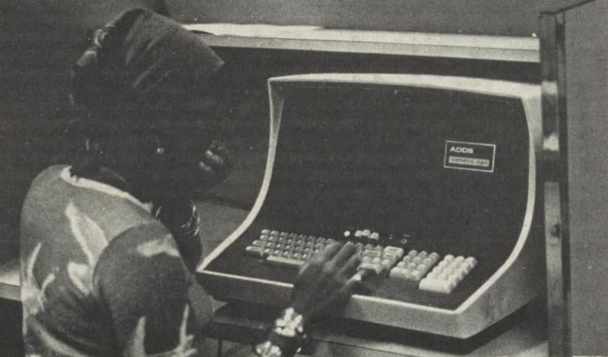
By October 1976, the WCC had taken on a variety of roles, as an article by Bethany Kandel ’79 described in The Argus. Kandel described the WCC as a student-run facility that User Services Manager George W. Zepko likened the center to an unrestricted library “in the sense that just as books can be taken out with no restrictions, the computer terminals can be used also without restrictions,” an unexpectedly cutting-edge resource for a school of Wesleyan’s size.
Driven by a time-sharing system connected to terminals across campus, the computer center hosted an array of users and applications. Football coach Peter “Kosty” Kostacopoulos relied on the computer to analyze opponent game footage and defensive formations, while external clients rented the system for tasks ranging from mapping Connecticut River currents to computing astrological data. Academic applications were similarly diverse, including theatre instructor Leonard Hellmers’ work modeling optimal audience seating, economics chair Michael C. Lovell running a macroeconomic simulation program called “Econoland,” and psychology professor Karl E. Scheibe studying human guessing patterns.
Students could even be found playing video games past midnight long before the invention of the first game consoles. According to Kandel, Wesleyan students were especially fond of “Trek,” a Star Trek-inspired game that computing hobbyists could pirate if they gained access to the code, which other fans would publish in newsletters and books.
In February 1978, Wesleyan discovered that the company that maintained its computers, the Digital Equipment Corporation—arguably the pioneer of the microcomputing industry—was phasing out its repair services on several parts of Wesleyan’s computing system. This meant Wesleyan would need to complete a computer system overhaul by mid-1979. Amy Rabinowitz ’80 reported on the concerning news in an article published in The Argus on Feb. 28, 1978.
Since ordering a replacement computer could take up to a year, Computing Center Director H. David Todd began searching for a machine that could offer double the capacity without spending more than it had invested into previous installation projects. Todd explained that they were looking for a machine with “the best performance at the lowest price” to handle student, faculty, and administrative work, and planned to offset costs by selling the old system for $50,000 in spare parts.
Alongside the hardware upgrade, Wesleyan set out to double its computer science offerings from three courses to six. Wesleyan was still over a decade away from establishing the computer science department, and finding faculty with adequate expertise proved to be a challenge. Until resources became available, Wesleyan would have to resign itself to overfilled courses and frustrated students.
Rabinowitz’s article reports how, following advice from consultants at Yale and Dartmouth, Wesleyan decided to keep the expanded program housed under the Math Department rather than creating a separate unit. Professor of Government Richard Boyd noted that a tiny “1 1/2-person department” would end up “isolated intellectually and politically come budget time.”
With a burgeoning computer science branch now under his supervision, Math Department chair William Reddy welcomed the addition of new faculty and courses, which aimed to cover both applied and abstract, elementary and advanced computing topics so that the overwhelmingly popular course Introductory Computer Programming (Math 135) wouldn’t have to “be all things to all people.” Students with programming experience gained opportunities to progress and those new to the technology received more personal attention.
In another article published on April 4, 1980, Jenny Altshuler ’81 reported that Wesleyan’s eagerly-awaited DEC-20 computer had arrived on campus to replace the aging DEC-10 model used since 1971. Computer usage had tripled over the preceding decade, leaving up to 1,000 students competing for system access.
Todd noted that servicing the old setup had become increasingly difficult, because “the servicemen…have all been trained to work on the DEC-20!” The incoming DEC-20 was expected to run nearly five times faster, and was set to operate alongside the DEC-10 for a few months to ensure a smooth transition before the old machine was sold for 20% of its original cost.
Beyond performance improvements, the system upgrade focused on expanding capacity and making the technology more user-friendly. The new system added four student terminals to bring the campus total to 14, switched account identifiers from numbers to names, and introduced support for the APL programming language, one of the first to use mathematically-derived symbols instead of English keywords. It also streamlined administrative database processing. Todd emphasized the importance of making the system accessible to non-experts, describing it as “friendly” and easier to navigate so students wouldn’t get discouraged by minor mistakes. As he put it, gaining a comfortable grasp of computers “should be part of a good liberal arts education.”
Three years later, on April 8, 1983, Danny Kelly ’84 wrote an Argus article demonstrating the severity of the bottleneck in Wesleyan’s computer education strategy. According to Kelly, out of the 322 students who applied for Math 135 that semester, only 60 were admitted. To address the widespread criticism from students and faculty, Math Department Chair Ethan Coven announced that Math 135 would shift to “unlimited enrollment,” with Assistant Professor Kevin Compton teaching a single section of unlimited size. Coven promised that “anybody who wants to take Math 135 will be accommodated.” Catering to that demand required more teaching staff, leading Wesleyan to hire MIT computer scientist Susan Landau. However, Coven firmly rejected proposals to bring in part-time industry programmers, insisting that “hiring [someone] who knows how to program is not what we do here.”
This stringent hiring approach and the overall curriculum changes drew students and faculty into debates. Professor of History and History of Science C. Stewart Gillmor argued that Wesleyan was passing over an opportunity by not recruiting local talent from companies like Pratt-Whitney. Gillmor added that, by focusing heavily on teaching programming languages like PASCAL and FORTRAN rather than theory, Wesleyan offered only “a piece” of a true computer science education. Meanwhile, students welcomed the course expansion while voicing concerns about the strain on university resources. Math major Carla Rissmeyer ’84 warned that the campus computer was already being outgrown, noting that “sometimes the computer is so slow you can hardly use it.” Despite those technical hurdles, student advocates like Pete Cram ’83 supported the initiative, maintaining that anyone interested in computer science ought to have the opportunity to take it.
Ezra J. Hausman ’85, a teaching assistant for Math 135, pushed back against the open enrollment plan in an April 19, 1983 letter to The Argus. He warned that removing class caps without expanding hardware was “more likely to breed anxiety and chaos than computer literacy.” Having worked with students directly, Hausman recalled crowded rooms in the Science Center where users waited hours for terminals, only to watch the system crash under heavy load-averages. Some students even came to him “in tears because they had not been able to get on the computer for days.” Even when physical queues thinned, users created new bottlenecks by staying logged in while stepping away for breaks.
With three to four hundred students expected to flood the single Math 135 section, Hausman believed that Wesleyan was overextending the physical limits of its existing computer infrastructure. To manage the ever-increasing demand for computer education, he proposed buying a dedicated computer for administrative tasks to double student space on the DEC-20, while also spreading Math 135 across two semesters. Hausman acknowledged that expanding infrastructure takes time and money, and captured the central challenge facing Wesleyan’s rapid computing expansion: “Until we have the facilities to handle the load, the dream of accommodating all eager computer students can not become a reality.”
“From the Argives” is a column that explores The Argus’ archives (Argives) and any interesting, topical, poignant, or comical stories that have been published in the past. Given The Argus’ long history on campus and the ever-shifting viewpoints of its student body, the material, subject matter, and perspectives expressed in the archived article may be insensitive or outdated, and do not reflect the views of any current member of The Argus. If you have any questions about the original article or its publication, please contact Head Archivist Hope Cognata at hcognata@wesleyan.edu.
Hope Cognata can be reached at hcognata@wesleyan.edu.

Leave a Reply