
Office Hours: Professor Ljudmila Bilkić on Learning a Language, Migrant Cinema, and “Sexy” Learning
Welcome back to Office Hours, a series brought to you by the Features section! In these articles, Argus writers speak to faculty, staff, and members of the administration about their interests, classes, and lives on and off campus.
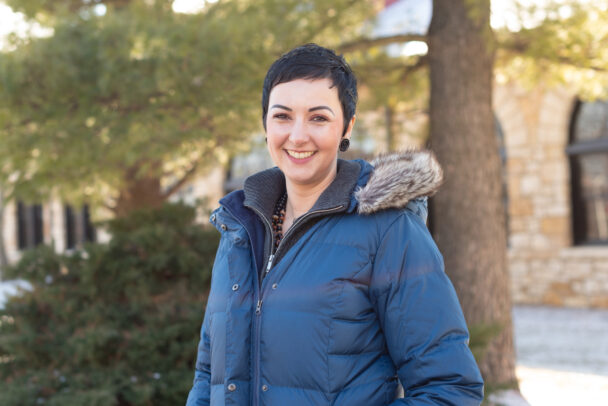
This Fall marks Professor Ljudmila Bilkić’s first semester at Wesleyan University, and she’s already shaping the face of language learning with a pedagogy developed from 16 years of teaching as well as her lived experience. To understand how Bilkić’s contemporary film expertise, her work as Duolingo’s first German language contributor, and her immigrant background have influenced her goals for her future at the University, The Argus sat down for a conversation with Wesleyan’s newest Assistant Professor of the Practice in German Studies.
The Argus: What drew you to becoming a professor at the University?
Ljudmila Bilkić: I didn’t want to become a professor at all! This is my sixteenth year teaching German. I started grad school for German in 2009 and have been in the classroom full time since then. I went to Middlebury College for my BA, and I did German studies and art history. Then, randomly, a friend of mine who works at a law firm was like, “The law firm needs someone who speaks German.” I was like, “Perfect, let me interview!” It was really in 2008 and 2009, when the recession hit, that I stopped and asked myself, “What do you really want to do?” I wanted to keep feeding my mind, and I’m like, “It’s time to go back to grad school.” So I tried to do as much as I could with German studies, but also to be as innovative as possible with teaching. I taught in many different environments: corporate, military, adults, university. Since 2018, I’ve been a full-time professor. When I saw the Wesleyan job posting, I wanted to hone my skills, have more one-on-one time with students, and have bigger, better, more focused opportunities for research.
A: How has working in diverse teaching environments shaped the way you think about language learning?
LB: Well, German is not my first language. I was originally born in the former Yugoslavia. However, we moved around, and that’s how I learned German. So I had that initial challenge of what it’s like to learn a language when you’re thrown into a classroom, and you’re expected to function like a human, but you’re like, “I don’t know two words.” When the opportunity with Duolingo came up, I wanted to see where the world outside of academia was going with teaching and learning a language. I was actually the first German contributor on Duolingo.
When I went to the Duolingo interview, I said, “I have a question for you: Why do you want to develop this app?” And without even thinking, both Severin Hacker, whose dissertation project it was, and Luis Von Ahn, his advisor, said: “We want to replace the teacher.” Honestly, I started laughing. I welcome the digital and other media avenues for language learning. But that, to me, is always secondary, and the human aspect needs to be at the forefront. It makes me feel better that Duolingo has not been able to replace the teacher!
A: You mentioned growing up as an immigrant in Germany. How did that experience shape your relationship with German language and culture?
LB: The very beginning of our stay in Germany was extremely difficult. I could feel that we were not welcome, from just walking down the street to being in class and not knowing how to speak a word of German. I liked literature class when we were in Serbia, but I couldn’t speak in German, so the only class I could show my skills in Germany was math, and I hated math! I remember one day I went to the chalkboard and did a math problem, and I guess it was correct because when I finished, something weird happened: everybody clapped, and I felt like I was a monkey in a circus. That really stuck with me; I was only nine years old. The people thought they were helping me, but there were these difficult moments that revealed this hierarchy, and showed me where my family and I belonged. However, at the same time, I had really good teachers. I had teachers who understood, who had seen the fall of the Berlin Wall, who really wanted to teach me and wanted to help out, and that’s when I really started falling in love with German literature and German art. The classroom, reading, and writing became my safe space.
A: Can you talk more about the social and emotional aspects of learning a language? What are some exciting teaching philosophies that you have developed over the years, and how do you hope to implement these practices at Wesleyan?
LB: One thing that I think will resonate with a lot of faculty and students is the term “project-based learning.” I am a big fan of the Finnish education model. In Finland and Norway, as far as I know, they follow the model of project-based learning. Instead of directly going over grammar and vocab, they implement these concepts with interdisciplinary projects. I was like, “How can I take that and bring it over to the U.S.?” Ultimately, I had to do a mix. Something as simple as not standing over students: I like to sit down, I like to be in the back of the classroom, I walk around all the time.
The other big thing for me is the idea that language is not going to be learned in a vacuum; there has to be a tailored, valuable experience for the student. For example, when you get off the bus or the plane, you’re going to hear slang first. Or, say you have to go buy a train ticket at the counter. How do you interact? I like doing skits and what I call “cultural week” instead of traditional assessment. You have an individual assessment where you do a diary entry or maybe a vlog. Then there’s a communal aspect where you work in a group, and you come up with a skit. For example, you pretend like one person is in a hotel and you need to book a room. I really try to bring in real-life scenarios, issues, and problems that still use the vocabulary and the grammar.
A: Why do you think language and cultural studies matter for students who don’t plan to work in that field?
LB: Both are essential tools to allow the student, especially upon graduation, to keep developing and to keep becoming who they are supposed to be intellectually. You may have the skills from your majors, but those moments where, maybe, it felt really difficult in the first week of language class, and you had to personally humble yourself and say, “Wow, how do I say what I want to say in the ten words that I just learned?” are unique. By having language learning as a background, I think you become stronger in your own character and your own personality.
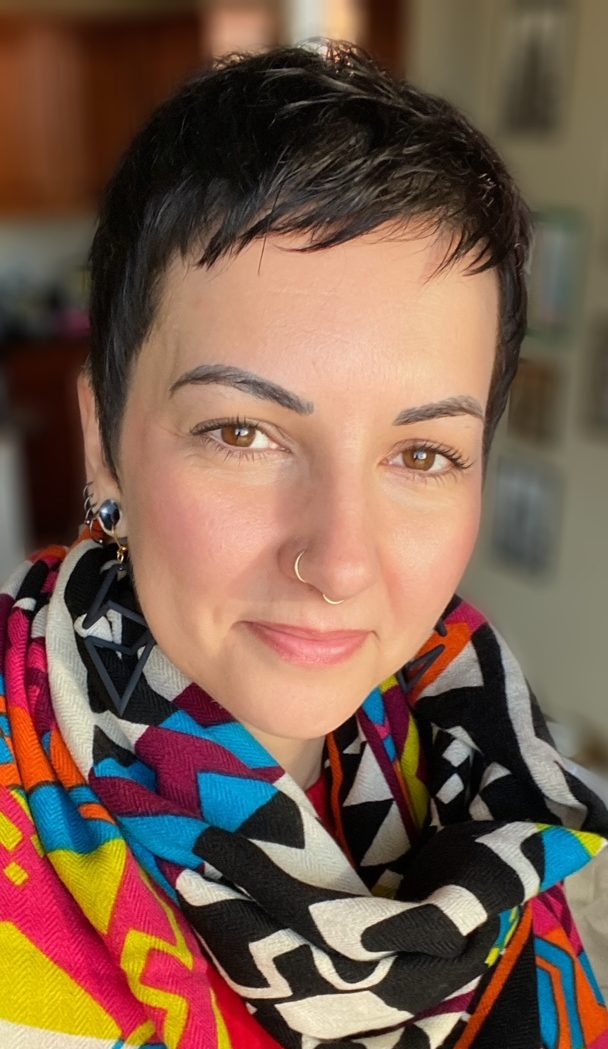
A: Much of your research focuses on migration and how migrants are represented in film and media. What first drew you to this work?
LB: The funny thing is that for professors there’s always a bit of a selfish aspect—or a lot of a selfish aspect—depending on the personality of the professor.
I was always obsessed with film. Even when I was four years old there was no such thing as censorship in my household. My parents are intellectuals and artists, so I was like “I wanna watch this horror movie,” and my dad was like, “Okay,” but then he would explain to me like “Don’t be scared, this is just fake blood.” That drew me to really love the magic that one feels at the movies, but also the mechanics behind it. That carried through, and when I got to grad school I wanted to explore more of the experimental aspects, so then my art history background came in through contemporary art and contemporary photography.
I wondered what people were doing to protest how Syrian refugees in Germany were being treated, and how migrants in general were being treated. I started seeing all of these experimental videos, experimental exhibitions, multimedia exhibitions, and I kept diving. There are these narratives that migrants are either weak or they are a threat, and it comes back to otherness. People have always gone from one place to another and a lot of times it’s the border crossing you instead of you crossing the border. Why has migration become such a problem to solve when we’ve advanced in all of these other areas?
A: Can you talk more about what film and media show us about migration that is otherwise overlooked?
LB: It shows what the majority of society does not want to see, which is that the migrant is really a complex individual. Nowadays, whether it’s conflict-induced or environmentally induced, when a person has to pick up and run, they don’t have the time to sit down and fill out the paperwork! I call it forced migration. When people just say “you want open borders,” it’s more complicated than that. I’m not saying I have a solution; I’m just saying that film and media force us to create what I call a “critical knowledge scape,” where the concept of the migrant is in flux.
A: What movies would you recommend that illustrate this complexity?
LB: So there’s “Neukölln Unlimited” (2010), and there’s also “Foreigners Out! Schlingensief’s Container” (2002), both of which are documentaries. The latter’s director Christoph Schlingensief was a performance artist who, in 2000, built these real-world, Big Brother–type houses, put cameras on a group of asylum seekers in Austria, and told the Austrian public that they could vote off—i.e., deport—their two least favorite migrants every day. What that documentary really shows is how people reacted to it, how they fought against it. Schlingensief was like, “It’s interesting how you’re so upset at me for doing this simulation, but down the road there’s an actual detention center where people are suffering; go protest that!”
A: Are you working on any particularly exciting projects or research right now?
LB: I am working on finishing my book that historicizes new media in German-speaking countries. The first couple of chapters look at the postmodern definition of the migrant. So I try to bring in economics, poli-sci, everything, to say that all of these topics matter even though my work is specifically in German studies. I really want to keep the conversation going in terms of who and what the migrant is. If we are going to do better as humanity, across the world, we need to clean up the definitions a bit.
A: What is something you’re hoping to bring to Wesleyan beyond the classroom?
LB: I hope to contribute to a community of all the language instructors, and genuinely share our approach to teaching. If there is a place where we can become more innovative than other institutions, it would be at a liberal arts college. How can we bring project-based learning (we need a sexier name for that!) into the classroom, and how do we adapt to AI? With Duolingo, it was there, but now it’s morphed into something else. Let’s build something because our students are smart and strong enough to put it into practice.
A: What else do you want people to know about you?
LB: I paint, love the history of tattoos—and getting them!—and I absolutely love animals. Once in my life, I plan to spend a whole summer volunteering and working at the Elephant Nature Park in Chiang Mai, Thailand. Also, my door is open, even if it’s closed. I remember what it’s like to be a student, and I’d like to offer a comfort zone to any students, should they need it. I’m just excited to be here and get involved. If anyone has any recommendations for restaurants in Middletown, I would love to know! Stop me on campus and say hi!
This interview has been edited for length and clarity.
Beth Huggins can be reached at bhuggins@wesleyan.edu.


Leave a Reply