
WesCeleb: Iza Konings ’26 Talks Studying in Rwanda, Shakespeare, and Seeing the Sun Again
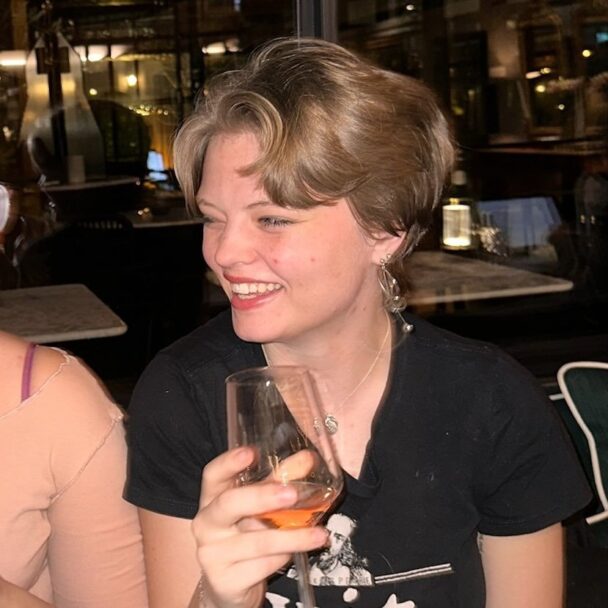
If you have stopped by any Shakespeare production at the University in the past four years, from last semester’s Pericles to the 2023 Spike Tape production of Twelfth Night, chances are you have seen the work of Iza Konings ’26. She just finished her second thesis last week, and finally has time to sit down with The Argus to discuss Spike Tape, her studies in government and history, and her time abroad in Rwanda.
The Argus: Why do you think you were nominated for WesCeleb?
Iza Konings: The only thing I can really think of is that I work in the book lab at Olin, and I have an Instagram account of all of the book restoration stuff that I do for Olin. We do all the restoration work on all the circulating collections. I’ve been working there for four years now, and I’m a part of Spike Tape, which is all over campus.
A: What’s your major?
IK: I am double majoring in history and government, and I just finished a thesis for the government department.
A: I heard you did two theses. What were they about?
IK: I did a capstone for my history major, and then I did a full thesis for government. The history one was about the role of Pope Pius XI during the Spanish Civil War. And then my thesis is my baby. It’s about the role of the United Nations (UN) in the post-genocide reconstruction of Rwanda. I did my study abroad in Rwanda for four months, and I interviewed a bunch of people while I was there, and then I spent a couple of weeks last summer at the UN headquarters in New York City, digging through their archives about the UN Assistance Mission for Rwanda. I wrote about how the UN really messed up their job in Rwanda, basically.
A: Could you tell me a bit more about your experience going abroad in Rwanda?
IK: Yeah, so I found the program on the University’s Office of Study Abroad website. No one from the University had ever done that program before, so I was kind of the guinea pig. It was a really interesting process getting ready to go, because I had to get a bunch of shots, and I had to take malaria pills every day while I was there. Obviously, that is very different from going to Wesleyan. Motorcycles are the main method of public transportation in Kigali, the capital. It’s scary to be in a new country completely by yourself, especially when you don’t speak the language at all at the beginning. It’s a completely different monetary system, and a completely different culture from what I was used to, but I had such a blast. I would highly recommend visiting Rwanda as a tourist. It’s a really cool country.
A: What was your daily routine in Rwanda? Did you have classes there, or was it all research for your thesis?
IK: So the first six weeks that we were there, we had classes, and that included a class about the history of Rwanda, the politics of Rwanda, and the language. And then once those six weeks had ended, there was also a class specifically about the genocide, and the events that led up to the genocide. But the last two months that I was there, we were just completely on our own. I had to find people to interview and figure out how to do a completely independent research project, and I had never done anything like that before. It was a really unique experience, because it wasn’t just going to classes every day in a different country, but I really had to figure out what to do every day for two months.
A: Did you know what you wanted to write your thesis about before going to Rwanda?
IK: No. I knew going into the program that one of the requirements of the program was to do a big research project, and so I did that project, which was published in The Yale Review. And then I was like, “This is awesome, this is such an interesting topic.” So I decided to continue with it. The first published iteration that I did was about the role of international NGOs [non-governmental organizations] in Rwanda. And then my thesis was about the UN.
A: What did you discover was the role of NGOs in Rwanda?
IK: The genocide happened in 1994, and it happened only in 100 days, and one million people were killed. And the UN knew in advance the lists of names that were being circulated of people that the government wanted to kill. The UN knew this, the U.S. government knew this, and they didn’t do anything to prevent the genocide.
While it was happening, there were all of these pictures circulating the world of these horrible things that were going on in those 100 days in Rwanda, and governments around the world started calling them “acts of genocide,” as opposed to a genocide. In international law, if there is proof of a genocide happening, the international community, or basically, the UN, is legally required to intervene. But all of these world governments were calling it acts of genocide, which is a really weird legal loophole to make it legally not an actual genocide, even though it was one. So, these world governments didn’t do anything to intervene.
In the 30 years since that happened, Rwanda understandably has a distrustful relationship with the larger international community, but the UN still carried out a mission there for a couple of years after the genocide ended. My thesis is about how that relationship worked, areas where it went horribly wrong, and one area in which there was a proper relationship between the two.
A: And your thesis focused on post-genocide Rwanda?
IK: After genocide, yeah. The title is “The Role of the United Nations in the Post Genocide Reconstruction of Rwanda,” so 1994 on.
A: How are you feeling about your thesis being done?
IK: I’m really, really relieved. I loved it, it’s such a fascinating topic, and I had a lot of fun writing it, but I spent my entire life in Olin, and I’m really excited to see the sun again. But I’m very proud of it, and I’m really glad that I did it.
A: Could you tell me about Spike Tape?
IK: Yeah, I have been doing shows with Spike Tape since my freshman year. What I think is unique about my relationship with Spike Tape is that every single Shakespeare play that it has put on in the years that I’ve been at the University, I have been involved in in some way or another. My freshman year, there was a production of “Twelfth Night,” and I acted in that. My sophomore year, I stage-managed a production of “Much Ado About Nothing.” My junior year, I acted in a production of “Macbeth,” and then, obviously, last semester, I directed “Pericles.” This semester, there was a production of “Richard III,” and I did the fight choreography for that. I even have a Shakespeare tattoo on my arm.
A: What is your Shakespeare tattoo of?
IK: It’s from “Hamlet.” It’s “If it be not now, yet it will come. The readiness is all.” It’s one of my favorite quotes from “Hamlet.” I got that during my freshman year.
A: Last semester, you directed Shakespeare’s “Pericles.” How did you go about adapting the old Shakespearean text into a modern form?
IK: This is one of my favorite things ever, adapting Shakespeare. I think that people have this aversion to Shakespeare, which I completely understand, because the language is really insane and difficult. But, we know that Shakespeare was wildly popular in his day, it’s because he’s not talking about complicated ideas. He’s talking about things, emotions, and experiences that everyone can relate to, even now. It’s the responsibility of the director to take the meaning and the intention behind how Shakespeare wrote these plays, and adapt them in a way that a modern audience can understand.
What we did was a post-apocalyptic version of “Pericles.” Not to make it too political, but sometimes it feels like we’re heading towards an apocalypse a little bit. I thought that would be a cool aesthetic to play around with. There are a lot of lines in the play that talk about “these latter times” and this “disaster that we live in.”
A: Why do you enjoy theater?
IK: I would say that my relationship with theater is more than just a hobby. It’s something that is just purely joyful for me, that I kind of use as a way to escape from anything else that’s happening in my life. The kinds of people who do theater are great, and I know that it’s always an atmosphere that I’ll enjoy being in.
A: Switching gears, what is it like to study government and history at this time?
IK: It’s been really weird. I think that being a government major has actually made it a lot easier for me. Very frequently, people see articles on the news about all of the heinous things that are happening around the world. It’s so scary, and it feels so all-encompassing, and it’s so difficult to comprehend. But professors, especially government professors, are very willing to talk through modern events with you. For example, on Thursday [April 23], three of the International Relations professors are giving a lunch talk about the war in Iran. And, they don’t have to do that, but they’re doing it because they’re interested and they want to help keep people informed.
A: How are you feeling about graduating soon?
IK: It’s kind of a mixed bag. I definitely feel like I’m ready to graduate and see what’s next in my life. But I’m also gonna be so sad to not be at the University anymore and will miss my friends who are underclassmen, who I’m not going to see every week anymore, or even my friends also graduating with me. A lot of us are going all over the world. I don’t know when I’m going to see these people again. But, I’m really proud of what I was able to do well in the four years that I was at the University, and I wouldn’t have done it differently.
A: Do you have any post-grad plans at the moment?
IK: I am moving out of the country. I’m originally from the Netherlands, so I’m probably going to go back there. I’m taking a few months off just to kind of relax and recuperate, and then I’m going to be applying to grad schools in peace and conflict studies, so studying war theory and the history of war and conflict prevention.
A: What advice would you give to your first-year self?
IK: Don’t stress out too much. It’s all gonna get figured out. I think I could have saved a lot of time and pain if I had just been like, “Take it easy. You’re going to graduate, you’re going to get there.” Four years seems like a long time when you’re a freshman, but when you’re on the other end of it, you’re like, “wow, that went really fast.” Take the time to enjoy it.
This interview has been edited for length and clarity.
Claire Farina can be reached at cfarina@wesleyan.edu.




Leave a Reply