
Champagne & Sun: Class of 2026 Celebrates Thesis Completions on Olin Steps
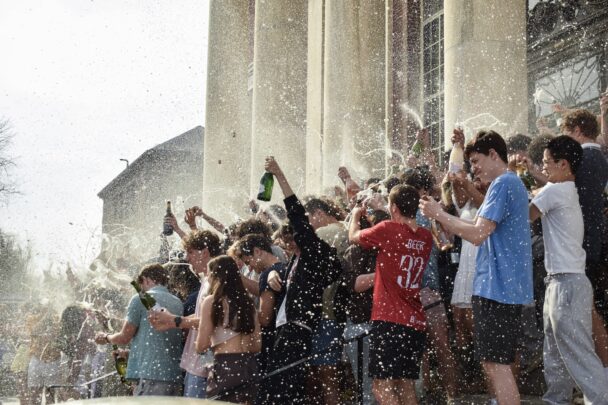
Cheers! April 16, 2026 at 4:00 p.m. marked the moment the class of 2026 had been awaiting for months: the deadline to submit honor theses. As seniors gathered on Olin Library’s steps to soak themselves in champagne and embrace their friends in the sun, they bid farewell to a long year of hard work. The Argus passed through the roaring crowd to ask seniors about the journey of a thesis, from idea to champagne pop.
Claire Larson ’26, Chemistry and Earth & Environmental Sciences Double Major
The Argus: What is your thesis about?
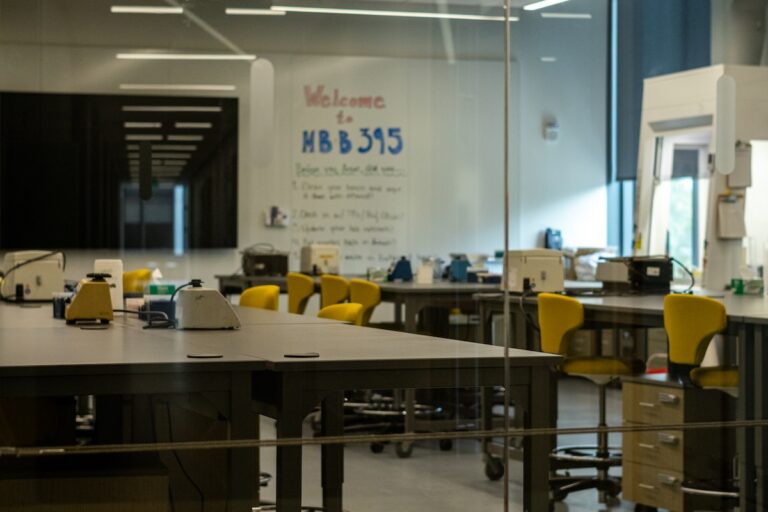
Claire Larson: My thesis was on the development of CO2-based polyesters with bio-based starting materials.
A: What was the process of completing your thesis like?
CL: I started pretty early. I’ve been doing research for over two and a half years, so I had a lot of data, and I was able to start writing at the end of last semester.
A: Any advice for rising seniors considering writing a thesis?
CL: In STEM, a lot of your data comes early, and you can write most of it in the second semester, which I think is really nice. And just be concise. The beauty of STEM theses is that it doesn’t have to be 100 pages.
Max Grosman ’26, Theater Major
A: Tell me about your thesis.
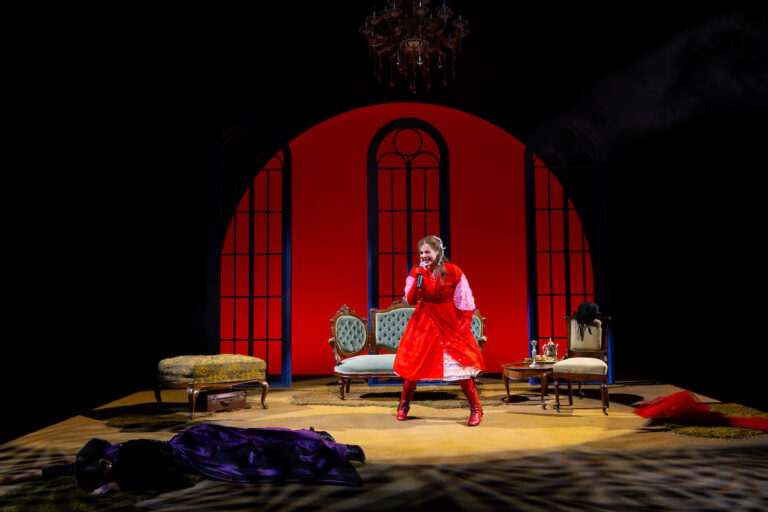
Max Grosman: For my thesis, I played John Proctor in the department’s production of “The Crucible.” The thesis was exploring how I, as an actor, with a vastly different moral compass than that of John Proctor, can understand the character through his own terms, to basically help myself embody the character. I approach the play through the ideology of Puritan America, specifically covenant ideology, and I consider two notions of covenanting as a way in which he [John Proctor] tries to find his goodness.
A: What was the most challenging part of the thesis process?
MG: Honestly, all of it. I think the fact that [my thesis] really kept changing in the early days, and that I didn’t really know what I was doing, was kind of unsettling. And then the revisions were really hard. I spent probably a month and a half revising and going through each sentence and to make sure it sounded clear and was conveying the specific argument, because the page count was pretty short. It was only 30 pages because there was also a performance component.
A: Any advice for rising seniors considering writing a thesis?
MG: Research over the summer and let yourself explore. Don’t pin yourself down to one topic so you can find something that actually interests you. Definitely don’t do it for just pure academic validation.
Lucas Donat ’26, French Major
A: What was your thesis about?
Lucas Donat: My thesis was on how Jewish identity is talked about in memoirs written by French people—Jews and non-Jews—who survived the Holocaust.
A: What was the most challenging part of writing your thesis?
LD: There were a lot of hard parts. I think since I kind of made up an interdisciplinary project and included text data analysis as part of my approach, it was often hard to know what exactly the “right” path was, because I didn’t have a lot of examples for the mixture of empirical/humanities work that I wanted to do.
A: What was the most fun part?
LD: The champagne pop is an obvious answer. But, during the process of working on it, it was really fun and fulfilling to engage with the subject on a personal level. My great-grandparents were Holocaust survivors and they wrote about their experiences in a memoir, so it was really cool to learn about memoir storytelling in an academic way. I even sometimes saw their book cited in the research I was looking at!
A: Any advice for rising seniors considering writing a thesis?
LD: Don’t, LOL. Or at least understand the time commitment. There were weeks when it felt like finals week in the middle of the semester. It’s a lot of stress, and I think a semester-long project fulfills a lot of the same goals as a thesis, but your year isn’t consumed by it.
Leandra Sze ’26, Studio Art Major, and Oliver Brown ’26, Art History Major
A: What are your theses about?
Leandra Sze: My thesis was called “Discarnate Bodies.”
Oliver Brown: My thesis was on a 19th century French painter named Gustave Caillebotte.
A: What was the most challenging part of writing your thesis?
OB: Probably just the mental hump of realizing that I need to be confident and happy with what I’m writing.
LS: It was just such a long process, and it was hard to find motivation, especially in the middle of creating it.
A: What was the most rewarding part?
OB: Not to sound very superficial, but this moment: The collective effervescence is through the roof.
LS: Yeah I agree. Having the support from my family and friends today, and seeing how proud they are of me has definitely made the thesis process worth it.
Remy Fu ’26, Biology and Education Studies Double Major
A: Tell me about your thesis.
Remy Fu: My thesis was on teacher agency: examining the barriers and structural constraints teachers face and how they view and interact with them.
A: What was the most challenging part of writing your thesis?
RF: I think it feels really overwhelming to take on such a large project and ensure that there’s a clear connecting thread between each chapter.
A: What was the most fun part?
RF: Champagne pop, LOL! But also being able to conduct interviews and learn so much about 11 passionate teachers who were so excited to share with me.
A: Any advice for rising seniors considering writing a thesis?
RF: Start literature review early!
Rachel Masterson ’26, Environmental Studies and Psychology Double Major
A: What was your thesis about?
Rachel Masterson: My thesis used ecology, climatology, environmental psychology, and environmental law to evaluate how the health of the Edwards Aquifer in Central Texas has changed over time.
A: What was the most challenging part of writing your thesis?
RM: The most challenging part of writing my thesis was incorporating all of these different disciplines into one cohesive and concise paper, while also adding in interview quotes and repeat photography.
A: And the most fun part?
RM: The most fun part of my thesis process were the in-person interviews that I conducted in Texas last summer. I had never been to Texas or seen an aquifer before.
A: Any advice for rising seniors considering writing a thesis?
RM: Ask for as much help as you can, many professors will be happy to advise you, and make sure the topic you chose is a topic that you will stay interested in!
Kiara Reeves ’26, Feminist, Gender, and Sexuality Studies (FGSS) and Theater Double Major
A: What is your thesis about?
Kiara Reeves: I’m doing a joint thesis about gender and performativity.
A: What was the most challenging part of writing your thesis?
KR: I think staying with one project for so long really tests your stamina and your ability to push through obstacles and stay focused.
A: What was the best part?
KR: Finishing it.
A: How does it feel finally popping champagne for your thesis?
KR: It feels so, so awesome. Everyone is so supportive and so emotional. It’s been really lovely.
Mya Catino ’26, African American Studies and FGSS Double Major
A: Tell me about your thesis.
Mya Catino: I’m double majoring in African American Studies and Feminist, Gender, and Sexuality Studies. My thesis was in the FGSS department, and it was about pro choice humor as an activism strategy. It was called “Laughing Matters.”
A: What was the most challenging part of writing your thesis?
MC: Having no real set structure, and just being let loose to do whatever research I wanted was very exciting, but a little daunting at first. Ultimately it made the project more meaningful, because I was fully able to craft it from beginning to end.
A: What was your favorite part?
MC: This moment! It’s so awesome seeing everyone who I’ve seen in Olin for the past couple of weeks out here celebrating. We were so hunkered down, and now it’s all coming to fruition. Also, seeing everyone on Instagram posting the titles of their theses was very rewarding.
Julian Fried ’26, Philosophy Major
A: What is your thesis about?
Julian Fried: I was writing about disorientation and how we inhabit our bodies after we disorient.
A: What was the process of writing your thesis like?
JF: Honestly, I started in junior year, and I had no idea what I was writing about. I started with a completely different topic, so it evolved quite a lot over the course of a year. I went to a dance intensive over summer, and that altered the course of what I was writing my thesis about.
A: How did you feel while popping the champagne?
JF: Absolutely exuberant.
Ethan Norton ’26, Film and English Double Major
A: What is your thesis about?
Ethan Norton: My thesis was a short, 12-minute fiction film. It’s called “Nighttime.” It’s about a sister and her younger brother as they venture out of this hideaway cabin in the woods into the real world.
A: What was the process of creating your thesis like?
EN: It was an overwhelming amount of work. It’s a sort of tired expression but in some ways, you invest a lot of emotion into it [a thesis], and you think of it as the culmination of four years of work, or even more. But really, I sort of learned that the most important part was all of the connections that I made along the way, people who I know I’m going to work with down the line. I’ve got some friends here too, across all four grades, who were involved with this film. Getting to see that kind of cross division in a collaboration was very valuable.
A: How does it feel to have finished the process?
EN: It’s a bit surreal. My roommate just pointed out to me that he lived in the dorm right over there [Clark Hall] his freshman year, so to be standing here now, four years later, popping our own champagne bottles is just crazy. While I’m at it, I’ll do a bit of self promotion. Check out
Canceling Productions, a growing production company by three now completed thesis filmmakers!
Miles Horner ’26, Science and Technology Studies Major
A: What is your thesis about?
Miles Horner: I wrote about how the new science center is evil.
A: Oh! Tell me more.
MH: Basically, there’s this guy who donated $25 million to build it [the new science building]. He’s the [vice] chairman of our board, and the head of this evil company that builds DNA surveillance databases for people around the world.
A: What was the process of writing your thesis like?
MH: So much work. Just so much work.
A: Any advice for rising seniors considering writing a thesis?
MH: Make sure you have at least 25 pages done in the Fall.
A: How does this moment feel?
MH: WOOOOO!
These interviews have been edited for length and clarity.
Maggie Smith can be reached at mssmith@wesleyan.edu.
Leah Ziskin can be reached at lziskin@wesleyan.edu.
Leave a Reply