
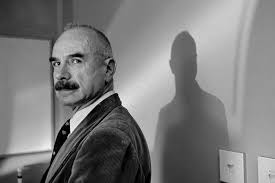
From the Argives: Revisiting Watergate Mastermind’s Infamous Visit to the University
On Wednesday, Sep. 28, 1983, G. Gordon Liddy, a key player in the Watergate scandal of 1972, came to speak at the University, hosted by the Student Events Committee (SEC). This, unsurprisingly, caused an uproar among the student body and faculty, which is now preserved in a myriad of Argus articles that commented on the controversy as it unfolded. In students’ and professors’ own words, these pieces track how a debate surrounding a guest speaker spiraled into unsettling questions about two of the University’s foundational values: free speech and ideological diversity.
For those unfamiliar with Liddy and why his presence on campus was met with backlash, Liddy was known to be the mastermind behind the Watergate break-in. He was responsible for planning the illegal wire-tapping, managing the burglars, and committing political espionage. Liddy was ultimately convicted of conspiracy, burglary, and illegal wire-tapping for his role in the infamous plot to secure former President Richard Nixon a successful reelection.
Liddy was originally sentenced to 20 years in prison, but former President Jimmy Carter commuted his sentence to eight years, and he ultimately got out in a little over four years on parole. After his release from prison, Liddy began speaking at universities, which ultimately led him to arrive in Middletown.
On Sep. 23, 1983, The Argus published three separate articles in anticipation of Liddy’s talk, criticizing the SEC’s choice of speaker, the money spent on the event, and Liddy’s political beliefs and history apart from his role in Watergate.
In a letter to the editor from the Sept. 23 issue, Dan Ackman ’85 listed his arguments against inviting Liddy to speak on campus, which emphasized the disreputable aspects of his career and moral character.
“An admitted life-long admirer of Adolph Hitler, Liddy burglarized Daniel Ellsberg’s psychiatrist’s office while working under John Erlichman in the Nixon White House,” Ackman wrote. “He went on to work for the Committee to Re-Elect the President (CREEP) in the dirty tricks division. Always the volunteer, Liddy offered, through E. Howard Hunt, to assassinate columnist Jack Anderson after he uncovered covert U.S. intelligence activities abroad. Finally, he organized the 1972 break-in to the Democratic National Committee headquarters in the Watergate Hotel. For this action, Liddy was caught, indicted, and the events which led to Richard Nixon’s ignominious downfall were set in motion.”
Evidently, Ackman saw Liddy’s upcoming visit as an insult to the values of the University’s predominantly liberal student body and faculty. To those sharing Ackman’s view, Liddy unapologetically participated in illegal acts and held beliefs fundamentally opposed to democratic values.
Several faculty members also voiced their opinions of Liddy in the same issue of The Argus, discrediting the SEC’s decision and attempting to organize a boycott of the event.
“The college speaking tour is populated by so many large-scale killers…that it may be silly to fuss about the seventh-rate thug like Gordon Liddy,” English professors Richard Ohmann, Helen Zawisa, Richard Slotkin, and Khachig Toloyan wrote in a letter to the editor. “We suggest saving your dollar for some better use, and greeting Liddy with an empty hall on September 28th.”
According to the professors, Liddy was merely another disappointing guest in a long line of disappointing speakers who visited the University.
Jeff Hoffman ’86 also reported on the University’s anticipation of Liddy’s visit in the same issue. His article investigated the reasons underlying SEC’s decision to invite Liddy to campus.
“According to Ron Hammer ’84, chairman of the SEC, the decision to bring Liddy here was made because, ‘we (the SEC) believe that it is important that the student body be exposed to a wide spectrum of political viewpoints. Whether we, as individuals, support those views,’ he said, ‘is not an issue,’” Hoffman wrote.
Hammer framed the SEC’s decision as the realization of the University’s values of open-mindedness and diversity, but students and faculty were displeased with where their money was going and that they had no direct say in the matter.
On Sep. 27, 1983, The Argus’ editors published a brief update on Liddy’s impending speech.
“At a cost of $4,350, G. Gordon Liddy will speak Wednesday evening in Moconaughy Dining Hall,” the editors wrote. “A question to ask ourselves and the Student Events Committee (SEC) is whether or not the price justifies the person.”
For reference, that sum is equivalent to $14,421.71, accounting for inflation. Seeing the price tag on Liddy’s talk and the financial crimes he committed during Watergate, several students and faculty had reasons to question the transaction.
The Argus further outlined that the cost would be more justifiable if Liddy added something new to the conversation of Watergate or American politics in his talk.
“Liddy is not a legitimate enough historical figure to warrant the publicity he has received,” the editors wrote. “The SEC should not waste its funding on promoting an image, especially if it is a false image, as is the case here. Liddy’s speech will be predictable and will serve only to further the media image he has so carefully kept in shape.”
Despite the disapproval from the student body and faculty, the event was held, the room was packed, and The Argus made sure to report on its aftermath.
In an Argus article issued on Sept. 30, 1983, Chris Chester ’86 loosely described the atmosphere of Liddy’s talk.
“The audience listened quietly to Liddy,” Chester wrote. “No boos were heard and no picket-signs were seen. Liddy’s frequent jokes, including his plan to sabotage the air conditioning system at the 1972 Democratic Convention, elicited moderate laughter.”
In terms of attendance and demonstrated interest, the event was undeniably a success. While many may not have agreed with his beliefs, students at the University would not pass up an opportunity to engage with such an otherworldly, contentious figure.
Hoffman, who interviewed Hammer in the days leading up to the event, wrote another article published in The Argus’ Sept. 30 issue.
“No, the SEC was not wrong in bringing G. Gordon Liddy to Wesleyan to address the Wesleyan student body,” Hoffman wrote. “Yes, it proved an educational and worthwhile experience as Ron Hammer, SEC chairman, promised it would be. Liddy brought to our attention many misconceptions we hold about the nature of our government and its functions. More importantly, however, Mr. Liddy reaffirmed what we already know about him: he is a barbarian with a civilized facade. He is an educated man who is, unfortunately, morally bankrupt.”
Hoffman, and presumably others packed into Liddy’s full audience, found something valuable to be gained from his words, regardless of whether they agreed with him.
Hoffman went on to chastise those who maintained their disapproval of the event.
“In dismissing the Liddys of the world and their importance, they have proved themselves not shrewd protesters, but merely morally limp persons,” Hoffman wrote. “In this matter, I find that Wesleyan has shown itself to be not politically, but morally impotent. If we ignore all the Liddys, they may well prevail as they claim they will. Liddy will not disappear simply because we disregard him.”
The Liddys of the world have certainly not disappeared and will presumably continue to incite debate among University students.
Lara Anlar can be reached at lanlar@wesleyan.edu.
“From the Argives” is a column that explores The Argus’ archives (Argives) and any interesting, topical, poignant, or comical stories that have been published in the past. Given The Argus’ long history on campus and the ever-shifting viewpoints of its student body, the material, subject matter, and perspectives expressed in the archived article may be insensitive or outdated, and do not reflect the views of any current member of The Argus. If you have any questions about the original article or its publication, please contact Archivists Hope Cognata at hcognata@wesleyan.edu and Lara Anlar at lanlar@wesleyan.edu.


Leave a Reply