
Russell House Raves Revitalize the Historic Building
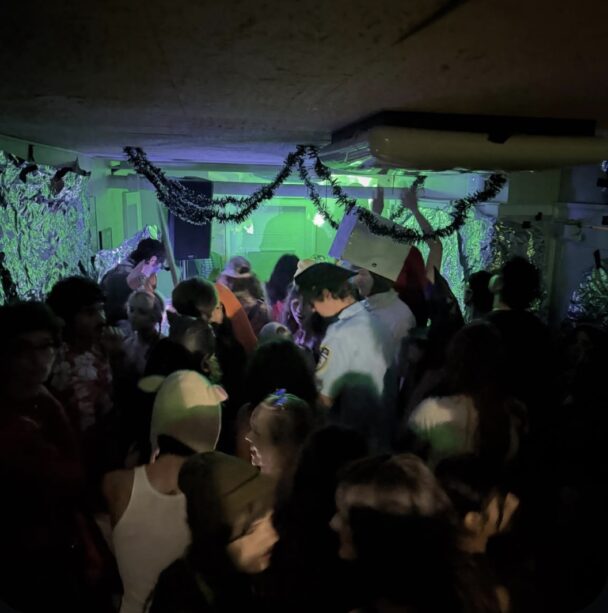
My fingers trace slick plastic sheets hung on a wall as I watch a throbbing video of skeletons, lit by flashing lights. Behind a cramped booth, a DJ spins electronic music, sometimes harsh and always loud. A small but passionate group bangs their heads and kicks out their legs in a circle. At the University, this kind of music scene is commonplace in spaces like WestCo Cafe and Eclectic. But late at night on Saturday, Oct. 17, I was in Russell House’s basement for Noisy Visuals’ “Evil Rave.”
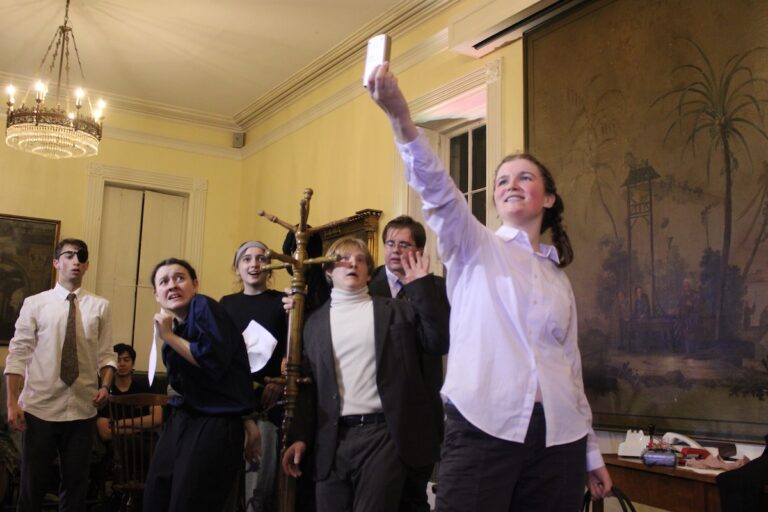
Noisy Visuals, a campus production club with audiovisual expertise in all things unusual, hosted two events in Russell House this October with “Evil Rave” and later “The Castle of Perseverance” on Thursday, Oct. 29, bringing the often-forgotten space to the forefront of student life, aided by a separate night of DJ sets hosted in the space on Friday, Oct. 30.
The Samuel Russell House stands solemnly on the edge of High Street and Washington Street, its palatial white-washed Corinthian columns marking it as yet another architectural departure among the University’s idiosyncratic collection of buildings. The acclaimed architect Ithiel Town, who popularized the Greek and Gothic Revival Styles, built the house in 1828 for his client Samuel Russell, a Middletown native and now-notorious trader, and it has been a part of the town’s landscape since before the University was founded. Thomas Macdonough Russell Jr. later donated it to the school in 1937, and in 2001 it was designated a National Historic Landmark, appreciated for its characteristic Greek Revival flourishes.
The building’s academic functions on campus have always been serious, bordering on stuffy, having housed the University’s Honors College until 1996, and now functions as the Philosophy Department’s home. Its many spacious, wallpapered rooms also make for remarkable classroom and event spaces, so it is no surprise that the building appealed to Noisy Visuals Co-President Mae Cohen ’27.
“Noisy Visuals in general tries to do everything possible that’s unconventional…we try to do that with the spaces that we book as well,” Cohen said. “But on campus, it is hard to book unconventional spaces. But we do feel like Russell House is one of them, even though there are events there all the time, because of its location far off campus and the way it looks. It’s very old and spooky.”
“Castle of Perseverance” leaned into the spooky vibes conjured by the house’s grand chandeliers and strange little rooms, which Noisy Visuals Co-President John Earling ’27 considers to be one of the space’s biggest assets.
“For Russell House, that’s usually for something that we want to be more interactive or more experiential just because of the scope of it and the layout,” Earling said.
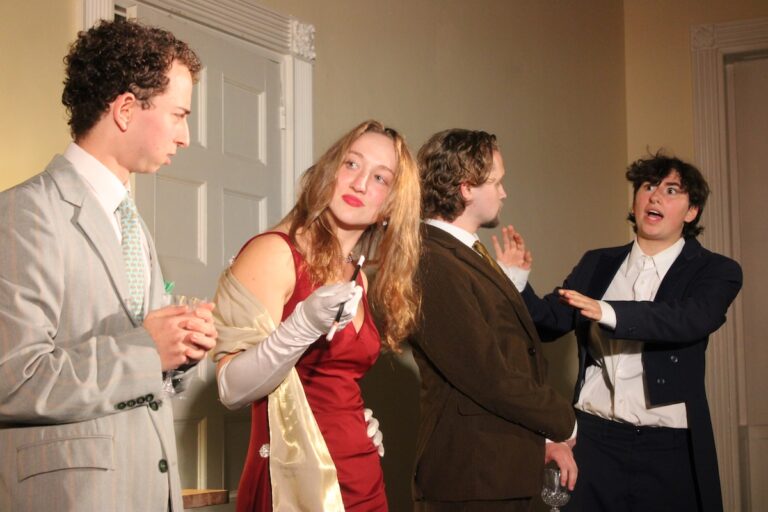
The event, led by Noisy Visuals Creative Director Vin Wiemelt ’29, was inspired by a Middle English morality play Wiemelt learned about in his Shakespeare class and took guests through rooms themed around the seven deadly sins before emptying them into the basement for a DJ set where students danced all night. Each room featured audiovisual projection elements and a myriad of other ways to overwhelm the senses.
“We had some of the characters giving out candy eyeballs and soaked in fake blood…the lust room, we just had a bunch of BDSM equipment and lights,” Weimelt said.
Kicking off the campus’ Halloween weekend nightlife, the event proved to be a big success.
“The basement rave was going strong until like 1:30,” Weimelt said. “We had to kick people out of that. It was packed for sure.”
“Evil Rave,” which occurred over Homecoming and Family Weekend, drew a comparatively niche crowd but similarly immersed attendees with the space’s overwhelming sensory nature combined with innovative effects. Earling and Cohen both emphasized the collaboration needed for events of this scale, from the technically-minded Disengineering Society, The Shed, and Wesleyan Sound Cooperative to improv actors who wandered the “Castle of Perseverance.”
Despite the success of these events and the Oct. 30 rave, everyone involved still had to consider the complications that come with Russell House’s historic standing and variety of uses. Cohen talked about “Castle of Perseverance.”
“There was a class [from] 7 p.m. to 10 p.m. on Thursday while we were setting up,” Cohen said. “And our event started at 10 p.m. and so a band was doing sound check and the teacher came down and yelled at us. So you definitely have to be respectful of the space. We were actually banned from using Russell House for at least a semester because we broke a window and a few things were out of place. I mean, it’s a historical house, so it’s important to the school to preserve it. It is important to us. But it’s also important to adapt it to modern needs.”
The Noisy Visuals team has a clear reverence for the space, partially due to a shared offbeat sensibility.
“The folklore is that there’s a tunnel under Russell House that connects to the Connecticut River which they used for smuggling opium,” Earling said, referencing Samuel Russell’s role as one of the most prolific opium dealers of the 19th century, whose eponymous Russell & Company was once responsible for smuggling 20% of the total opium to enter China for a year in the opening months of 1831, an amount totalling a staggering 3,500 chests.
Earling said that the group plans to “continue [Russell House’s] legacy through something a little bit less fucked up than whatever Samuel Russell was doing.”
The space’s grandeur and dark past complemented the decadence of the past month’s rave events, hosting a new generation of pleasure in its walls.
On Oct. 30, I moved between DJ sets on the main and basement floors like I was in a club in Berlin, acclimating to new pounding sounds and strobing lights. It was hard to remember that I’d spent hours in Russell House’s Millett Room reading Schopenhauer for a literature class held there last semester. Noisy Visuals plans to explore Russell House and other unconventional spaces in the future.
“It’s just so exciting to see the Wesleyan of yore and how students used to occupy these spaces and to try to continue with that,” Earling said.
Abby Slap can be reached at aslap@wesleyan.edu.
Leave a Reply