
Rabbi Without a Cause: Jewish Transcendence in the Modern Age, a Review of “Sabbath Queen”
When Amichai Lau-Lavie was outed as gay by a journalist in 1997, he fled his motherland of Israel to New York City, N.Y., fearing condemnation from both his broader Orthodox community as well as his prominent Israeli Orthodox family, which comprises 38 generations of rabbis (or 39, Lau-Lavie admits with uncertainty. His cousin is Israeli Chief Ashkenazi Rabbi David Lau; his uncle was Israeli Chief Ashkenazi Rabbi Yisrael Meir Lau.)
Alienated from his religious community, Lau-Lavie’s fate seemed isolated from his ancestral lineage, embracing a path of secular self-expression and radical queerness throughout his young adulthood in New York. This idiosyncratic journey is captured in Sandi DuBowski’s riveting documentary, “Sabbath Queen,” which was screened on Wednesday, Oct. 21 at the Jeanine Basinger Center for Film Studies with an accompanying Q&A. The documentary follows Lau-Lavie’s twenty-one-year-long journey from an ostracized queer Jew to a Conservative rabbi.
Sandi DuBowski, the film’s director and producer, is best known for his work on the intersection of queerness and religion. He directed the 2001 documentary “Trembling Before G-d”, which explored queer Jews reconciling their Orthodox identity and produced the unprecedented 2007 documentary “A Jihad for Love.” In his newest film, DuBowski compiles nearly 1,800 hours of original footage, plus 1,100 hours of archival footage and photographs, to deliver one of the most impactful documentaries I have encountered.
The film explores Lau-Lavie’s experimental Judaic approach and his eventual resignation from the Conservative Rabbinical Assembly because of their prohibition of interfaith marriage, revealing the tension between traditionalist interpretations of Judaism and more reformed, inclusive approaches to religious life.
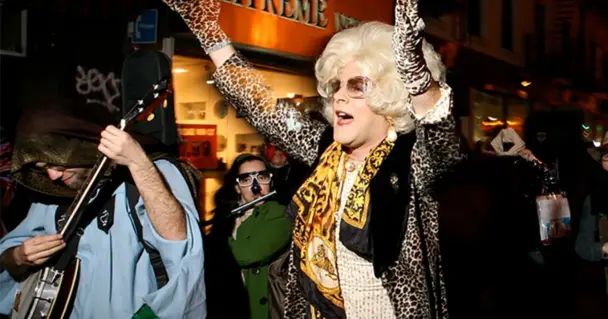
Lau-Lavie embodies these contradictions. Despite his experience as a member of the Radical Faeries, a decentralized LGBTQ+ spiritual and countercultural movement, as a co-founder of his religious community, Lab/Shul, a non-denominational, God-optional Jewish congregation, and as a drag performer (his persona: Rebbetzin Hadassah Gross), he was eventually ordained as a Conservative rabbi by the Jewish Theological Seminary of America.
In particular, DuBowski’s uncensored portrayal of Lau-Lavie, whose passionate journey has been criticized by his friends and family for perceived egotism, accentuates the complicated tension between preservation and reform, tradition and reinterpretation, and heroism and conceit.
Lau-Lavie’s older brother and father, who are both rabbis, criticize him for “playing a game with Judaism,” favoring consistency over experimentation. In a poignant scene, the audience learns Lau-Lavie’s family eventually embraces his multitudes as a queer man, a non-denominational spiritual leader, and a Conservative rabbi. As his drag persona confesses, “redemption will only come with transgression.”
However, this division between Amichai’s experimentalism and his family’s Orthodoxy characterizes broader progressive inquiries that challenge the Jewish diaspora, highlighting the precarious relationship of faith, community, and the politics of change.
While many rabbis of the Reconstructionist and Reform traditions officiate interreligious marriages and marriages of patrilineal descent, this act is forbidden for Conservative and Orthodox Rabbis, who maintain that the prohibition of interfaith marriage is “an important bulwark against the threat of the American melting pot, a key to Jewish continuity, a boundary distinguishing the Conservative movement from the Reform movement, [and] proof that halakhah is a priority for the movement,” as articulated by the senior rabbi at the Conservative Synagogue Bet Torah in Mount Kisco, N.Y.
To reconcile these contradictions, Lau-Lavie proposes a recognition of non-Jewish partners in Jewish interfaith relationships through a new category, “JOY,” which combines “Jew” and “goy,” a Yiddish term used to categorize non-Jews. This approach seeks to rectify this gap by reconceiving the rabbinic category of “ger toshav” (resident alien) to “welcome gentile partners who do not, or do not yet, formally convert but are members of the community, and to officiate at their weddings with a Jewish partner,” Lau-Lavie describes in “JOY: A Proposal.”
With a growing number of interfaith marriages among Jewish individuals, this debate is highly salient among Orthodox and Conservative Jews. Both groups are distinct in their strict adherence to both traditional Jewish law (halakha) and the Talmud, a central text to Rabbinic Judaism comprised of centuries of rabbinic discourse, biblical interpretations, and legal arguments, condemning homosexuality, interfaith marriage, and gender equality as violations of Jewish law.
As a religion grounded in communal belonging, collective identity (“Am Yisrael”), and shared religious obligations (“mitzvot”), Judaism, as Lau-Lavie argues, must reconcile these traditions with liberal individualism and civil freedoms. Yet many Orthodox and Conservative Jews worry whether Judaic reform can accommodate contemporary understandings of Jewish identity without sacrificing the mitzvot, mesorah, and spiritual commitments that have sustained Judaism across generations. In particular, Israeli journalist Yair Sheleg describes how “halakha does not recognize equality between men and women, between Jews and non-Jews, or between people with different sexual orientation,” yet concedes that individual freedoms and equal rights have become a key aspect of Western democratic society and may contradict traditional Jewish commandments.
Interestingly, particularly for American Jews, the New York Jewish Week editors argue that “perhaps the greatest threats to Jewish continuity are also the greatest gifts this country has to offer: democracy and pluralism.” This notion of “Jewish continuity” reflects the traditionalist concern that interfaith marriage and the growing influence of liberal ideals threaten the preservation of Jewish religious practices, communal identity, and inherited obligations across generations.
In Israel, with the rise of the ultra-Orthodox (Haredi) and Jewish-nationalist parties, the topic of integration is of increasing salience, particularly Haredi Jews.
“[Haredi Jews are] projected to grow to over 20 percent by 2040…accept only the Torah and religious laws (halakha) as the basis of Jewish life and Jewish identity, are critical of democratic principles,” political scientist Dr. Peter Lintl describes. In this way, the film frames the gruesome and historic conflict in the Occupied Palestinian Territories through the internecine conflicts between Israeli religious and political authorities.
While this construction may disregard the Israeli government’s egregious violations of international human rights, it was provocative in highlighting the complexity of the Israeli identity and the communal trauma and collective fear of persecution that make violence appear necessary and justified.
In a painful portrayal of Jewish division, the documentary shows Lau-Lavie, who attended a protest in Israel to mourn with Palestinians shortly after October 7, being berated by fellow Israelis with insults such as “bastard” and “you should’ve died with them.” Struck by this scene, I had the privilege of asking Lau-Lavie how he was able to reconcile his Jewish identity with the fact that many other Jews believe that he is not a part of their community. Lau-Lavie, who confesses in the film that “the deity I pray to is all-encompassing,” stresses the importance of worship through humor and art, believing that the Torah is all Jews’ birthright, primed for reinterpretation, not paternalism.
In particular, Lau-Lavie used his drag persona, Rebbetzin Hadassah Gross, to “tweak the shadows and live with the dark side.” Gross, in discussing her fictitious experience in the Holocaust, confesses on stage, “the important thing is we survived.” Perhaps this is what makes Lau-Lavie’s notion of survival so radical. It is not merely surviving as Jews, but surviving as Jews who refuse to surrender their capacity for humor, contradiction, and reinvention.
Carter Appleyard can be reached at cappleyard@wesleyan.edu.

Leave a Reply