
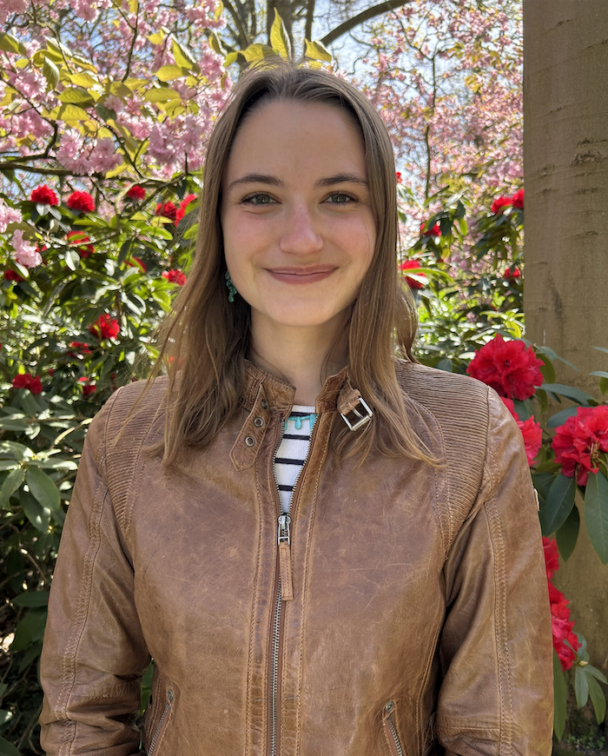
WesCeleb Scout McKibben-Baier ’27 on Globetrotting, Gender Equity in Education, and Getting Out of the Comfort Zone
Last year alone, Scout McKibben-Baier ’27 found herself living on three different continents. Over years of extensive travels, she became fascinated by the contrasting legal landscapes she encountered, which drew her to pursue the public policy and civil engagement work now central to her Wesleyan experience. When the Obama Foundation granted McKibben-Baier its prestigious Voyager Fellowship, she followed her passion for travel to Lisbon, Switzerland, and Greece, advocating for gender equity in education along the way. In light of her work, The Argus sat down with McKibben-Baier to talk about widening one’s comfort zone, navigating cultural immersion, and how gender equity impacted her experience abroad.
The Argus: Why do you think you were nominated to be a WesCeleb?
Scout McKibben-Baier: The nomination really surprised me, so this is a bit of a tricky question. I’ve been involved in a range of things and different subjects at Wesleyan: everything from swimming and international relations to poetry and astronomy. I’ve also had a pretty unique path at Wesleyan. I was abroad for all of last year, which not many people do.
A: You mentioned you were abroad for the entirety of your junior year. Could you talk about this experience?
SMB: I studied in two different locations. In the fall, I was in Amman, Jordan. I chose Amman because I’m interested in geopolitics, international relations, and the situation in the Middle East. I wanted to learn from people in that area firsthand. I lived with a host family, and it was an amazing experience. In the spring, I was in Amsterdam, which was totally different. I took English classes at the University of Amsterdam, which was very enjoyable.
I love living in different places around the world and expanding my bubble as much as possible. I knew I wanted to go abroad before I even came to Wesleyan, and I took a gap year before coming to Wesleyan, where I spent time abroad as well. So it was a given that I wanted to get out of my comfort zone, continue to travel, meet new people, and try different things.
A: What was the experience of having such radically different study abroad experiences in one year?
SMB: The culture in Jordan was unlike any I had ever lived in or experienced before, which was wonderful, and I was able to travel all around the country. I’m not Muslim, so it was interesting to learn about a new religion and new values. It’s quite a conservative country by American standards. I always had to keep my shoulders and knees covered, things like that. There’s no alcohol, and no tolerance for drugs. And then Amsterdam, on the other hand, is probably the most open and tolerant city that Wesleyan offers abroad. They are super liberal. Everything is either legalized or tolerated. All hard drugs are tolerated. Prostitution is legal. It’s super open and queer. That is part of the reason why I chose Amsterdam: I wanted two places that were just polar opposites.
A: Could you talk about your summer grant work with the Obama Foundation’s Voyager Scholarship? How was the application process, and what work did you conduct?
SMB: I applied during my sophomore spring. The application was open to any sophomore on financial aid who was interested in public service, and I fit all of those criteria. I did not expect to get it, so it was a very happy surprise. But essentially, it funded me to go out and study or participate in public service in any way I wanted. My focus was on gender equity, especially gender equity in education.
I spent the first half of the summer in Lisbon, working with a large-scale nonprofit foundation in their gender equity department. I helped assemble a new framework for the organization’s headquarters that analyzed all of the projects they were developing across the world through a lens of gender equity, regardless of whether those projects were outright focused on gender equity or not. For example, I was looking at a disaster response initiative in Switzerland and researched, “How can we predict what the long-term effects of the disaster will be, and how they will affect men and women differently?” I spent the second half of the summer in Athens, Greece, doing more groundwork and volunteering at a women’s refugee shelter.
A: How does the Voyager Scholarship function on a larger basis?
SMB: The program is conducted through the Obama Foundation. So there were a hundred of us who got this grant in my cohort, and everyone was focused on different things. I was the only person selected to focus on gender equity.
A: What was the most rewarding part of this experience?
SMB: This was one of the most meaningful and amazing summers of my life because I was not only doing something that felt impactful and helpful for the world, but I was also totally out of my comfort zone. It was my first time living fully alone in countries where I didn’t know a single person, and I ended up loving that. I made lots of connections and long-lasting friends through the program. But also, the work was so fascinating and engaging because I was looking at gender equity through different lenses that I had never considered before, and in areas of the world that I never would have been able to go to.
A: How are you continuing your public policy and civic engagement work back on campus?
SMB: I have been involved in a range of extracurriculars, mostly focused on education. I worked in the art department my freshman year, running classes for fourth graders about Native Americans in the Middletown area. I worked with SAWA (Strengthening, Assisting, Welcoming, and Advocating for Refugees in Greater Hartford), which provides education and English classes to recently resettled Syrian refugees. I have also worked with Literacy Volunteers of Central Connecticut, which also provides English classes to adult immigrants in the Middletown area.
However, the organization I’ve worked with the most is called Afghan Female Student Outreach. They are based in Hartford, and they provide online classes to women in Afghanistan, in hopes that these classes will help women apply to colleges and scholarships outside of the country as a means of escape. I’ve worked with them over the past three years, and I’m also writing my thesis about the state of women’s education in Afghanistan. Right now, there’s not a significant humanistic element to much of that research. It’s all data-focused. I’m using pre-published research from interviews with my past students to show the real-world effects and the emotional aspects of the education ban in Afghanistan. I hope to provide a more holistic picture of the state of things in the country right now.
A: How has your teaching work changed since beginning your senior project?
SMB: It’s been really interesting. My other extracurricular activities have not been as much of a deep dive. I joined the organization in the spring of my freshman year, when they were just starting out, and since then, attendance has quadrupled, if not more. I’ve been able to recruit other teaching assistants and English grammar teachers to the organization, which has been rewarding. The main thing is the impact. Watching this organization grow and watching more women benefit from it has been incredible.
A: What is your major?
SMB: I’m an English major and a civic engagement minor. I love to write, and I believe in the importance of being able to convey what you mean through writing. That doesn’t directly connect to my ultimate career goals, but regardless, being a good writer will help me immensely in my career.
A: Do you have a favorite class you have taken at Wesleyan?
SMB: I enjoyed studying journalism and poetry because those subjects are both outside my comfort zone, and I loved learning to write in new formats beyond analytic essays. In my sophomore year, I took this really good class on U.S. contemporary politics. That was right during the time Trump got elected, so it was good timing for that. The course was unique because it helped me think about things from views that I don’t necessarily agree with: not in an overly critical way, but to learn where people are coming from and how their backgrounds influence their beliefs.
A: Any advice for students hoping to get involved with activism both on campus and abroad?
SMB: I would say to just go for it, cast a wide net, and see what interests you. And then when you find that, focus on it. The thing that ignites you is the best thing for you to work on, which will allow you to be the best asset for public service work, because your effort is coming from your heart instead of a feeling of obligation. I am a little biased as someone who obviously loves to travel, but I believe getting out and seeing the world is crucial for being a good public service worker, because you need to interact with different communities and learn different viewpoints. I think the most growth happens when you’re not in your comfort zone.
A: What are your goals for senior year?
SMB: I want to keep making the most out of Wesleyan while I’m here: taking as many classes and meeting as many people as possible, as well as finishing my thesis. I want to try a bunch of new things!
A: What advice would you give your first-year self?
SMB: I would say my freshman self was quite out of her comfort zone. I had just come back from a gap year where I was working a bunch to earn money for college, but also traveling on my own. So, Middletown felt very small. I think that Middletown felt particularly small because I wasn’t going out and doing enough. I should have joined more clubs, and I should have traveled around the Middletown area more. I have since branched out immensely, but I should have started that process earlier.
This interview has been edited for length and clarity.
Leah Ziskin can be reached at lziskin@wesleyan.edu.


Leave a Reply