
Collector Subculture Turns the Tables in Favor of Physical Music Media at WESU Record Fair
The Recording Industry Association of America (RIAA) recently released its Mid-Year Music Industry Revenue Report for 2026. Results show that physical music revenues jumped 25.9% in the first six months of the year, compared to digital revenue with only 4.2%.
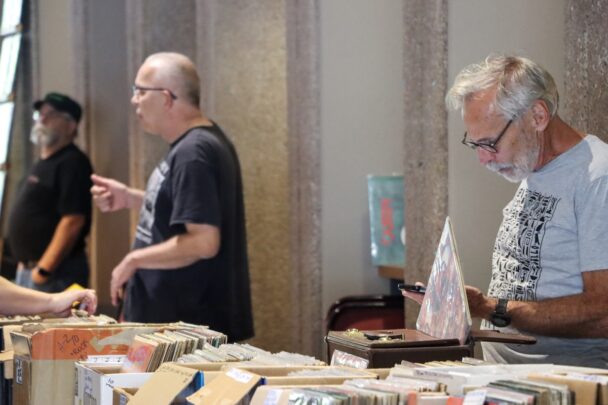
WESU, Middletown hosted its biannual Record Fair on Saturday, Oct. 3. Founded in 1939, the station is available on the frequency 88.1 FM. WESU and is, according to their mission statement, “a noncommercial, community/college radio station…. [serving] Wesleyan University students and members of the greater Middletown area.”
The station supports a variety of shows, covering local affairs alongside a mix of music and talk shows hosted by students and Middletown residents alike. Not only a community event, the Record Fair also raises money for the radio station.
The event gathered various vendors from across New England, and WESU DJs spun vinyl, creating a comforting environment throughout Exley Science Center. The station has organized the Record Fair since the early 2000s, with collectors bringing thousands of records, CDs, cameras, and books for both the Wesleyan and Middletown communities to browse through and purchase.
For Agnes Peebles ’29, the station’s event coordinator, hosting events such as the Record Fair has reaffirmed the merit of physical media.
“[By] being forced to look through albums at the radio station and CDs, you have a different type of connection, [or] investment [in] the music,” Peebles said.
Echoing Peebles, WESU Music Director Lela Jennings ’29 said that listeners engage with an artist’s creative vision in a more direct way when experiencing their work through a physical medium.
“One thing that you do more when you have physical media is really listen to the full album or discography, [where you are] actually getting to know what an artist is trying to sound or say or be perceived as,” Jennings said.
WESU’s General Manager Ben Michael highlighted that physical media’s private nature can foster this personal connection.
“With physical media you can listen to it in your dorm room with your friends, but your parents on the other side of the country can’t necessarily hear it,” Michael said. “It’s an intimate thing; therefore you also have to take good care of it.”
Beyond the amplified experience that listening to physical media nurtures, Michael said that the ability to touch the music adds another level to its uniqueness.
“It’s something that people can hold onto, [that] they can look at. People even smell the physical stuff,” he said.
Furthermore, Chaim O’Brien-Blumenthal, the station’s community volunteer liaison and Record Fair vendor, said the act of attaining the music itself is priceless.
“There’s something about the discovery process of going to a record [fair], of looking in the bins,” O’Brien-Blumenthal said. “That process can never truly be replicated by digital [media].”
In terms of modern convenience, Mark Morehouse, a vendor at the Record Fair, noted that the accessibility we have to digital music is unbeatable.
“The benefits [of] digital music [are] portability; you can copy hundreds of songs onto your phone and carry it with you,” Morehouse said. “Carrying a box of records that [weighs] 50 pounds is not anywhere near as convenient.”
However, according to WESU’s Public Relations Director Eloise Linas ’29, the concept and aesthetic of physical media may be more appealing than the music itself.
“[People] like the idea of physical music, but in reality, everyone uses [digital music],” Linas said. “I definitely listen to Spotify more than I’ll put on a CD [because] you can listen to [music] anywhere you go.”
Morehouse continued to comment on the role practicality plays in the modern music experience.
“If I want to sit down and really listen to and enjoy the music, I’ll put it on my stereo, turn it up loud so I can hear the detail and the body of the music,” he said. “But if I’m busy doing something and I want to put [music] on [just as] noise, I want the massive library of digital music.”
Similarly, Peebles has always had an appreciation for digital music, but has found that it hasn’t provided her with the well-rounded experience she believes music should cultivate.
“I’ll play [Spotify’s] recommended tracks or make a playlist, and I love it, but there’s a detachment from the album [and] the artist’s vision,” she said. “It becomes a general hub of music instead of one project or one artist.”
Michael compared physical music to digital from a standpoint of supporting musicians.
“There’s something different when you actually own and buy [musicians’] records,” he said. “You know you’re supporting them and you own a little piece of what they’ve gifted to the world, as opposed to just being a witness to it passing by in the algorithm.”
Michael also reflected on his personal experience.
“As somebody who has been at the radio station for 20 years, I can tell you that we don’t get as many records and CDs in the mail anymore,” he said. “It’s been a hard transition to make.”
With this shift in mind, Peebles hopes for people to create balance in their music choices.
“When digital media is so [present] in your everyday life, it’s hard to get rid of it completely, [so] I would encourage people to interact with physical media [even] a little bit if they can,” she said.
According to Jennings, a subculture at the University celebrates alternatives to digital music consumption.
“I do think that there’s still very much a community that’s alive in the youth that prioritizes physical media,” she said. “The fact that a university is willing to host a record fair, and that it was started by the University itself, [shows that] there is a collectors’ community.”
Ultimately, Michael noted that the community cultivated by physical music has been reflected at the WESU Record Fair.
“[The experience of physical music media] is intergenerational, where you appreciate the past, and you carve out a future based on [the] sense of community,” he said. “The WESU Record Fair encompasses that.”
Hana Futai can be reached at hfutai@wesleyan.edu.

Leave a Reply