
From the Argives: When Transformations in Life at the University Hit Two Years into World War 2
Although September 29 enjoys no legal recognition as a public, federal, or statutory holiday in the United States, plenty of curious events that have transpired on this inglorious day in years past nevertheless merit attention. A walk through The Argus’ archives testifies to this truth, at least as it applies to the University’s history. One edition published 83 years ago today, on September 29, 1943, warrants a reexamination and reflects day-to-day life at the University during a time of unforeseen international conflict.
In 1943, readers of The Argus rarely found an article free from references to the ongoing World War. By September of that year, the United States was nearing the two-year mark since officially joining the global conflict on Dec. 8, 1941, the day following the Imperial Japanese Navy’s military strike against the U.S. Pacific Fleet at Pearl Harbor. One edition of The Argus, published on Wednesday, Sept. 29, 1943, illuminates the realities of a University continuing to function in a wartime environment in a particularly revealing fashion.
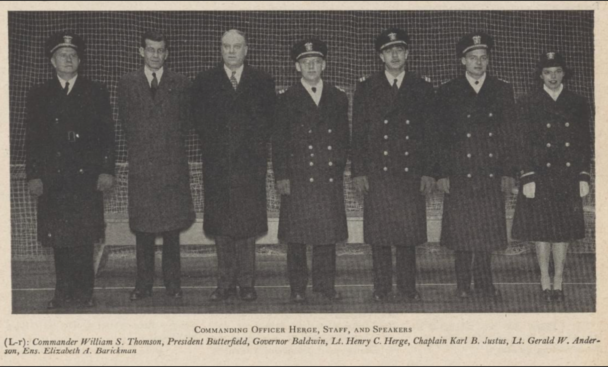
The title of the headlining article, “200 Couples To Attend Prom: Servicemen & Civilians Combine in Celebration,” stretched across the full width of the front page, its letters printed in a thick, black typeface. The unaccredited article anticipated the upcoming weekend prom: the first of the year. According to the piece, a “well-known Wesleyan quartet” known as the “Jibers” would dazzle the crowds at the Psi Upsilon House on Friday evening, although “almost all of the [fraternity] houses are having house dances or informal parties.” Students in the University’s V-12 Navy College Training Program had also “been granted liberty on Friday night until midnight in order that they can attend the parties.” On Saturday, the “Williams Pre-Flight Band” was to entertain the attendees of the formal dance in the Patricelli ’92 Theatre, known as the ’92 Theatre at the time of the article’s publication.
Excitingly, the stringent dormitory rules in place at the time of the Fall Prom—which restricted visitation permissions, imposed a curfew, and regulated similar matters—would be suspended for the entire weekend. Given the article’s first line called out the “over 200 girls descending upon the campus,” lifting the restrictions pertaining to female visitors was plausibly well-received by a number of students among the student body, which excluded women at the time of the article’s publication.
Other articles featured in the September 29 edition noted the war more directly, including an essay by Professor of Music Frederick William Sternfeld titled “Are We Incurable?” According to the Memorial Book for the Victims of National Socialism at the University of Vienna, Sternfeld adopted an anglicized version of his former name, Friedrich Wilhelm Sternfeld, when he emigrated to the United States in order to flee the intensifying Jewish persecution in his home country of Austria.
According to the Memorial Book, Sternfeld was officially “forced to abandon his studies and leave the University of Vienna for ‘racial’ reasons under National Socialism” on June 6, 1938. By 1940, Sternfeld had completed his education and began to teach at Wesleyan.
In his article analysing “the Nazi theory of the division of mankind into unequal races and nations,” Sternfeld maintained the importance of considering the American political situation.
“[T]he products of militaristic and totalitarian indoctrination may be difficult but not impossible to combat,” Sternfeld wrote. “The individual German is as incurable or curable as the individual American, and it is time we applied the principles underlying our criticism of the Nazi ideology…here at home.”
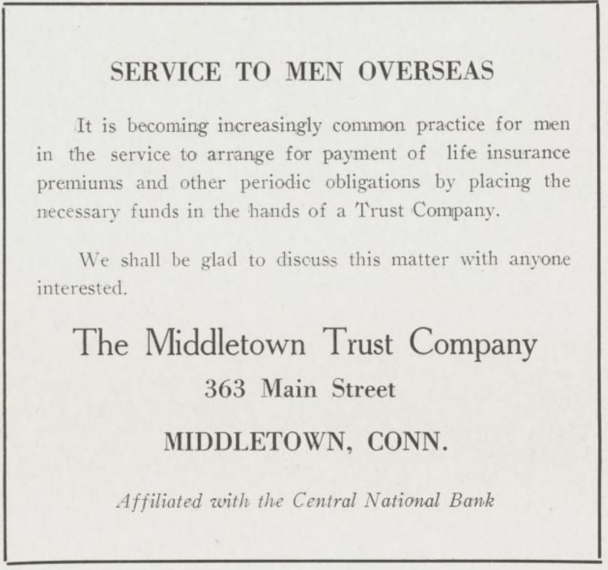
Advertisements in this edition of The Argus also reflected the war’s weight on the Middletown community, including one posted by The Middletown Trust Company, which stood on 363 Main Street in 1943.
“It is becoming increasingly common practice for men in the service to arrange for payment of life insurance premiums…by placing the necessary funds in the hands of a Trust Company,” the advertisement read. Ostensibly eager to service the families of enlistees entering the war, the company highlighted its “service to men overseas” at the very top of their advertisement, printed in bold, capital letters.
On another page from the same issue, a short notice addressed the University directly. Under the headline “Red Cross Calls For Donors,” the Red Cross explained its work collecting life-saving donations “for the armed services.” A Red Cross unit was to be in Middletown on Thursday, Oct. 7, occasioning the publication of their note in The Argus.
“If any Wesleyan students wish[ed] to aid in this worthy cause,” they were directed to call a phone number before their donation, and minors had to obtain written permission from their parents. This additional step for minors may appear irrelevant to students at the University; however, that the parental permission forms were “to be obtained at the Christian office”—the Wesleyan Christian Association’s on-campus headquarters—gestures at the rule’s potential relevance to underage students.
“If you have wondered what you can do for the war effort, here is your opportunity,” the final line of the posting read.
The Argus’ editors voiced their own concerns for the shape of higher education after the war in the same Sept. 29, 1943 issue. An editorial, aptly titled “Social Science,” defended the place of the social sciences in a liberal arts curriculum. According to the editors, this topic was one of the most popular causes for debate on college campuses. The editors described the social sciences as facing constant pressure from “die-hards” eager to minimize this field of study, if not to refuse to recognize it altogether.
For the editors, the global reordering that they predicted would follow the end of World War II provided the strongest evidence for the worth of the social sciences.
According to the editorial, many government figures believed the end of the war was “unquestionably going to father a new international system,” and that effective leaders would need to guide the inevitable social upheaval into “proper channels.” Social conditions, the editors wrote, resulted from interacting causes, and no event could be treated “simply as a repetition of past history.” Without the social sciences, they concluded, the University’s search for a “balanced and liberal curriculum” was impossible.
Hope Cognata can be reached at hcognata@wesleyan.edu.
“From the Argives” is a column that explores The Argus’ archives (Argives) and any interesting, topical, poignant, or comical stories that have been published in the past. Given The Argus’ long history on campus and the ever-shifting viewpoints of its student body, the material, subject matter, and perspectives expressed in the archived article may be insensitive or outdated and do not reflect the views of any current member of The Argus. If you have any questions about the original article or its publication, please contact Head Archivist Hope Cognata at hcognata@wesleyan.edu.



Leave a Reply