
Students Map Housing Accessibility Barriers in First Formal Residential Tour
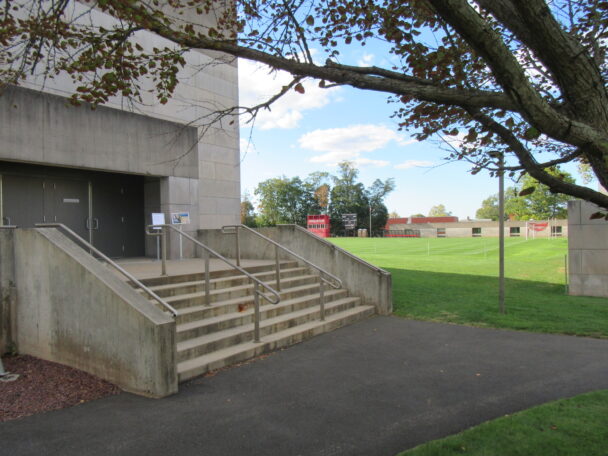
Roughly two dozen students fanned out across campus with clipboards, rulers, and levels to document every broken push button, missing handrail, and inaccessible bathroom stall they could find in the major student dormitories on the morning of Sunday, May 3. The accessibility tour, organized by student disability advocacy group WesAbilities and the Wesleyan Student Assembly Equity and Inclusion Committee, covered 11 residential buildings between 10 a.m. and 1:30 p.m.
When the two groups regathered that afternoon to review their data, one of their earliest realizations was that not a single automatic door push button had been functional across all the dormitories they surveyed. In a spreadsheet, students logged over 70 barriers to access (e.g., an entire bathroom has no handrails in the showers or stalls) during the tour: many of them in spaces the University already designates as accessible.
The Gap Between Stated Accessibility and Reality
The accessibility tour revealed a recurring disconnect between how the University discusses accessibility and the conditions students encounter. WesAbilities Primary Contact Emma Moyer ’28 noticed this firsthand at the entrance of first-year dorm Bennet Hall. As the University’s newest dorm, Bennet Hall has a reputation for its modern look, cleanliness, and accessibility features.
“I had an expectation about Bennet…and then I was really surprised that it didn’t have a push button at the entrance, especially because Bennet had a sticker on the door that [said] it had automatic door opening,” Moyer said.
This observation was followed by multiple more accessibility failings in residential areas. The problem, members found, was often not just that features were broken, but that incorporating accessibility measures appeared to have been considered and then abandoned halfway through. WesAbilities Event Coordinator Tess Soraire ’28 described one such example.
“If you’re having a ramp, that feels like an accessibility conscious decision, and then you put stairs [at the end of them],” Soraire said. “And I was like, okay, so we didn’t actually make an accessibility conscious decision.”
Soraire elaborated on how inaccurate labeling creates real consequences for disabled students trying to advocate for change.
“[A sign saying “accessible”] doesn’t actually mean anything,” Soraire said. “It’s just a sign. I think it can [erase] the struggle of a disabled student to label something incorrectly like that. It really shuts down any conversation about accessibility, because people that aren’t struggling with accessibility don’t realize that it’s not accessible.”
According to Nico Carrillo ’29, a senator on the Wesleyan Student Assembly Equity and Inclusion Committee, the committee designed the tour with WesAbilities to address the gap between institutional messaging and student experience.
“The decision to prioritize a campus accessibility tour this year was driven by consistent student feedback, which highlighted a gap between Wesleyan’s stated commitments to accessibility and students’ lived experiences on campus,” Carrillo wrote in an email to The Argus.
Carrillo personally designed the Accessibility Tour Guide that he handed out to students before the tour began. This guide explains a categorization system to track the urgency level of various accessibility barriers:
Small Fixes, Large Consequences
Students found that some of the most significant barriers came down to small, easily overlooked design choices. Carrillo pointed to a single step at the Butterfields’ entrances as an example of how minor details can have an outsized impact.
“Just because the building’s technically accessible, because there’s one entrance with a ramp, doesn’t mean that [it] shouldn’t be [accessible at] the rest of the entrances,” Carrillo said in an interview with The Argus. “The singular step on all the Butts’ doors—or most of them—may seem insignificant to some people, but it is so significant for others, and it’s such an easy fix.”
Members of WesAbilities also noted that accessibility improvements tend to benefit far more people than those they are designed for. WesAbilities member Avi Mohanan-Maselko ’29 observed this across campus.
“I’ve seen so many people carrying things coming out of WestCo [or] Usdan with a bunch of packages in their arms, and they hit the push button with their elbow or something, which is called the curb cut effect: when things that are made for disabled folks end up benefiting everyone,” Mohanan-Maselko said.
Along with campus navigation, the WesAbilities tour surfaced safety concerns inside campus bathrooms. As an ambulatory wheelchair user, Mohanan-Maselko said one absence stood out to them above the rest.
“I did not see a single pull-for-help cord in any of the showers,” Mohanan-Maselko said. “I’ve spent quite a bit of time in hospitals in my life, and in all of those, you have a pull-for-help cord by the toilet and pull-for-help cord by the shower…. I thought that was quite surprising, and concerning as well.”
Moyer drew a distinction between features that are broken and features that were never installed in the first place, a difference that shapes what students can realistically request from the University.
“Broken things can normally be fixed, whereas if it’s nonexistent, that’s an entirely different issue,” Moyer said. “Like, there were no grab bars in the…bathroom that I used last year, and they said, ‘we can’t install grab bars, but we can give you a shower seat.’”
Director of Construction Joseph Banks acknowledged that each accessibility fix ranges widely in complexity and cost, and that student feedback is essential to how his office prioritizes work.
“Sometimes addressing accessibility on a project is straightforward, like installing an automatic door opener, or making sure a microwave in a kitchenette meets reach range requirements,” Banks wrote in an email to The Argus. “Other times, barriers to access require a lot more thinking (and often budget) to achieve, such as accessing upper floors in a building with no elevator, or balancing ADA, plumbing code requirements, and historic considerations in one of our historic buildings.”
Infrastructural History
Banks described how older buildings were designed without disabled students in mind, often assuming that everyone would be able to use the stairs. Additionally, the physical layout of the University’s campus adds to the challenges inside individual buildings. Banks described how the hilly terrain of campus creates barriers that exist independent of any single structure.
“From the top of Foss Hill to the entrance to 45 Broad, where the Argus offices are, for instance, the elevation drops almost 100 feet, and some of that route is quite steep,” Banks wrote. “So in addition to buildings that may not have fully accessible features, there can be significant difficulty just navigating an intuitive pedestrian route from one place to another on campus.”
Newer projects are generally designed to be accessible from their conception, but much of the University’s building stock is old, which Banks says adds another layer of difficulty when it comes to retrofitting for accessibility.
“While new projects like the Frank Center [for Public Affairs], the Fries Arts Building, and the New Science Building are designed to be accessible from the start, many of our other buildings date from a time when accessibility was not as well understood, or well prioritized as it is now,” Banks wrote. “This can make renovations to these older structures more difficult and expensive.”
Housing Options
For disabled students, inaccessible buildings directly limit where students can live and, by extension, what they can participate in. Mohanan-Maselko described how the scope of that limitation became clear to him.
“I did not expect [accessibility concerns] to narrow [my housing options] down so much that there are only two buildings on campus that I can live in,” Mohanan-Maselko said. “This ends up meaning that I cannot live in any of the program houses…wood frame houses…[or] any of the affinity houses…. I don’t even get the chance to apply to anything like [a] program house or a Copenhagen in Butts, or any of these really cool opportunities that Wesleyan has.”
The housing system narrows options for students with a disability, but also for students with medical accommodations. Soraire described how the intersection of air conditioning needs and class-year housing assignments leaves these students with limited options.
“If you have an air conditioning accommodation and you have [a] central housing [accomodation], there’s no building [for you],” Soraire said. “The only building that they’re willing to put sophomores in that has air conditioning, with the exception of maybe three sophomores in Fauver…is Butts, and Butts is not central.”
A Cycle of Exclusion
Students described an unspoken dynamic in which disabled people are expected to be entirely thankful and accepting of accommodations that their non-disabled peers take for granted.
“There’s an expectation of disabled people to be grateful for things you wouldn’t ask an able-bodied person to be grateful for,” Soraire said. “I don’t think it’s crazy to ask for a bathroom on each floor that you can use…. We are asking for you to give us the same opportunities as everyone else.”
As an ambulatory wheelchair–using student, Mohanan-Maselko said requests for repairs can be misread as personal asks rather than systemic ones.
“I’m the only wheelchair-user student on campus,” Mohanan-Maselko said. “And so as part of that, when I complain about, ‘Hey, this wheelchair lift is broken’, what it looks like is I’m saying, ‘Hey, I need you to go buy this who-knows-how-expensive part just for me.’ What I’m actually saying is, ‘I need you to change this so that other people like me can come here too.’”
Mohanan-Maselko described a self-reinforcing cycle in which inaccessibility discourages disabled students from attending the University, which in turn reduces institutional pressure to improve accessibility.
“It’s the cycle of something’s not accessible, so disabled people don’t come, so there’s no need for it to be accessible because there’s no disabled people, so something never changes, so disabled people don’t come—and that ends up just going over and over and over itself. And that really sucks,” Mohanan-Maselko said.
Making the Invisible Visible
The accessibility tour was designed to produce something concrete: documented evidence that can be used both by students advocating for change and by administrators making decisions about where to invest.
Banks said that student-led efforts like the tour provide his office with visibility into campus conditions that staff don’t always have on their own.
“We gain a tremendous amount of understanding when we’re able to see the campus through the eyes and experiences of the students,” Banks wrote. “As staff, we aren’t always aware of the challenges that a building or a landscape might present for a student, so it’s incredibly important for us to get that feedback.”
Mohanan-Maselko described a moment during the tour when a slope that met ADA guidelines still felt dangerous to navigate.
“There was a part crossing Lawn Avenue where I almost skidded into the road…when we measured it, it was only a seven degrees slope, which is within the ADA guidelines, but it felt much steeper, and it felt much scarier,” Mohanan-Maselko said. “I’m almost tempted to go and buy a super cheap hospital-standard wheelchair and be like, ‘Okay, you try getting around this campus for a little bit. Actually feel the strain in your arms…. Actually feel what it’s like to try to open these incredibly heavy doors when you’re on wheels, moving back and forth.”
For Moyer, the tour represented a shift from personal advocacy to something broader, an effort on behalf of the entire campus community.
“I find it much easier to advocate for other people than I find to advocate for myself,” Moyer said. “And this isn’t something where I am advocating [solely] for myself. I’m advocating for everyone on campus, and especially disabled students on campus.”
Banks said that the most productive conversations happen when students and facilities staff can engage directly, with room for questions on both sides.
“I think it’s most effective when we can see and hear from students in a format where we can ask questions, and where we can translate some of our constraints (often budget, technical, or schedule related) in a way that doesn’t shut down discussion,” Banks wrote.
What Comes Next?
With the tour complete and findings documented, students and administrators described what genuine follow-through would require. Carrillo laid out what accountability should look like going forward.
“Meaningful accountability would involve transparent follow-up from the administration, including acknowledgment of the findings, a clear action plan, and regular progress updates,” Carrillo wrote. “It should also include designated points of contact responsible for implementing changes, along with opportunities for continued student input. Accountability should not end with the report.”
For WesAbilities, the tour is a beginning rather than an endpoint. Mohanan-Maselko said the group sees physical accessibility as the first phase of a longer effort.
“I do want to highlight that this is our starting point as WesAbilities,” Mohanan-Maselko said. “Part of the goal was to make campus accessible for everyone, so while right now we’re looking at physical accommodations and physical accessibility, I think this is probably going to be just the start.”
For WesAbilities, this tour is a starting point, rather than an endpoint, to making campus safe and accessible for all students.
Hope Cognata can be reached at hcognata@wesleyan.edu.
Leave a Reply