
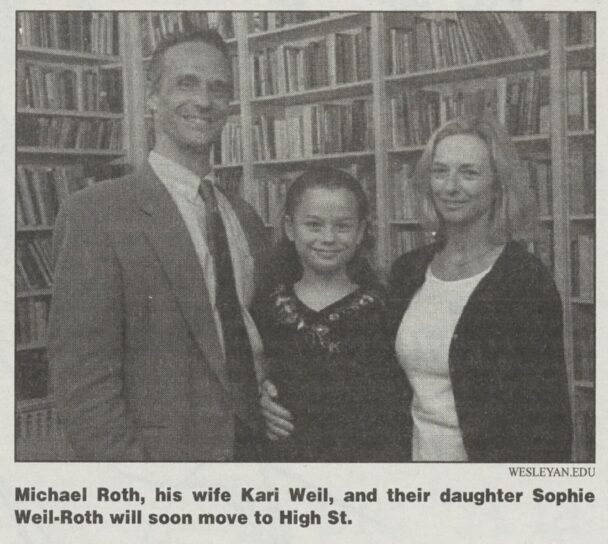
Roth in The Argives: Michael Roth ’78 Prior to Presidency
Wesleyan President Michael Roth ’78 has been named in no less than 229 editions of The Argus. Six of these editions, however, have nothing to do with his presidency. These early appearances trace Roth’s presence primarily in connection with student organizations, academic recognition and conversations around campus culture.
The Argus first mentioned Roth during his junior year in an April 29, 1977, article entitled “Center For The Humanities Announces 1978 Fellows.” According to the article, the Center selected Roth to serve as a Fellow during the Spring semester of 1978, “during which time the Center [would] conduct an interdisciplinary study of the nature and function of perception.” Roth would work alongside Wesleyan faculty from the College of Letters, Sociology, and Classics departments. The Center also appointed Senior Research Fellows from Cornell University and the State University of New York at Buffalo to aid in the project.
Exactly one week later, on May 6, 1977, Roth co-authored his first Argus article with 12 other members of the People’s Business Commission (PBC), entitled “PBC Report On The ‘Quality Of Life.’” American economic and social theorist Jeremy Rifkin founded the PBC in 1970, and The Argus first described its presence on campus on Nov. 9, 1976.
According to the Nov. 9 issue, Rifkin established the PBC—originally named the People’s Bicentennial Commission—to “[apply] the principles of our founding fathers to the contemporary corporate-run state…today in the government and the workplace.” The Argus described Rifkin’s belief that “the American Revolution was based…on economic issues and domination by powerful elites,” and that he established the PBC to carry out similar acts of resistance.
In the May 6, 1977 issue, those involved in the PBC at Wesleyan wrote to express concern about the institution’s hierarchical structure and its effects on student life. The group argued that this hierarchy not only organizes authority but also actively shapes student life by producing isolation rather than collective engagement.
“At Wesleyan, our lives are ordered in a hierarchical fashion, with power flowing from the top down,” the committee wrote. “At the top is the administration…. Next down the line is the faculty…. At the bottom of all this is the student body. We have token representation on faculty and trustee committees.”
From there, the committee discussed the effects of the administrative structure on student life.
“All this results in a narrow individualism,” they wrote. “Our community is but a semblance of a community, with weak internal or organic connections holding disparate parts together. We students must appeal to the hierarchy to make things happen. This dependency stifles spontaneity and reinforces our isolationist tendencies.”
They also focused on how this structure impacted everyday interactions on campus.
“At present, faculty alone determines policy, which students must accommodate,” the committee wrote. “We advocate committees with equal student-faculty representation to share in decision-making over hiring, curriculum, and the organization of academic life.”
The committee then laid out specific proposals for changing how decisions were made.
“Dorms are all too often places where we feel no sense of community,” they wrote. “We advocate turning the dorms over to the students in order to foster interaction and a feeling of responsibility for the places we live in.”
The authors extended the same logic to residential life, concluding the piece by framing these changes as something students ought to actively realize.
“It is of central importance that we the students know and feel that we are self-determining,” they wrote. “It’s time to stop grumbling about the problem. It’s time to start acting. If we want to create a new life for ourselves, it’s within our power to do so.”
Roth made his next Argus appearance on October 19, 1977, in an article entitled “Shanahan to Frats: ‘Don’t Drink or Curse’” by Peter Mazola ’81. In his piece, Mazola covered the University’s responses to Associate Dean of the College Ed Shanahan’s recent public statement against unruly student conduct during football games, specifically that of fraternity members.
“Soon rowdiness at football games may become a fad of the past,” Mazola wrote. “If Ed Shanahan … has his way, fraternities might soon find themselves cheering on their team with phrases like ‘Expletive Deleted, Expletive Deleted’ instead of ‘Bull–, Bull.’ The former may not be as catchy, but at least in Shanahan’s words, it will not be ‘offensive to the older generation.’”
According to Mazola, Shanahan called upon several fraternity presidents, including then-president of Psi Upsilon Dan Brugioni ’78, to discuss his concerns.
“Basically, what Shanahan said is to tone down the general behavior of people and have them channel their energies to more clean ways of having fun,” Brugioni said. “I don’t totally believe what he says…. Yelling and shouting create team spirit. Also, I don’t agree with keeping beer out of the stands. In the past we brought entire kegs into the stands. Now that isn’t allowed anymore. Next, they want to prohibit even the small amounts of beer that we manage to get into the stands. I think a little beer is good.”
As the president of the Wesleyan chapter of the Alpha Delta Phi Society (ADP) at the time of the article’s publication, Roth also met with Shanahan to speak about the issue.
“Shanahan says that someone in the administration complained to him about behavior at football games,” Mazola wrote. “He told this to Michael Roth ’78, president of Alpha Delta Phi. Roth said that he told Shanahan few members of his fraternity could have invoked the complaint since they are a literary society and few if any members ever attend football games.”
About a month later, on Nov. 15, 1977, Amy Zinsser ’80 published an article entitled “Diverse As Ever, But The Activism May Be Going Out,” which discussed concerns about the state of political activism at the University, especially in light of the freshman class of 1981. Zinsser spoke with Roth and other members of the senior class who had interviewed the incoming students to get their opinions.
“I think that many of the students are looking for something flexible enough to meet the needs of the individual within a liberal arts education,” Roth said of the incoming class.
Roth suggested that this emphasis on flexibility reflected a broader shift in how students approached college itself. That sense of integration, he added, was part of what was drawing applicants who had already moved beyond narrow academic specialization.
“Some students felt that, at Wesleyan, they would have a chance to integrate different fields that they studied separately in high school…. Wesleyan seems to be developing a reputation for integrated programs,” Roth said.
Alongside academics, Roth also noted a limited history of political engagement among the applicants he and others had interviewed.
“The students have had little experience in political activism. What experience they have had…centers around environmental issues such as nuclear energy,” Roth said.
Jodi Wilinsky Hill ’78, another senior tasked with interviewing the incoming freshmen, told Zissner that the new students’ political inexperience was one step in a longer trajectory of declining activism on campus.
“Senior interviewers said this year’s Wesleyan applicants are bright and ambitious, but are continuing a trend away from political activism. Political apathy…appears to have been increasing at Wesleyan since [Hill] was a freshman,” Zissner wrote.
Even so, the senior interviewers concluded that this shift did not necessarily signal disengagement, but rather a different kind of orientation toward the world.
“Still, according to the seniors, even if the applicants aren’t activists, they are aware of the world around them, of where they have been, and where they want to go,” Zissner wrote.
On May 5, 1978, The Argus printed a full-page report on students’ outstanding creative and academic achievements under the headline “Wesleyan Student Awards, 1977-78.” Roth received three academic honors: the Robins Prize, the Wise Prize, and induction into the Gamma chapter of Phi Beta Kappa (PBK).
According to the report, the Robins Prize was “established in 1969, in memory of George D. Robins [18]98, by Frank D. Robins ’34 and Douglas H. Robins ’66, for excellence in History.”
The Argus described the Wise Prize as “the gift of Daniel Wise…for excellence in the Department of Philosophy” and “the best essay on moral science or on some subject in the field of values.”
The University’s Academic Catalog describes PBK as the “oldest national scholastic honor society,” and states that PBK inductees must complete their General Education requirements, “have a grade point average of 92 or above to be considered for election in the spring,” and receive a nomination from their major departments. As a University major, Roth designed his own course of study, which he has called the “history of psychological theory.” The current Academic Catalog explains that “University majors can be nominated by their class dean” rather than by their major department. According to The Argus, Roth and 45 other students were elected into PBK during the 1978 spring semester.
On May 28, 1978, 23 days after The Argus published its student awards report, Roth received his degree at Wesleyan’s 146th commencement ceremony. It was 29 years before Roth officially became Wesleyan’s 16th President on July 1, 2007. Notably, Roth made one last appearance in The Argus before becoming president of Wesleyan.
On Oct. 10, 2000, The Argus published “Freud Lecturer Psychs Up Wesleyan Students,” an article by Lee Glasser ’03 that detailed Roth’s psychoanalytical presentation, which was given in conjunction with Wesleyan’s fall lecture series. At the time, Roth was the president of California College of Arts and Crafts.
“There are people in America who think the best thing to do about Freud is to stop talking about him,” Roth said in his lecture, challenging the assumption that Freud remains central to modern psychoanalytic thought.
In his talk, Roth presented traditional interpretations of Freud alongside contemporary, skeptic views.
The slides of his presentation were based on a Library of Congress exhibition he curated, originally designed so that “the top floor would represent the conscious and the bottom would represent the unconscious,” Roth said, though the plan had to be reworked when the building became unavailable.
To translate Freud’s often inaccessible writing for a public audience, Roth introduced a visual strategy he called “exploding text,” which “gives you a sense of the key ideas that Freud enunciated in his own voice,” according to Roth.
Roth also emphasized Freud’s continued presence in mass culture, Glasser noted, tracing references through television and film ranging “from ‘The Dick Van Dyke Show’ through ‘Peanuts,’ ‘Popeye,’ and ‘Murphy Brown,’” illustrating the extent to which psychoanalytic language had entered everyday media.
He then turned to what he described as the “post-Freudian” present, marked by a shift toward pharmacological models of mental health.
Elaborating on the concept, Roth said modern psychology is increasingly shaped by psychotropic drugs such as Prozac, in which “personal past is irrelevant, as psychological problems can be ultimately reduced to chemical imbalances and treated as such.”
Student responses to the lecture reflected a range of reactions to this novel framing of psychoanalysis. Rachel Kriger ’02 said she felt Freud’s method still had value.
“While sometimes I think it’s necessary, the drugs seem to be a bit over-prescribed,” she said. “A lot of the problems could be solved in different ways. Everyone should have a psychoanalyst in their back pocket.”
Others disagreed.
“I think all of this [psycho-analysis] is just BS garbage,” said another student, who withheld her name.
Roth’s first presidential Argus appearance came in the headline of the paper’s March 30, 2007 issue: “Presidential Pick: Michael Roth 78 to Replace Bennet in May,” an article by then-Editor-in-Chief Greg Dubinsky ’07. This edition included four other articles about the incoming president, each analyzing his appointment from a different angle.
In an open letter to the student body entitled “Letter for Presidential Search,” then Wesleyan Student Assembly (WSA) representatives Patrick Senat ’08 and Brittany Mitchell ’07 reflected on the “yearlong process headed by the Presidential Search Committee, comprised of students, faculty, and trustees” to select a presidential candidate, and expressed their optimistic view of Wesleyan’s future. Like Dubinsky, Senat and Mitchell positioned Roth as a potentially unifying figure, noted for his openness, communication style, and stated willingness to listen before making decisions.
In the same issue, articles such as “Wes Yet to Appoint Female or Person of Color to Presidency” and “Our New Prez!” by Jessie Schiewe ’10 and Matthew Danzig ’09, respectively, questioned what Roth’s selection signaled about diversity and institutional change.
“Hey look, the new president is another old white Academy insider, what a surprise,” Danzig wrote. “And oh look, a long catalogue of dry sounding academic achievements. Actually, this one’s fine. At least he went to Wesleyan in the 70’s when it was a pretty cool place, not in the 60’s when it was still old-boy, old-money, frats-and-football…. And he’s from Brooklyn, his parents didn’t go to college, and he went to public high school, indicating that he’s not insanely loaded like the trustees. We’re taking baby steps in the right direction here.”
Hope Cognata can be reached at hcognata@wesleyan.edu.
“From the Argives” is a column that explores The Argus’ archives (Argives) and any interesting, topical, poignant, or comical stories that have been published in the past. Given The Argus’ long history on campus and the ever-shifting viewpoints of its student body, the material, subject matter, and perspectives expressed in the archived article may be insensitive or outdated, and do not reflect the views of any current member of The Argus. If you have any questions about the original article or its publication, please contact Archivists Hope Cognata at hcognata@wesleyan.edu and Lara Anlar at lanlar@wesleyan.edu.


Interesting to see how Michael Roth’s journey shaped his presidency. What was the most surprising part about his time before leading the university?