
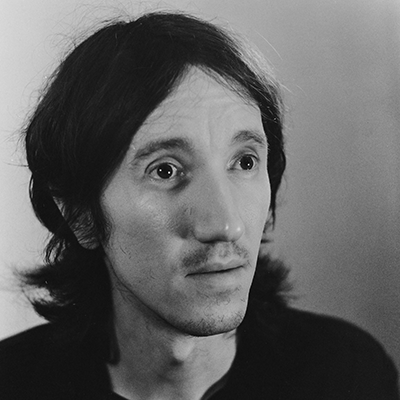
Office Hours: James Praznik on Creating with NASA and Surrealist Music Ensemble No Exit
One day, outside a door in the Center for the Arts (CFA), I heard a beautiful symphony on the grand piano. This was the office of Assistant Professor of the Practice in Music and Technical Director, James Praznik. Praznik has a long history in the world of musical composition, audio design, and filmmaking, and also serves as faculty advisor for Noisy Visuals, Sound Co-op, and other creative clubs. This week, The Argus sat down with Praznik to discuss the many hats he wears on campus, “not being naturally good” at piano, collaboration with NASA, and his Cleveland-based surrealist ensemble, No Exit.
The Argus: What piece were you playing when I walked in?
James Praznik: That was the third movement of Camille Saint-Saëns’ Fifth Piano Concerto, which is a piece that kicks my butt quite a bit. When I get nervous about doing an interview like this, I’m like, “I’m gonna play something that I have to just go all out.”
A: What draws you to the piano?
JP: I tend to spend my time working endlessly on things I’m not very good at naturally, like piano, for example. I’m not naturally good at it. I have to work super hard to do the most basic stuff. But it constantly keeps me reevaluating myself. If you’re not a prodigy, it demands constant reinforcement of, “No, do it like this; make sure to have that finger weighted like that.” I absolutely love the time you have to take to focus on things that you’re not super good at. It helps round out your thinking to not take the easy path. Even if you’re not naturally talented at something, there is value in the work. And it’s not a fruitless endeavor, because at the end of the day, people take me seriously as a musician.
A: Could you characterize the University’s music department in a few words, for someone who doesn’t know much about it?
JP: I would say the culture around the music department is that students here are interested in everything. I have advised projects across all realms. People have written musicals. People have made video games. People have made math-learning tools through music. Students in the arts, especially, want to cross collaborate all the time. I get to know all sorts of film and art students, and now, for example, I have a starring role in one of these thesis films coming up in two weeks.
A: What classes are you teaching currently and next semester?
JP: I’m teaching the class “Music, Recording, and Sound Design” (MUSC223), where students are basically learning how to work in a recording studio, and the other half is…making big creative projects using digital workstations. When the music department discovered that I was a gigantic video game nerd, and that I have development experience …they were like, “Hey, would you want to teach a course on this?” So in the Fall, I’m teaching my “Video Game Audio Design” (DDC230) course. It’s mostly geared towards learning how to design interactive music and sound.
A: Has teaching and working with students changed the way that you approach your own creative projects?
JP: A lot of the way it affects me is that I get thrown into situations where I have to explore new parts of myself to be the most effective collaborator. I have so many students being like, “Oh, can you play on this track?” and it demands a very specific kind of sound. Being here, I have to interface so much more with pop music, and I was always a contemporary avant-garde music person. For Noisy Visuals, they asked me to be like a central part of the puppet show in December, where I had to play this phony magician called Oswaldo Fabuloso. I was not a part of that world before I did it. A lot of my advisees are like, “James, this is our project,” and I benefit just as much as the students do. There was a graduate recital where I collaborated with one of the graduate students last year, and one of the techniques that we used, I actually used in a piece of mine a few months ago. Every time you do something, you take a little bit of it with you.
A: What have you taken into your teaching from your experience designing audio for performances?
JP: At the end of my second year of my Ph.D., a concert producer told me, “James, we have this broken piece of equipment. I don’t know what to do. Can you help?” I fixed it, and the person who ran concert production at the time offered me a job. Because they didn’t have a recording studio at Brandeis, I ended up building out the concert production technology side there on my own. I put together a studio, put together all the microphones, did everything like that, and ended up doing that work throughout my Ph.D. and dissertation. It was this very grassroots experience to have that hands-on knowledge of figuring all of it out on my own. I had to basically learn how to wear every single hat there is. Because I would be the recording engineer, I’d be the editor, I would be the conductor for the sessions, and I would play. And it was a fascinating experience to see these situations from every single angle.
Now at Wesleyan, I can still teach people the sort of nuts and bolts of techniques I developed to record specific instruments. The best and worst part about teaching a recording class here is that, really, the answer to everything is that there is no answer. Every great recording engineer has to come up with their own way of doing things that is a lot of trial and error, but there’s no right way. So it’s kind of fun to teach the students to just figure out something that works for you.
A: You’ve been running a music ensemble in Cleveland, Ohio, called No Exit for over 15 years. How did that start?
JP: It started because a friend of mine had this idea that he wanted to make a group that would support the work of early-career artists. It’s been a remarkably fulfilling experience. Over those 15 years, we’ve played 450 or so new pieces. It’s nice to support people by giving them money to make their art, but also to actually bring something to the community. He and I have continued to grind away, even when it gets rough, and put the work in to keep expanding. I get to do a lot of very weird projects.
A: What is a “weird” project you did with No Exit that has stuck with you?
JP: A couple of years ago we commissioned two artists, Kristen Newell and Leila Corey, to make a surrealist dreamscape scene that is like a whole gallery. Instead of just playing in a concert hall, we commissioned art exhibits and played within each one. For one of them, Newell and Corey wanted to take a bunch of plaster cast molds of people to put around. Well, the only person who sat down with them and did it was me. So it turned out to be 50 different sculptures of me around this entire beach scene. It was very weird and very disorienting, especially to go to the gallery opening and have people realize it was all me. That’s the fun part about having a grassroots organization: There’s no shortage of weird art projects to be a part of.
A: So No Exit is a music ensemble, but do you also incorporate visual elements like film?
JP: Certainly. When I started this job, we did a surrealist periodical, and the back of the program included poems that we wrote and art pieces. Just recently, we did a show at the Cleveland Museum of Art, and we had things inspired by paintings of people from the Cleveland School. We showed some short movies. Artistic thought is not as exclusive as a lot of academic disciplines want you to believe. There’s a lot of people who would tell you, “If you’re composing music, you shouldn’t be making a sculpture,” or, “If you’re a filmmaker, then you shouldn’t be writing the music for it.” When I was in my Ph.D., I was told, “You’re just a composer. Do not make movies, do not write poetry.” One of the reasons why I love Wesleyan and No Exit so deeply is because there’s none of that spirit.
A: How did you end up collaborating with NASA?
JP: I was in a piano and saxophone duo called Duo Approximate, where we would do film score soundtracks. The duo was with Garrett Cameron, a wonderful person. I ended up collaborating with NASA because the first soundtrack we got together was “The Cabinet of Dr. Caligari.” From that performance, I got contacted by the director of this huge arts festival that was based out of Cleveland, which NASA was a partner for. He said, “James, I’d like to work with you and your saxophonist on a project.” It was all these engineers from NASA who ended up making a film called “The Ascent,” which was sort of an amalgamation of launch videos they had in their archives to make into a full-length film of spaceships taking off. I spent the next couple of months of my life figuring out the flow of this soundtrack. No one from the festival heard what we were doing until we played an excerpt at the PBS show “Applause.” The host of the show said, “John Coltrane lives,” which I guess was a very big compliment, but they were like, “Dude, we were expecting something much more meditative.” I’m like, “Have you heard my work?”
A: What kinds of work were you in charge of as the pianist for a NASA festival?
JP: This was a music arts festival, but they held it in these decommissioned subway tunnels in Cleveland. They ended up renting a concert grand piano to wheel into these tunnels, and then we had a movie screen. Basically, it was just a crowd of people gathered around, and we did our show. I just played.
A: As a music technician, is there a technical skill that you believe every modern musician should have?
JP: I’m a firm believer that everyone should know at the very least the basics of how to record yourself and how to get sound into a computer, even if it’s just using your laptop microphones. Number two is being able to notate your own music on the computer. I encourage every student or anyone to learn those basic skills, because those things will serve you very, very well. It’s just like learning how to type, but for musical equipment.
A: Do you think growing up in Cleveland, Ohio, has influenced you as a musician?
JP: Oh, absolutely. The Rock & Roll Hall of Fame in Cleveland is just the tip of the iceberg of its strong music scene. Cleveland has one of the most remarkable underground music scenes from the ’40s, until the ’90s-ish, when it was all about the suburban flight. Especially in the ’80s, so many of the great punk bands of the time were all from Northeast Ohio. My Cleveland artist friends and I are always like, “What is it about these bleak, Rust Belt areas that breeds this type of art?” We’ve come to the conclusion that arts in those areas is so palpable because you are surrounded by culture, but most of the time you are left alone seeing all these blue-collar jobs, especially if you have a creative inkling to do your own thing…. In the good old Midwest, you’re left alone with your thoughts for too long. There’s a different type of creativity that sparks from that.
This interview has been edited for length and clarity.
Claire Farina can be reached at cfarina@wesleyan.edu.

Leave a Reply