
Behind the Scenes with the Wesleyan ICE Out Coalition
“No fear. No hate. No ICE in our state!”
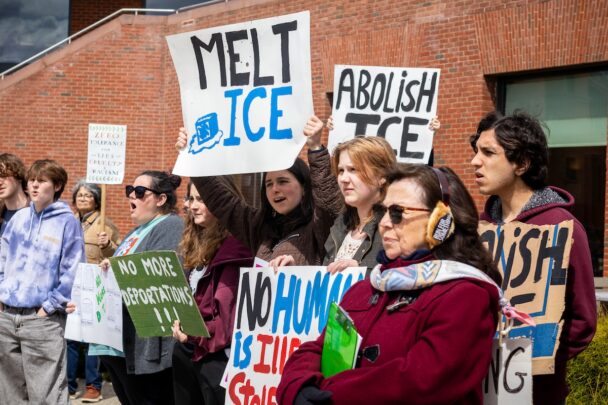
This chant most recently rang loud and clear outside of Usdan University Center on Monday, April 6, as a group of passionate students led a crowd of protesters in solidarity against Immigration and Customs Enforcement (ICE)’s recent deportations in Middletown. One of many demonstrations that have taken place this semester, this rally was in support of the two detainees: Keyla Vazquez-Zuniga, a Southern Connecticut State University nursing student, and a male Middletown resident. This team of activists has engaged the student body in demonstrations against ICE, which typically feature local political organizers, powerful personal narratives, and chanting “ICE OUT” as loud as possible.
But who are these student leaders, and which of the University’s many political activism groups do they belong to?
Wesleyan ICE Out Coalition is not one club, but a larger organization composed of student groups with similar political aims working to keep ICE off of the University’s campus.
The ICE Out Coalition is composed of a variety of smaller, specialized organizations, including Wesleyan Democrats (WesDems), Wesleyan Young Socialists, Sunrise Movement Wesleyan, Wesleyan American Civil Liberties Union (ACLU), Wesleyan Refugee Project, and the United Student Labor Action Coalition (USLAC).
WesDem and ACLU officer Brendan Barry ’28 noted that the coalition was developed at the beginning of the Spring semester out of an urgent need for student action against ICE.
“We have a very large immigrant population here in Middletown, and we have many students on campus who are at increased risk from being targeted by immigration authorities,” Barry said. “We do feel a moral imperative to protect the members of our community who are most vulnerable at this time and serve them in whatever small way we are able to here as students.”
According to Barry, the coalition’s first meetings served as a space for open communication about individual club efforts and perspectives. Eventually, coalition representatives came to the conclusion that their advocacy efforts could be enhanced through a collaborative project.
Sasha Lovell ’28, a representative from Sunrise Movement Wesleyan, echoed Barry’s ideas about the need for collaboration. She added that forming the coalition helped solve a key problem of redundancies in political club events and projects.
“We have all these groups that have been working on very similar things, like anti-authoritarianism and anti–illegal ICE overreach,” Lovell said. “WesDems had a town hall event about what to do in the face of authoritarianism, and no one in Sunrise knew. And so we had a similar town hall event one or two weeks later.”
According to Lovell, the coalition has allowed student activists to facilitate communication and collaboration on causes they are passionate about.
“I think this coalition still has more to go, but we really have been increasing communication and integrating different perspectives and skills, and I have to say, we have been pretty successful,” Lovell said. “Because of how centrally focused the coalition’s organizing group is, we haven’t run into a lot of ideological things that are tearing us apart.”
Much of this effective internal collaboration can be attributed to the coalition’s emphasis on what Barry calls “horizontal leadership,” a system that lacks formal club officers.
“It was important to us that no club’s interests are placed higher than others,” Barry said. “I think a really integral part of creating such an ideologically diverse coalition is ensuring that everyone’s voices are heard, respected, and integrated deeply into the decision-making process.”
Within the coalition, participating clubs can delegate representatives to communicate their group’s particular interests during larger coalition events. Club representatives may also take on specific initiatives that align with the club’s goals or their individual skill sets.
“Another really great facet of the coalition is that each group takes on a specific area of specialty,” said Barry. “The Wesleyan ACLU specializes in using our connections with the state and national chapters of the ACLU to advance immigration education and immigration law education. The Wesleyan Democrats have extraordinary connections in local government and politics and have been able to help facilitate connections to some very important political figures on the local and statewide level.”
Sunrise Movement Wesleyan also has a unique role within the coalition, namely addressing concerns related to the national Sunrise Movement’s focus on climate change and anti-authoritarianism.
Furthermore, Helen Xie ’27, the financial manager for the Wesleyan Refugee Project and a representative for the club within the coalition, has also become its fundraising manager.
“Basically, I coordinate all the fundraisers that we do and manage the budget,” Xie said. “The most recent event that we’ve done was a fundraiser in collaboration with Prometheus, the fire-throwing group on campus, to do a fundraiser for MIRA [Middlesex Immigrant Rights Association]. We raised a bit more than $400 for MIRA through the fundraiser.”
Events such as the Prometheus Fine Arts collaboration have allowed the coalition to weave its fundraising efforts into club events across campus.
“Even events which do not on their surface have connections with immigration have been able to serve immigration-related causes,” Barry said. “We’ve worked closely with the organizers of Prometheus and Folk Night, for example, to integrate fundraising opportunities into their existing events. They’ve been extraordinary partners in raising tremendous amounts of money for really important causes.”
In addition to their campus events, the coalition has worked on a variety of projects to uphold their partnerships with outside organizations such as MIRA and Integrated Refugee & Immigration Services (IRIS) through external fundraising and educational initiatives. According to Barry, supporting existing anti-ICE campaigns within the Middletown community, such as MIRA and IRIS, has been an effective strategy.
“We’ve knocked on hundreds of doors in the Middletown community, providing resources and information,” Barry said. “If you want to count the year-long contributions of all of the constituent members, even before the coalition was officially announced, we have raised over $2,000 for immigrant-related causes, including IRIS as well as MIRA.”
Barry added that the coalition’s partnership with local organizations is especially crucial, as it has allowed for increased communication between the University and the local immigrant community.
“[Working with MIRA] is improving our resilience to deal with ICE, should they come back to the Middletown community, and it’s also expanding our connections to share information about detentions when they do happen,” Barry said. “That was indispensable two weeks ago on Tuesday, [April 7,] when two people were abducted from Middletown. We were able to collect information very rapidly from different sources here on campus and share that with our local partner groups. That way, the information was able to travel faster than otherwise would have, and clarity was given to the immigrant community.”
Further, according to Lovell, the coalition has been focusing on educational training events, which aim to teach the community how to better support their immigrant neighbors in the face of ICE’s presence in Middletown.
“We had our ICE bystander training, which was pretty successful, as well as our court accompaniment training,” Lovell said. “These are kind of like the skills that we want to keep teaching more people how to use…. We’ve been trying to get the word out about that in a way that’s responsible and motivates action instead of fear.”
Still, the ICE Out Coalition is relatively new on campus, and hopes to continue building its current community engagement and fundraising efforts, as well as expanding to focus on new initiatives tied to Middletown’s immigrant community.
“A goal of MIRA and ICE Out is to really get more in contact with immigrants in Connecticut, which is challenging because a lot of this information is sensitive,” Xie said. “We don’t want to make people uncomfortable, but also, we can’t really give people resources if we don’t know who needs them. Being more in touch with the community and getting people more comfortable with reaching out for court accompaniment, grocery needs, or rent needs, is something that we should work on.”
The coalition also hopes to enact increased protections for individuals on the University’s campus who are at risk of being targeted by ICE agents.
“Our goal is to get more people on campus feeling like they know what to do in the case of ICE activity,” Lovell said. “That means building even stronger connections with groups like IRIS and MIRA. We’re going to do another canvas session later this year, and we’re even thinking about ways for [the University’s] campus itself to defend itself against illegal ICE activity.”
Barry added that students vulnerable to ICE’s potential presence on campus believe that a policy similar to the Connecticut Trust Act, which bars Connecticut law enforcement from working explicitly with ICE officers, should be enacted at the University with regard to Public Safety officers and other members of administration.
“The University has exhibited trepidation about adopting these sorts of policies, no doubt because they are unnerved at the possibility of being targeted by the Trump administration as a repercussion for this stand,” Barry said. “But frankly, there’s no better time to make it than now. There are so many people…terrified of the threat that ICE poses. The University should be deeply supportive of those members of our community in these very difficult times, and they cannot express that support if they are not also committed to refusing any collaboration with ICE.”
Ultimately, members of the coalition believe their ambitious agenda could not have been accomplished if not for their founding principle: collaboration, both between coalition representatives and the larger University community.
“I think part of the reason that ICE Out works is that everyone around feels the sort of urgency, I don’t know that we feel the same urgency about other issues,” Xie said. “It’s not even just clubs coming together. It’s also people who are not associated with these clubs, independent people who think ‘wait, I’m passionate about this. I want to be able to organize and mobilize around this.’ It’s amazing that people feel that way and that students are working to do something that is actively helping the campus.”
Leah Ziskin can be reached at lziskin@wesleyan.edu.





Leave a Reply