
Archaeology Faculty Talks the Past and Future of the University’s Osteology Collection
A surprising number of students entering the Science Library in Exley probably don’t notice the remarkable collection of natural history artifacts displayed at the entrance, including “Wisdom Teeth” curated by Fletcher Levy ’23.
However, for the Chair of the Archaeology Department, Dr. Katherine Brunson, this sprawling collection of natural history artifacts is a point of fascination and pride. Brunson’s particular interest is in osteology, the scientific study of bones, and she manages the University’s expansive repository of bone specimens, only a small portion of which is featured in the Science Library.
In an interview with The Argus, Brunson discussed the history of the vertebrate osteology collection, including over one hundred genera of animals with backbones, and its current state at the University.
“There used to be a museum on campus for both natural history and cultural objects,” Brunson said. “It was in use in the late 1800s through 1957, when it shut down. At that time, all of the collections were sent to different places on campus or were put in storage.”
The Wesleyan Museum of Natural History, first opened in 1871, was previously located in Judd Hall. Particularly between 1870 and 1900, the University collected both natural history specimens and cultural objects to represent the rigor and scope of the natural science curricula. When the Museum of Natural History closed to make room for more research labs, these collections became dispersed. Today, the vertebrate osteology collection previously featured in the museum is primarily housed in the Environmental Archaeology Lab.
Brunson also discussed the University’s continuous efforts to conserve and properly catalog the former museum items.
“I have students in my lab who … have been working to try and figure out what we have in the [osteology] collections, make sure that they’re properly cataloged in our system—[which is] called Specify—do some basic conservation and re-housing, and then do research on their history…” Brunson said. “The students in my lab are working on updating our database of the vertebrate osteology collections to make it more user-friendly so that others in the Wesleyan community will be able to know what types of animals are in the collections.”
Brunson added that there were significant challenges in tracking down the items in the osteology collections.
“It’s important to say it’s [cataloging is] an ongoing process: we’re always trying to work on these collections,” Brunson said. “Many of them are fragmentary because of their history. Some of them date to the 1800s; others are more recent acquisitions from biology faculty who purchased comparative collections for teaching. We don’t have a lot of information on most of them, so what students are doing is going back through the old museum archives, trying to figure out when certain objects were accessioned into the museum collections. What was their history…. We also want to preserve them for the future.”
The collections also encompass replicas of bones made by students.
“A lot of [the bones in the osteology collections] are real,” Brunson said. “And then there are also plastic replicas that we’ve bought over the years. Another thing we’re doing is 3-D scanning a lot of the collections so that we can then have digital versions that students and faculty can access remotely or 3-D print.”
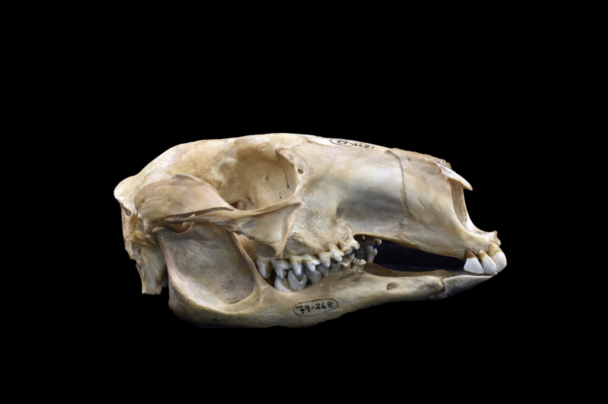
These replicas allow for both the conservation and reconstruction of skeletons. Brunson discussed a student project that exemplified the utility of replicas, aiming to 3-D print a missing opossum skull.
“Andy Tan [‘21] and Yu Kai Tan [‘20] were working with these collections,” Brunson said. “They noticed that this complete opossum skeleton does not have a skull…. The skull is a 3-D model they found online and printed in the IDEAS [Integrated Design, Engineering, Arts, and Society] Lab. And so they created this Frankenstein version of an opossum with the original postcranial skeleton and a replica skull so that we then have a complete skeleton for reference.”
The osteology collections have been put to use in classrooms and public outreach campaigns. Brunson particularly involves these items in lessons in her “Animals in Archaeology” course (ARCP350), a hands-on class teaching students how to identify animal bones.
“When you have a small bone fragment from an archaeological context, you need a complete reference collection so that you can say, ‘okay, which part of the body is it? Oh, is it a humerus or a femur?’ And then you can say, ‘Oh, does it look more like a pig or more like a sheep, or more like a cow?’ And you can identify the ancient bones that way,” Brunson said.
The osteology collection was recently used in the University’s Science Saturday program, a biannual scientific outreach program for kids in grades K–5.
“Some of the students who were involved in [Science Saturday] asked to borrow some of the animal skulls so that they could teach about animal diets and how teeth reflect diets,” Brunson said. “They also borrowed my collection of replica animal poop, which is always fun for kids. Thinking about how these collections can be used to teach about anatomy, teach about species diversity, and teach about animal bodies is really interesting.”
Archaeology Collections Manager Dr. Wendi Field Murray adds that students don’t need a purely academic reason to visit the collections; rather, they are an open resource.
“Spending time with these objects for your own enrichment is a perfectly valid reason to come visit,” Murray said. “I think a lot of students are hesitant to do that because they think they need an academic reason or a concrete project in mind. But you don’t! We are working this year on getting more of the collections into a browsable format so students and faculty can search them, so I am hoping that will add another dimension to the collections’ accessibility as well.”
Brunson hopes to continue expanding the reach of these collections so more students can use them in interdisciplinary ways.
“I think there are lots of opportunities for courses across all disciplines, not just the natural science courses, to make use of these objects,” Brunson said. “Wesleyan’s unique collections are a real resource for Wesleyan and our students.”
Remi Peltzman can be reached at rpeltzman@wesleyan.edu.
Leave a Reply