
Panel Examines Hungarian Parliamentary Election Upset: Magyar’s Win & Orbán’s Defeat
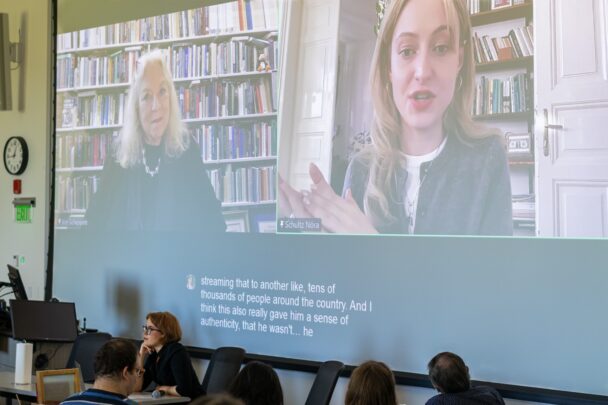
Over 50 students and faculty members gathered in the Frank Center for Public Affairs for a panel discussing the recent Hungarian elections on Monday, April 27. The panelists, who appeared via Zoom, answered questions from the audience and offered their insights on the success of Péter Magyar’s campaign and their takes on the fall of Viktor Orbán’s 16-year reign as prime minister.
Sponsored by the Adelphic Educational Fund and the Government Department, and organized by Cecilia Földessy-Stiegemeier ’26, the event was moderated by Colin and Nancy Campbell Professor in Global Issues and Democratic Thought and Russian, Eastern European, and Eurasian Studies Peter Rutland.
Two types of Hungarian treats were provided at the event by Ajna Kertesz, Visiting Professor of Psychology: Gerbeaud cake—a layered cake of chocolate, apricot jam, and walnuts—and pogača, a cheese scone.
Földessy-Stiegemeier reflected on the organization of this event, which was personal to her as a Hungarian raised under the reign of Orbán.
“It’s a passion project of mine,” Földessy-Stiegemeier said. “I’m very glad that [the panelists] both said yes, and I thought that their chemistry worked really well together. I thought it was also so cool to see those different perspectives…with two people who had a lot of embodied knowledge. I think diversifying the conversations that we’re having will add to and enrich everyone’s understanding of the topics that they’re studying. I was really glad to be able to give a glimpse of [Hungarian politics] to other people.”
The two panelists were Nora Schultz, a political analyst based in Budapest, Hungary, and Kim Lane Scheppele, the Laurance S. Rockefeller Professor of Sociology and International Affairs at Princeton University.
Elections were held on Sunday, April 12 to elect the 199 members of the Hungarian parliament. The elections saw the highest voter turnout since 1990, when Hungary became a democracy from a socialist state under Soviet influence. Magyar and his centrist Tisza Party, the primary opposition to Orbán’s far-right Fidesz Party, won the election in a landslide with a supermajority of 141 seats. Orbán conceded defeat the same day.
The talk examined the barriers to political opposition imposed by the Orbán administration and how Magyar achieved mass mobilization despite these odds. Panelists noted how Orbán manipulated Hungary’s democracy to challenge any political opponents who sought to gain influence within parliament with different tactics such as using spies to track Magyar and severe gerrymandering. To overcome these hurdles, Magyar’s campaign primarily targeted younger voters, a traditionally politically disillusioned demographic, and leaned heavily on social media platforms.
“Péter Magyar was very clear from the beginning that Orbán could be defeated,” Schultz said. “The communication style of the campaign was very innovative. Magyar was live streaming for 8 to 10 hours a day at some points in the campaign. He was not just talking to voters outside of Budapest in those rallies and marches that he did, but he was always streaming to tens of thousands of people around the country. I think this also really gave him a sense of authenticity.”

Schultz and Scheppele also emphasized the importance of humor in Magyar’s campaign. Citing memes and self-deprecating parody videos produced by Magyar’s social media team, the panelists emphasized the campaign’s ability to take criticisms from Orbán and to turn it into comedic appeal.
“There was this moment when somebody distributed to the state media a still photograph of a bed taken from a camera [in] the ceiling with messed up sheets,” Scheppele said. “So first of all, [Magyar] came out, and he said, ‘I am a 45-year-old healthy man. I have sex with consenting women.’ Then what happened was that young people involved in this campaign gave it energy, imagination, and creativity. All of these young Hungarians who were really adept at [technology] started making fake AI videos with [figures like Trump and Putin] in that room.”
The panelists concluded the talk on an optimistic note, highlighting the joy of Magyar’s campaign and the Hungarian public throughout the election process. Scheppele described the electric feel of the night of the election, with many taking to the streets in Budapest to celebrate the occasion.
“I’m so glad you’re laughing because the whole campaign was joy,” Scheppele said. “It was, ‘Do not be afraid. We are in this together.’ There was a lot of dancing. There was a lot of fun the night of the election. It actually matters to have fun in an election campaign. Joy actually wins.”
Akari Ikeda can be reached at aikeda@wesleyan.edu.




Leave a Reply