
Landscape Architect Kate Orff Takes Us to Petrochemical America and Beyond in Lecture
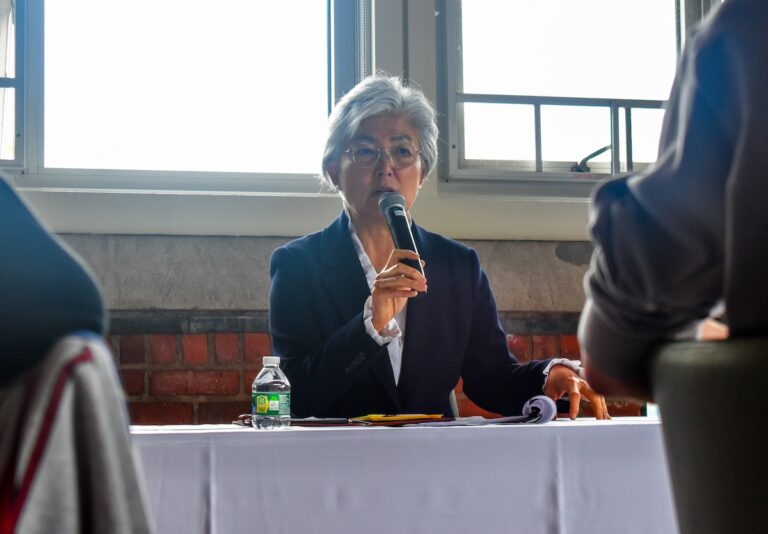
Over three dozen students and faculty gathered for a lecture entitled “Petrochemicals America and Beyond” in the Frank Center for Public Affairs on Wednesday, April 15. The event was sponsored by the Bailey College of the Environment and the College of Science and Technology Studies. The lecture featured Kate Orff, founder of New York-based landscape architecture firm SCAPE, and professor and director of the Urban Design Program at Columbia University’s Graduate School of Architecture, Planning, and Preservation.
Orff attended the University of Virginia to obtain her undergraduate degree in Political and Social Thought and wrote her thesis on ecofeminism. She then attended the Graduate School of Design at Harvard University for her master’s degree in Landscape Architecture. Orff is the first landscape architect to be honored with the MacArthur Fellowship. SCAPE, her company, has also been awarded the prestigious Landscape Architecture Firm Award from the American Society of Landscape Architects.
Orff began the lecture with a brief introduction of her academic background and career before introducing the challenges of matching the scale of her architectural work to the current climate change crisis.
“There’s the sixth extinction, or biodiversity crisis, for North America,” Orff said. “So, unfortunately, these are the headlines that you all see every day that you are living in. There are so many disconnects, but [one] massive disconnect is that the landscapes that you need to be thinking about and the scale [of work] needed doesn’t really match the moment.”
Orff also explained the motivation behind one of her most famous projects, Oyster-tecture. Describing her love for Jamaica Bay in New York, which has been affected by issues such as dead biomass accumulation and rising sea levels, Orff shared that she began thinking about how she could integrate it into the New York landscape. Taking inspiration from the life cycle of an oyster, Orff designed an integrative housing project where residents could farm oysters in their backyards, which would also protect Jamaica Bay from further erosion.
“Oyster-tecture is a much bigger vision about how to positively live in the world and think about urban nature and the climate-adapted world alongside other species,” Orff said. “The oyster is an inspirational figure, or animal element, to help build out a new society. So this [project was originally] a 16-foot-long drawing which described how the life cycle of the oyster itself could be grafted onto an urban landscape and help regenerate our harbor […] and defragment us in our communities.”
Orff also introduced another project, Living Breakwaters, which followed Hurricane Sandy in 2012 and integrates oysters into functional architecture. Using a chain of breakwaters that would serve as habitats for oysters, Orff’s project included an educational curriculum to help communities prevent further damage from extreme climatic events. Emphasizing that declining biodiversity has made watershed areas along the East Coast more vulnerable to flood damage and erosion, she spoke about the importance of education in cultivating the next generation of environmentally minded individuals.
“Superstorm Sandy is a touch point for much of this work, because it really galvanized our entire region to really wake up and pay attention to what is happening,” Orff said. “We developed a curriculum with the Building Oyster Project. What’s really hard is to find that regenerative way of tying things back together. So by making this school curriculum and engaging this next generation, it feels like you’re developing this future mindset, because these are future stewards of this structure.”
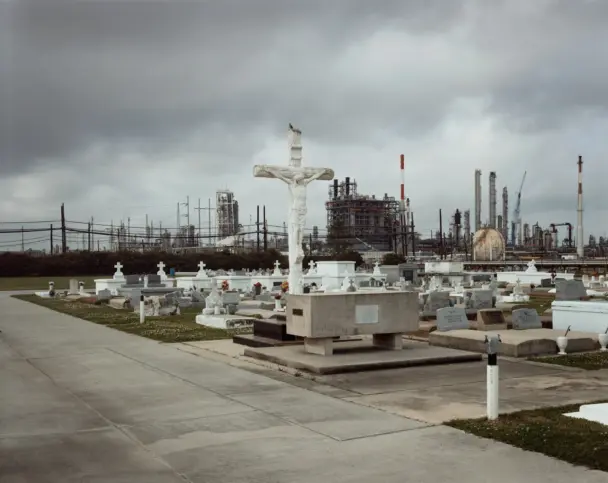
Orff then spoke about her 2012 book, “Petrochemical America,” which she worked on with Richard Misrach, a renowned American photographer. The book documents the stories of the residents of Cancer Alley in Louisiana and features photographs, diagrams, and speculative drawings that explore the impacts of the petrochemical industry in the area. Orff described what she called a “Faustian bargain”: While communities benefitted from the industry through more job opportunities, the trade-off has left a significant environmental footprint on Louisiana and its residents, most notably through the degradation of the coastline.
“So we began to unpack, moving back into deep time to understand why Louisiana was ground zero for oil and gas in the United States,” Orff said. “Because guess what happens after you’re extracting oil and gas from those sediment pockets below and you’re creating a levee? All the sediment of the river, instead of moving and settling on all of these wetlands and accumulating into a living marsh, is pushed off the continental shelf as a waste product. So that is the Faustian bargain that is Louisiana. [Their] land is rapidly sinking, and their own economy has made them wildly vulnerable to intense hurricanes.”
Following the publication of “Petrochemical America,” Orff began working on the Louisiana Coastal Master Plan, commissioned by the State of Louisiana. Designed to protect the coast from land loss and flooding, the project arches across architecture, land conservation, the petrochemical industry, education, and community involvement to ensure the creation of a sustainable ecosystem and the preservation of the Pelican State’s cultural identity. Orff hopes that the plan will foster a healthy relationship between the Louisianians and the environment.
“Now [Louisiana] has a disappearing coast, losing more than a football field’s worth of land every hour and a half, and there’s a race to prevent it,” Orff said. “So this was how I chose to engage. [We] designed a set of very discrete, very doable projects that can help make New Orleans safer, and also tried to put forward a kind of post-petrochemical economy for the region.”
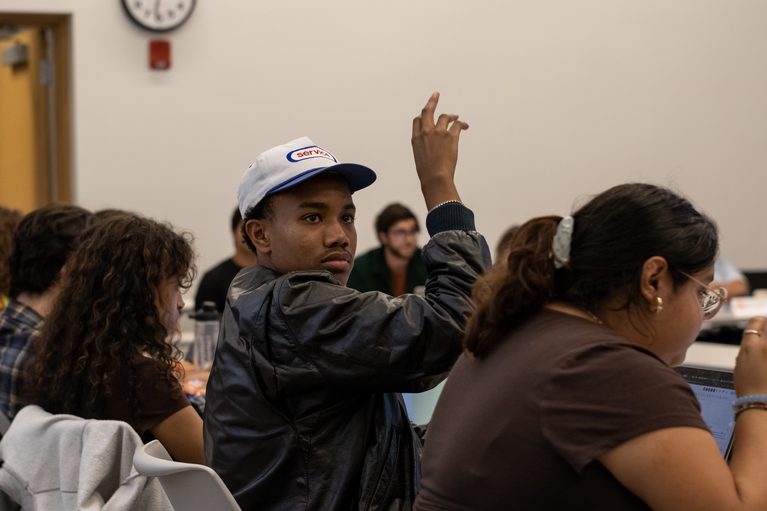
The lecture drew in local community members as well as alumni. Orff stayed afterwards to take pictures with students and faculty.
“I’m in a transition in my career from having worked for different clients at different scales, from residential [projects] to affordable housing projects, to wanting to work more on coastal resilience,” Ruth Webb ’93 P’26, a landscape architect, said. “I love her example of Jamaica Bay. She just found a landscape that she fell in love with, and I’ve had a similar experience in Dartmouth, Mass. […] I’m kind of toying with the idea of trying a project where there isn’t a clear client. I thought it was so cool that she is encouraging people to think beyond what a client is going to ask you to do.”
Many students attended the lecture as part of courses taught by Professor of Environmental Studies and Science and Technology Studies Courtney Fullilove and shared how the lecture sparked further understanding of the course material.
“I really was inspired by how she talks about reinventing the landscape architecture space,” Ben Lipper ’28 said. “Going from [architecture that is] cut and dry, right and wrong, to creating these solutions that are for the future and for these environmental issues we face is just super unique.”
Akari Ikeda can be reached at aikeda@wesleyan.edu.

Leave a Reply