
Students & Residents Show Support for Good Neighbor Project at Town Hall
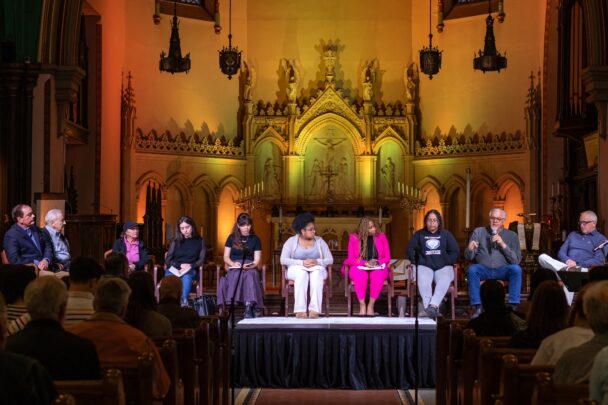
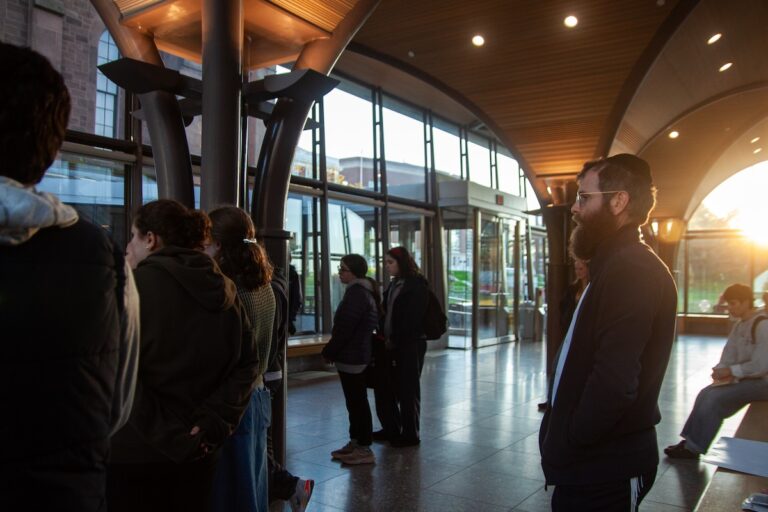
Over 50 Middletown residents and University students filled the Church of the Holy Trinity for a town hall event hosted by the Good Neighbor Project, a newly launched initiative aimed at strengthening the University’s relations with the town, on Wednesday, April 29.
Panelists fielded questions from organizers and the audience on the ways in which University students can develop a stronger relationship with the Middletown community.
Included on the panel were leading organizer at Middlesex Indivisible Ed McKeon, President of the Middletown Common Council Jeanette Blackwell, Emily McEvoy ’22 of the Middletown Young Democrats, former Jewett Center for Community Partnerships administrator Diana Martinez ’07 MA ’19, Middletown Common Council Members Vinnie Loffredo and Leslie Spatola, Connecticut State Building Trades Council Executive Director Joe Toner, Wesleyan Student Assembly (WSA) Senator Makayla Kidd ’29, Blythe Lavin ’29, and Mayor Gene Nocera.
Organizers reflected on the town hall’s attendance and key takeaways.
“The town hall left me and everyone I spoke to with renewed confidence in the desire of Wesleyan students and Middletown residents to make our town-gown relationship closer and more equitable,” project organizer Brendan Barry ’28 said. “Our panelists came from many different parts of Middletown society, but whether they were councillors or union reps, Democrats or Republicans, residents or students, they all agreed that Wesleyan needs to do more to be a good neighbor to our local community.”
Notably absent from the town hall were members of the University administration. McKeon asked at the beginning of the event if there were any University members present in the crowd, but no one raised their hands.
“See, that’s one of the problems,” McKeon said in response. “We’re having a community conversation about a relationship, and the administration didn’t think it important enough to send someone here to represent them.”
Nocera, who has served as mayor since June 2025, decried the lack of engagement from the University.
“We know that they contribute, but the spirit isn’t there…we can’t thrive alone,” Nocera said on the panel. “A university is an important part of this community. The city government is an important part of this community. We sustain one another, and that’s an important concept to think about. We can’t sustain on our own. We can’t be alone in these times.”
Many comments from attendees questioned why the University has shut down its relations with the community while simultaneously not working towards building new ones.
The Green Street Teaching and Learning Center, opened by the University in January 2005 and closed in July 2018, provided after-school education and arts programs for the community. Located on the North End, many of Middletown’s impoverished residents relied on its free programs for childcare and creative expression. The University cited a lack of donations from private benefactors and charitable institutions as the reason for its closure.
“While Green Street contributes to the community in many important ways, we believe we need a new model for supporting the community engagement of our students,” President Michael Roth ’78 wrote in a message to the community announcing the closure in June 2017. Similarly, Traverse Square, a student organisation providing after-school services to children in Middletown, had to roll back its services following a budget mishap last year.
During the question and response portion of the event, Middletown residents said there was a lack of communication as to which resources are open to the greater Middletown community versus which are only for University students. At the same time, many individual members of the school and community advocated for a stronger University-Middletown relationship at the town hall.
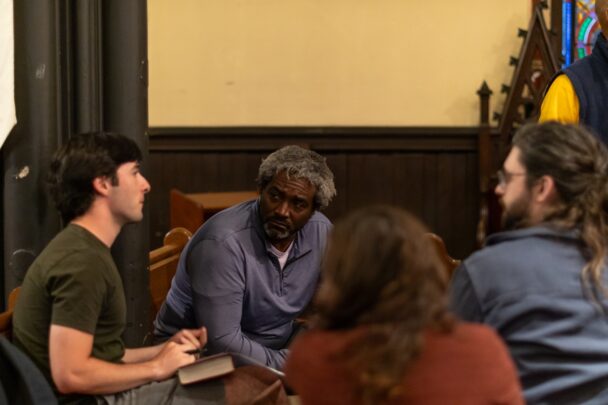
“Every time we talk about [Middletown], every time we talk about Wesleyan, the words ‘connection’ and ‘integration’ come up,” Middletown Common Council Majority Leader Darnell Ford said. “People are passionate about it. They want it.”
The WSA voted to endorse the project last week. Proponents of the endorsement estimate that the University’s tax-exempt status costs Middletown over $10 million a year in lost revenue. Its resolution, introduced on Sunday, April 26, to officially endorse the project and its mission, passed the same day. Passages were added to the original resolution to address General Assembly concerns on the realization of resolution promises and investigate where funding would be coming from to support the Project.
“I think [the resolution] is a great first step from the WSA to at least endorse it, so that in the future, we have this base of support,” Senator Zerek Laghari ’29, the primary sponsor of the WSA resolution, said. “We’re already starting to organize what that support is going to look like.”
Finn Feldman can be reached at ffeldman@wesleyan.edu.
Miles Craven can be reached at mcraven@wesleyan.edu.
Anabel Goode can be reached at agoode@wesleyan.edu.

Leave a Reply