
From the Argives: The First Wesleyan Women and Our Winding Path to Coeducation
While Wesleyan prides itself on its woke, progressive campus culture today, for the majority of its history, the University held a markedly conservative stance on coeducation. Women walked a winding path toward full integration into University life: Women were allowed to enroll at the University as early as 1872, but the University reversed its decision to accept female students in 1909. Women were ultimately allowed to attend the University once more beginning in 1970.
Considering the strong presence of women on campus in clubs, academic groups, and sports, it is worthwhile to explore the intricacies of the University’s relationship with coeducation and to meet the students who have helped shape today’s campus culture.
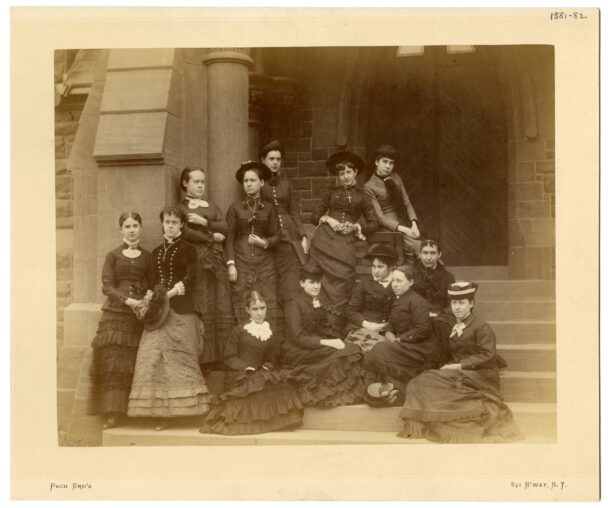
Though women were first allowed to attend the University in 1872, only four women were admitted to the class of 1876. In response to their entrance into the student body, The Argus’ editorial department published an article on Oct. 23, 1872.
“To the four brave ladies who have sought the privileges of Wesleyan, we extend a hearty welcome and God-speed,” the editorial board wrote. “To them we look to vindicate the justice of a cause which is dear to thousands of women in our land. They are fully aware of their situation, and the trust confided to them; aware that many other eyes than those of [18]76 are upon them.”
Entering an effectively all-male university must have been daunting, given that women’s education was a new, controversial concept in American society. Despite the pressure and attention heaped upon these four students, the women expressed a relatively modern mindset toward access to education.
“The ladies affirm that neither their natural acuteness, nor that aroused by various comments on the waywardness and wickedness of Sophomores, has succeeded in detecting any insult offered to them,” the editorial board wrote.
University faculty and underclassmen commented extensively on the presence of women in the classroom, yet The Argus reported that the four new students were unaffected by the surrounding gossip. In the same Argus article, the editorial board published a message from the female students, addressed to the University and to reporters beyond the University’s bounds.
“We ask of the newspapers, simply that they will not be too hasty in their conclusions concerning us, but will seek to know their duty toward the oppressed, and then make no mistakes as to who are oppressed,” the group of women told The Argus.
Despite the novelty of women in higher education, Wesleyan’s four female students insisted to The Argus that they should not be viewed as oppressed because of their minority status. Their persistent rejection of this label stands out; even the editorial board’s optimistic report acknowledges that they stood at the University’s social margins and in the center of the public gaze. In 1909, the board of trustees voted to stop admitting women to the University. According to the Wesleyan University Bulletin, the trustees voted in response to pressure from alumni to make the University more masculine and remain competitive with its all-male peer institutions. Their vision of an exclusively masculine University was realized in 1912, when the last woman in attendance graduated from the University.
In 1911, just two years after the Trustees’ decisive vote, the Connecticut College for Women was founded by alumna Elizabeth Wright, class of 1897, in response to Wesleyan’s end of coeducation, becoming Connecticut’s first all-female academic institution. While the institution is now coeducational and named Connecticut College, it was renowned in the early 1900s for creating higher education opportunities for women at a time when such opportunities were few and far between.
Finally, the University reopened its doors to female transfer students in 1968, ending more than 50 years of an all-male student body. The University’s decision stemmed from the rise of coeducation across the United States and the impending federal legislation that would outlaw sex-based discrimination in higher education.
An Argus article written by Jim RePass ’71 and issued on Sep. 20, 1968 marked the University’s pivotal decision.
“After more than half a century of asceticism in the classroom, after nearly two generations of a life that was ‘monastic on weekdays, and orgiastic on weekends,’ after five decades of libidinal crush, the Wesleyan undergraduate is at last exposed to the presence—inconceivable as it may seem—of female undergrad students,” RePass wrote.
Based on this article, it can be safely assumed that the men on campus were desperate for coeducation, as they no longer had to seek a female presence outside of the University. Now, their dating lives wouldn’t have to be limited to weekends.
What’s more interesting from RePass’s writing is saying, “the Wesleyan undergraduate is at last exposed.” While much of his writing seems to be in utter enthusiasm for leaving behind a life of “monastic weekdays,” it also exposed the fact that the University was late in allowing coeducation in comparison to other higher education institutions. By 1900, the Russell Sage Foundation cites that the majority of higher education institutions had begun coeducation; the University was over 50 years late to the game.
In 1972, Title IX was added to the Higher Education Act of 1965, which prohibited sex-based discrimination in education. Notably, the Act mandated equal access to athletic opportunities.
A number of changes made 1970 an important year for University admissions.
In an unaccredited Argus article issued on Jun. 5, 1970, The Argus wrote, “The Class of 1974, which will enter Wesleyan this fall, is not only the first class in half a century to admit freshmen women—it is also the largest class in Wesleyan’s 139-year history.”
According to The Argus’ reports on the introduction and reintroduction of coeducation at Wesleyan, male students were more willing to accept women into their academic and social communities the second time around.
Notably, the admission of female students to campus in 1970 coincided with the introduction of the first woman in a leadership position at The Argus.
In an unaccredited Argus article issued on Sep. 29, 1970, The Argus reported, “For the first time in The Wesleyan Argus’ 102-year history, a woman has become a member of the paper’s Senior Editorial Board. Beginning with the September 25 issue, Jean Christensen ’72 of Laramie, Wyoming, assumed the post of Assistant Editor.”
Fifty years later, women constitute the majority of Wesleyan’s current student body (52%). Few would expect that enduring coeducation at the University is still relatively new.
Lara Anlar can be reached at lanlar@wesleyan.edu.
“From the Argives” is a column that explores The Argus’ archives (Argives) and any interesting, topical, poignant, or comical stories that have been published in the past. Given The Argus’ long history on campus and the ever-shifting viewpoints of its student body, the material, subject matter, and perspectives expressed in the archived article may be insensitive or outdated, and do not reflect the views of any current member of The Argus. If you have any questions about the original article or its publication, please contact Archivists Hope Cognata at hcognata@wesleyan.edu and Lara Anlar at lanlar@wesleyan.edu.





Leave a Reply