
Gregory Mandel ’91 Reflects on Working on Hubble and the Gravity of Legal Academia
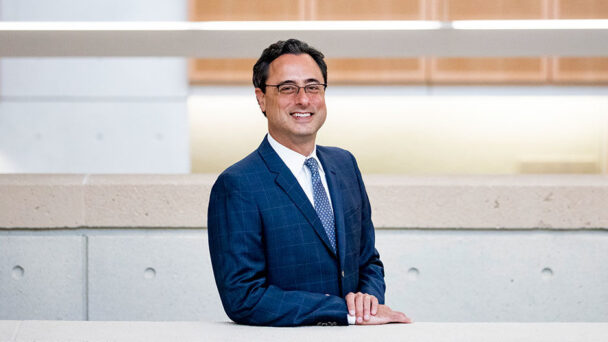
Gregory Mandel ’91, the Laura H. Carnell Professor of Law at Temple University Beasley School of Law, has cultivated a career that connects his passion for science and law. After graduating from Wesleyan as a double major in astronomy and physics, Mandel’s first job was working on NASA’s Hubble Space Telescope. Today, he is a leading scholar of intellectual property and the intersection of law and technology, and he served as the Dean of the Temple University Beasley School of Law from 2016 to 2021.
Mandel looks back fondly on his time at the University.
“I had a wonderful experience at Wesleyan. I was a very science-focused person and majored in astronomy and physics, but I was able to take lots of courses in the social sciences and some humanities as well,” Mandel said. “And [I] just really, really felt a nice match with the people and obviously, the students there. It was a good college choice, and there was just a lot of energy on campus, a very diverse student body both along demographic lines [and] in terms of backgrounds, beliefs, and what people were doing. I really enjoyed that environment.”
After graduating from Wesleyan, Mandel worked on the Hubble Space Telescope.
“I happened to graduate not long after the Hubble had launched. At the time it launched, there was a big problem with its main lens not having been ground correctly. There was sort of a blip in it, and actually, the job I got hired into was figuring out ways to account for that error in the lens so that the images could be corrected as much as possible. And then, eventually, after I had left, they actually sent up a mission and essentially corrected glasses on the Hubble. But during those first several years, that’s what our work was. And it was a wonderful first job out of college. You know, [it was] exciting to be working on something as at the forefront of tech and science as what was going on with the telescope, the first real space telescope, and so that was terrific.”
After working on the Hubble Telescope, Mandel was prepared to get a master’s degree. He was deciding between pursuing a PhD in either astronomy or astrophysics or a law degree, but ultimately chose to pursue a career in law.
“I actually had taken some law-related classes at Wesleyan,” he said. “[I took] a couple of really good classes: one on constitutional law, one on economics and the law. I had taken the LSAT while I was at Wesleyan, and what made me decide on law is that, although I enjoyed the intellectual challenge of the sciences and learning about the world, I wanted something that had a little bit more of a social impact and was helping people more directly than the sciences I was in. So that’s what led me from the space telescope into law school.”
Mandel pursued his juris doctorate at Stanford Law School and was the co-Editor-in-Chief of the Stanford Environmental Law Journal. He described his experience at Stanford as “spectacular” and one of his “favorite educational experiences.”
Following his graduation from law school in 1996, Mandel clerked for Judge Jerome Farris of the Ninth Circuit Court of Appeals.
“It was a very useful experience clerking with Judge Farris,” Mandel said. “And I’ll tell you, it was a real learning experience, because in law school, many law students tend to view law in this relatively formal way. You figure out the facts of a certain situation, you figure out the law, you apply it, and you get a result. I learned this while clerking, but every situation is so context dependent that you can’t be as formal as that. Sometimes he would come back from [an] oral argument and sort of walk down the hall towards his office and generally be shaking his head and would say, ‘I don’t know what they teach in law school, but it’s not how we decide cases.’ What he was referring to was lawyers spending a significant chunk of their time in oral argument, talking about issues that were not going to affect the judge’s decisions, instead of really focusing on what was going to drive the judge’s decisions.”
When Mandel applied to be a law clerk on the Ninth Circuit, Judge Farris was still in active service. However, Judge Farris entered his first year of senior status when Mandel was clerking for him. Working a reduced docket, Judge Farris took two months off to stay at a house he had in Italy.
“During that time, each of his clerks went and worked for a different district court judge,” Mandel said. “And so I actually got to work with a district court judge, Judge Thomas Zilly [of the Western District of Washington]. Circuit and district courts are very different. The experiences are both incredibly valuable.”
After clerking, Mandel spent time in big law at the San Francisco office of Skadden, Arps, Slate, Meagher & Flom LLP and Affiliates. Mandel practiced both intellectual property and environmental law for the firm.
Ultimately, though, Mandel realized academia was his calling.
“I talked to some professors at different schools at that point in time,” he said. “It just sounded like a really good career choice for me, and so that’s what led me to apply to become a professor. I became a professor, and that was probably my best career decision.”
From 2001 to 2007, Mandel was a law professor at the University of Albany. He joined the faculty of Temple Law in 2007 and served as the school’s dean from 2016 to 2021.
“Becoming a dean was not something that I had planned to do at all when I became a law professor,” Mandel said. “I still sort of refer to a law professor as the best job in the world, but becoming dean was an exciting opportunity to help the law school. It was very engaging to get to work more with our alumni, the local bar, and civic and political entities. We really were able to stabilize the finances of the law school. We were able to change how we were recruiting both students and faculty and ended up having the most diverse classes and the most diverse faculty we had ever had. There are parts that are downsides. I got to know fewer students on a one-on-one basis than as a faculty member, but I am really glad I got to do that for a period of time.”
Mandel had a piece of advice for students considering pursuing a career as a lawyer.
“It’s really valuable to talk to folks who are in the field in various ways. Law is an incredibly diverse field in terms of what people do to it. I think law school is a wonderful experience for many folks. It helps you think about the world in different ways, and that can lead you into careers in business or a startup or even in the arts. But I think it’s important to go to law school knowing that there are some career paths that you’re excited about, as opposed to going to law school because it’s an opportunity to continue education.”
Blake Fox can be reached at bfox@wesleyan.edu.


Leave a Reply