
From the Argives: The Spookiest Part of Campus
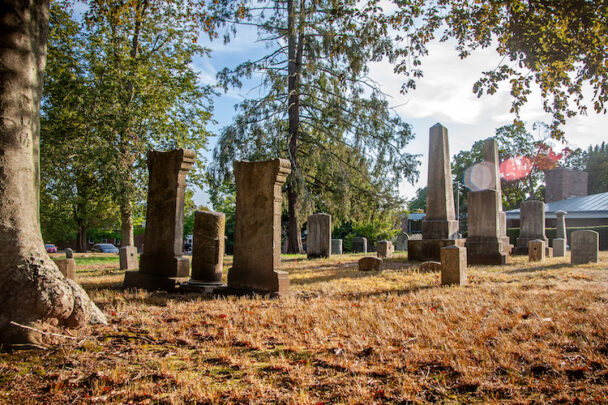
As we enter the spooky season and scramble to find our Halloween costumes, we must reflect on the spookiest part of the University: the graveyards! Whether your windows gaze upon them or you walk by them in passing, cemeteries comprise an unmissable part of our campus that hold bizarre tales, myths, and chaotic origin stories.
Indian Hill Cemetery
Established in 1850, Indian Hill Cemetery—a prime spot for watching the sunset—lies just above the tennis courts.
The Wangunk Tribe once resided where Indian Hill Cemetery is now located. Early European colonists built the cemetery on that land, claiming it was a place of remembrance for the Wangunk Tribe, a group they claimed had disappeared before their arrival. Claudia Stagoff-Belfort ’21 revealed that this rumor was in fact a myth in the Argus article “Remembering Wune Wajet’s Complex History and the Whitewashing of Middletown’s Past,” issued Nov. 28, 2017.
“Europeans claimed that this tribe was extinct, a falsehood that became central to Europeans who were attempting to cement an American identity and origin story in the area,” Stagoff-Belfort wrote. “The production of such extinction myths served as the basis for the cemetery’s construction. To allow for the birth of American identity, according to Kavanagh [Sarah Kavanagh ’04, an American Studies major and Associate Professor at University of Pennsylvania], the Wangunks were to be transformed into the ‘hallowed ashes of a race.’”
While the founders of the Indian Hill Cemetery denied these claims, the truth of this injustice still shines through.
“Even after stripping the Wangunk of any right to the land, these founders kept the land’s original name, Wune Wahjet, translated to ‘Indian Hill,’ which served as…a facade of respect for Native American heritage,” Stagoff-Belfort wrote.
The founders’ underlying disrespect betrayed the Wangunk Tribe and leaves us—the students and faculty who preside around the cemetery—with the responsibility to honor their legacy and ensure that they are not forgotten, a significant factor behind this article.
Foss Hill Graveyard
Indian Hill is only one of two cemeteries on our campus, as Foss Hill Graveyard also lies on our grounds.
In an Argus article issued on Feb. 21, 2012, titled “Unearthing the Past: Reviving the Foss Hill Graveyard,” Theodora Messalas ’15 wrote, “Both the Foss Hill Graveyard and nearby Indian Hill Cemetery were intended to be spiritual places for the living to reflect upon the dead.”
In the same article, Messalas continued, writing, “The graveyard includes not just famous University faculty, but also a number of students who perished during their time at the school, and even a few alumni who felt so connected to their alma mater that they wanted to make it their eternal home.”
Like the Foss site, Stagoff-Belfort delved deeper into the various historical figures buried in Indian Hill Cemetery.
“It’s the final resting place of Everett Bacon, an all-American quarterback from the early 1900s, three governors, three generals, and many city mayors,” wrote Stagoff-Belfort.
And like Indian Hill Cemetery, the graveyard on Foss Hill is shrouded in myths and misconceptions, which Colin Small ’11 covered in an Argus article issued on Feb. 17, 2009, titled “Foss Hill Graveyard: Myths and Legends Debunked.”
“Originally called ‘Wesleyan’s God’s Acre’ when the University was a Methodist institution, the cemetery was created as a space where students could reflect about nature, the future, and their role in the University’s history,” Small wrote.
While students have appreciated both the serenity of the scenery and the purpose of the cemetery, past students also used the space for other purposes, including club initiations.
In an Argus article issued on Sep. 20, 1988, titled “Three Singing Spirits Charged in Night Rite,” Marisa Cohen ’89 wrote, “Three members of the Wesleyan Spirits were arrested and charged by Middletown police with simple trespassing last Thursday night, after they allegedly set up lighted candles in a graveyard as part of their yearly initiation ceremony.”
The a cappella enthusiasts ran into a little bit of trouble with the law while trying to fulfill their yearly initiation ritual. Unfortunately, the styrofoam cups where the candles were in did not survive the debacle.
Cohen clarified the purpose of the initiation, saying, “the candle-lit ceremony was to have terminated the initiation rite in which the new members of the men’s a cappella singing group follow clues to different locations around campus. At each location, they must sing a song to receive the next clue.”
Unfortunately, the Wesleyan Spirits’ initiation ritual was left partially incomplete. Apart from clubs, students have made sure to keep these cemeteries central to our campus’ culture.
“Especially around Halloween and Friday the 13th, students become more aware of the presence of the Foss Hill graveyard, employing it to help set a spooky mood and as fodder for scary stories,” Messalas wrote.
For some, the graveyard sparks the excitement of Halloween traditions. While it can’t be proven, one piece of campus lore may convince others to avoid the graveyard during this time altogether.
“A 2009 Argus article discussed the rumor that a group of students had dug up the Foss Hill bodies in the sixties. However, administrators seemed to doubt this claim,” Messalas wrote.
“To be buried in the Foss Hill graveyard involves a tedious process of appeals to the Board of Trustees; the last time someone was successful in that appeal was 1980,” she wrote (The Argus has been unable to independently verify this claim.)
Both cemeteries contain layers of history irrevocably ingrained in the history of the University. To incoming first-years or tour groups, they may seem out of place; but, in reality, they are an integral part of our campus.
Lara Anlar can be reached at lanlar@wesleyan.edu.
“From the Argives” is a column that explores The Argus’ archives (Argives) and any interesting, topical, poignant, or comical stories that have been published in the past. Given The Argus’ long history on campus and the ever-shifting viewpoints of its student body, the material, subject matter, and perspectives expressed in the archived article may be insensitive or outdated, and do not reflect the views of any current member of The Argus. If you have any questions about the original article or its publication, please contact Head Archivists Hope Cognata at hcognata@wesleyan.edu and Lara Anlar at lanlar@wesleyan.edu.



Leave a Reply