
Are We Seeing the End of Flopping? How the NBA’s New Rules are Impacting Foul Calls
“Flopping has ruined our game,” Jaylen Brown said following the Celtics’ loss to the Philadelphia 76ers in the first round of the NBA playoffs. Jaylen Brown was criticizing his now teammate Joel Embiid for selling contact to gain free throws. Though comments like Brown’s are nothing new in the NBA landscape, critiques against flopping have become more and more common every year. Before the 2026–27 season began, the league passed multiple new rules to cut down on the prevalence of flopping and offensive fouls in modern basketball. Only two weeks in, the weight of these regulations have been felt league-wide, and their implications are interesting to say the least.
In recent years, the NBA has shifted its focus to highlighting the offensive side of the ball. With this has come more rules that benefit offensive players, and as a result, players have begun to get away with more rip throughs, travels, and foul baiting. These phenomena became more noticeable as players learned how to better exploit them. This trend has ruined the flow of play and created a boringly one-sided game.
This season, the league has a better incentive to adopt a stronger position on flopping and offensive fouls than ever before. Not only has frustration in the lack of anti-flopping enforcement reached an all-time high on social media, but players and coaches alike have increasingly criticized the league for rewarding players who flop. Star players such as Giannis Antetokounmpo, Cade Cunningham, and Donovan Mitchell have all criticized the league for its passive role in flopping’s prevalence. As pressure from inside and out of the association has reached a boiling point, the NBA has begun to enforce a number of offensive rules more strictly.
The media has called out flopping as the main issue in basketball. Players who are called for flopping in game are awarded a non-unsportsmanlike technical foul, awarding the opposing team one free throw. This rule has existed since the 2023–24 season, but NBA officials enforced it just 26 times before completely stopping. However, the enforcement of technical fouls for flops have surged this season, with over 10 enforced in just three weeks. What constitutes a flop is still a bit of a gray area in league policy, but officials focus mainly on whether a player’s movement appears unnatural or not.
Along with cracking down on flopping, the association has also focused on putting an end to illegal screens. League officials have increasingly punished players for illegal moving screens and especially two-handed illegal screens. NBA referees have begun to punish players for influencing the defender on screens using their arms and hands more often. The use of two hands during offensive screens greatly increases the range of said screen on a trailing defender.
Monty McCutchen, Senior Vice President and Head of Referee Development and Training at the NBA, touched on the importance of calling these infractions more often.
“In some instances, it will create an advantage for the dribbler,” McCutchen said. “In others, it will create an advantage for a pocket pass, which leads to advantageous positions on the floor.”
Arguably the most impactful regulation is the cut down on off-hand push offs. Although many players successfully use off-arm extensions to create space, the league believes that the move creates an unfair advantage for the offensive player. NBA rules state that off-hand contact in the form of feeling the defender to gauge their position and bending the arm to maintain space without excessive force are both allowed. However, any type of off-arm contact where the arm is extended or used to shove the defender away is strictly illegal.
The impact of the NBA’s crackdown on offensive fouls and flopping were immediately felt once the season began. Offensive fouls per 100 possessions were up over 60% from last year’s averages in the first week of the season, the highest rate in 20 years. Calls on illegal screens have also increased astronomically through the first week, doubling the rate from last season.
In the past couple seasons, players have mastered the art of drawing contact on defenders during drives to the basket while in shooting motion, leading free throws at a highly efficient rate. Players have also utilized push-offs during drives to create space and prevent highly contested shots. But with the crackdown on these two moves coming into effect, driving to the basket while coming out with a score has become drastically more difficult. Both driving rates and efficiency per 100 possessions are at their lowest levels since 2019, and league efficiency as a whole has dipped slightly overall.
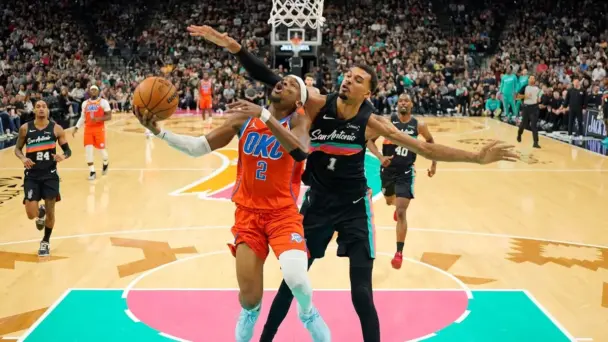
These regulations have noticeably affected players whose game centers around their ability to drive and draw contact. Reigning two-time MVP Shai Gilgeous-Alexander has recently become the internet’s poster boy for flopping and push-offs. Much of this criticism is warranted, as much of Gilgeous-Alexander’s game involved driving to the basket while drawing fouls or pushing off. Unsurprisingly, Gilgeous-Alexander started the season slowly, to his standards, in light of the new regulations. Through the first six games of the season, SGA averaged 26 points, 4.5 rebounds, and 3.3 assists per game. These numbers are by no means mediocre, but were noticeably lower compared to his 31.1 points, 6.6 assists, and 4.3 rebounds during his 2025–26 MVP campaign. Gilgeous-Alexander’s free throw attempts also dipped from nine free throw attempts per game to just 4.6 in the first six games. While other factors could have also contributed to SGA’s dip in production, the crackdown on both offensive push-offs and foul drawing remain the most likely factors.
Despite the impressive rate in which league officials have cracked down on problematic offensive moves, many of the most recent flopping calls have come at the defensive side of the ball, sparking criticism from many coaches and players. Three of these calls notably came during a matchup between the Los Angeles Lakers and Portland Trail Blazers. Blazers’ star Ja Morant, wing Toumani Camara, as well as Lakers wing Ziaire Williams were all awarded technical fouls during the final six minutes of the game for flopping.
Timberwolves head coach Chris Finch criticized the calls, arguing that defensive flops should be called less strictly than offensive ones.
“Where they got it wrong is that all these flops they’re calling are on the defense,” Finch said. “That’s not what the people want out of the game. They want the flops on the offense out of the game.”
Whether defensive flopping should be punished less than offensive flopping is a matter of ongoing debate, but the increase in anti-flopping calls is not.
Many coaches, including Warriors head coach Steve Kerr, find themselves confused and frustrated with a perceived lack of nuance in the new crackdowns. Following a loss against the Memphis Grizzlies in which the Warriors were called for six illegal screens, Kerr told the media that the Warriors had begun asking the league for clarity on what confused on what constitutes a flop and what doesn’t.
“Everyone is trying to figure out what’s a flop and what’s not,” Kerr said. “The league made it a point of emphasis, but it seems to only be on certain actions.”
There is a good amount of work to be done on adopting a more nuanced policy around what constitutes a flop and whether offensive flops should be called more strictly than defensive ones. However, if the NBA decides to stick with their current approach to offensive fouls and flopping, a version of play we haven’t seen in the modern NBA will emerge.
First, expect overall efficiency on high contact shots to hover under league averages from the past couple seasons. The more offensive players are restricted from separating through contact through push-offs and getting to the line by drawing fouls, the more difficult it is to make heavily contested shots. On the flip side, expect physically gifted and skilled on-ball defenders to thrive this season. With a large portion of offensive openings in highly contested shots now becoming restricted, expect defenders who thrive in absorbing contact to become increasingly valued by front offices across the league.
Also, expect free throw attempts as a whole to be harder to come by compared to previous seasons. Players will now have to find other ways to display contact to officials which don’t include flopping, flailing, or head snapping. Players who continue to flop will accumulate costly technical fouls in game and eventually fines if their antics continue throughout the season. With a dip in fouls also comes an increase in game flow. With less whistles, expect matchups to have less pauses and adopt a faster pace.
Gabe Fredette can be reached at gfredette@wesleyan.edu.

Leave a Reply