
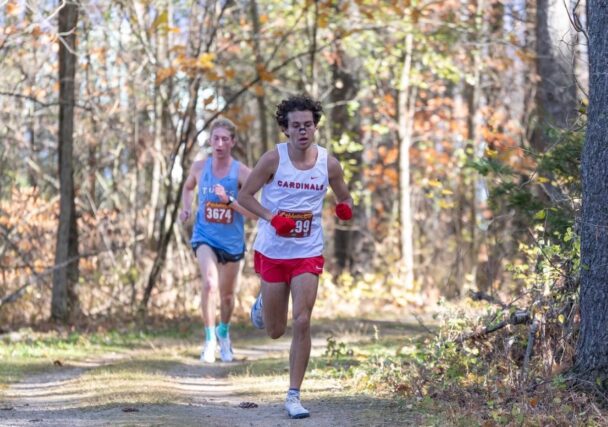
Player of the Week: Dylan Cote ’28 Discusses NESCAC Individual Title and Training Regimen
Dylan Cote ’28 is a junior English and history double major on the men’s cross country team. Cote made history when he joined Joe Mahoney ’94 as one of only two Cardinals to win the NESCAC individual title. Cote finished first out of 150 runners with a final time of 24:31.08. This performance was preceded by the first Cardinals Little Three win since 1984. The Argus sat down with Cote to talk about the team’s training schedule, the Little Three rivalry, and his goals for the rest of the season.
The Argus: When did you start running, and was cross country always the plan?
Dylan Cote: I started running during my junior year of high school. I did track when I was a freshman and a sophomore, but I was more of a soccer player. I ended up quitting soccer my junior year and started doing cross country and fell in love with that. I haven’t looked back since.
A: What was the recruitment process like, and why did you choose Wesleyan?
DC: I honestly didn’t know if I wanted to even run in college, because as a junior, I definitely wasn’t good enough, and then fall senior year I got good, so it was kind of last minute. My friend went to Brown, and he had visited Wesleyan, and he was like, “You should see if you could run there. That would be awesome.” So, I checked out Wesleyan. As soon as I came here, I really liked the environment, the location, and the people. I loved the open curriculum because I didn’t know what I wanted to do coming in, and obviously, the environment here was very diverse, and that’s something that I really wanted. The small class size was great, as I was always intimidated by classes that would be too large or [where] I couldn’t directly interact with the professor.
A: Walk me through the NESCAC race. When did you decide to make your move?
DC: It was kind of crazy, because I usually don’t win from the front. Whenever I’ve won races, I’m with someone until like the last 400 meters or so. However, in this race, there was one other contender, this runner from Tufts, Jonah Reisner, who kind of took the lead for the first mile-ish. It was a hilly course, so I kind of let him take it, knowing that it might pay dividends later to save my energy. Then, I caught him and passed him around, like, the second mile, and from then on, I started developing a gap. The way I run, I don’t burn my energy too soon, and I know I’m not going to slow down, so it was just about continuing to open that gap. By the time I was at mile three, I knew that I had it, which has never happened to me before. So, that was kind of crazy.
A: You went from 20th last year to first this year. What changed?
DC: Last year, I definitely was disappointed with getting 20th. That’s part of what helped me think I could win this year. Last year, I was like, I don’t think I can win, but I think I can be in the top five. I got, like, a pretty bad side stitch in that race, and so I tried to make excuses in my own head of “if this went right, then I would have been 10th. So, now I can jump to first.” The jump from 20th to first doesn’t seem as big of a gap when I do that. Other than that, I’ve been doing the same things—increasing my mileage. I’d say the one big change that I made is I went to altitude this summer. I went out to Wyoming and trained at 7,000 feet, which definitely was difficult and made my aerobic engine a lot stronger. Other than that, I’ve been doing what I normally do and believing that my progression will be linear and I won’t plateau.
A: You opened the season by helping win the first Little Three title since 1984. How did that set the tone?
DC: It definitely set the tone very well. We were super happy. The rivalry between Williams and Amherst is historic, and we’re often left out of that or written off as the third place team. So those are always teams that we want to come out and sucker punch. To beat both of them was very nice. Even though we lost a lot of good seniors last year, we have a strong team this year, and we were capable of doing a lot, and being even better than we were last year, and rebuilding our pieces via depth.
A: Cross country is scored as a team, but you’re alone for 8K. How does this group make it a team sport?
DC: I know a lot of people thrive off racing together. We have two packs. Our two to four are all in the same time range, and they race together, and then our five to seven or eight all finish within like two seconds of each other. When they were telling me about their race, they were pushing each other. They’re like “oh, at this hill, like, we were both dying.” We train together every day and do the same workouts together. Once you get on the line, even if you’re hurting maybe more than the other person, forcing yourself through that pain, knowing that you’ve done all the same things together, is helpful. It’s great having someone by your side while you go through one of the hardest things you can do physically.
A: What does a week of training look like?
DC: Mondays are off days. We do workouts Tuesday and Friday, which are usually some intervals. Then the days after those workout days will be recovery days, so just run as slowly as you need and recover, get your mileage in. In the middle of the week, we do a pace run, which is an up tempo, easy run, kind of. On Sunday we do a long run, which is like 20 or 25% of our weekly mileage.
A: Any pre-race rituals, superstitions, or a go-to pre-race meal?
DC: I always try to eat pasta to carb load. I like having something in my stomach that I know I can manage the night before. Then days of the races, I always have strictly bagels. I’ll make sure I’m not hungry and eat three or four bagels in the morning because it’s super plain, and I know I like them. As far as rituals, I feel like we don’t have much. Pre-meet, we eat dinner together, we’ll have a game plan meeting with our coach, and then we go to bed. Sometimes, we’ll watch “Family Guy” as a team.
A: What are your goals for Regionals and NCAAs, for you and the team?
DC: Regionals, I’d like to win. As far as the team goes, if we could beat Amherst or Williams, that’d be really cool. Then nationals, we really want to be top 15 in the country as a team. We were 17th last year and 23rd the year before, so we’re trying to build on those performances and trying to be as close to top 10 as possible, if not cracking the top 10 as well. Individually, I’d love to be top 10 or go for the win if I’m there, and just see what happens.
This interview has been edited for length and clarity.
Leila Feldman can be reached at lfeldman01@wesleyan.edu
Leave a Reply