
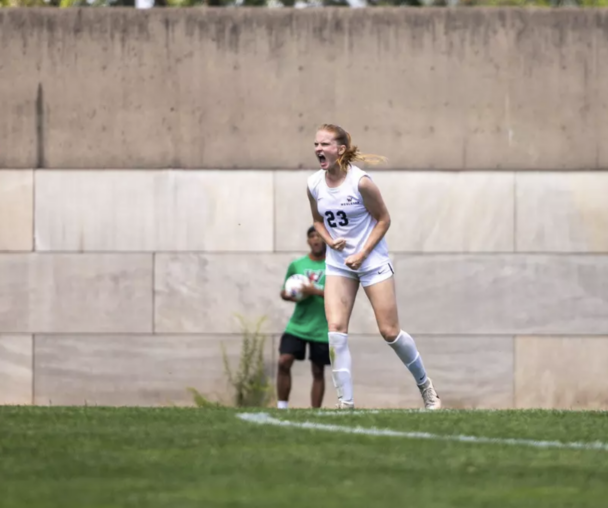
Player of the Week: Maria Utz ’27 Talks NESCAC Player of the Year Award, Resilient Wins, and Reflections on Four Years of Women’s Soccer
Maria Utz ’27 is an economics major and data analysis minor from Atlanta, Ga. She is a captain and starting forward on the Wesleyan women’s soccer team. On Wednesday, Nov. 11, she was named New England Small College Athletic Conference (NESCAC) Player of the Year and a member of the All-NESCAC First Team. She’s now been on the first team back-to-back years, and she’s the third player in program history to earn the NESCAC’s top honor. Utz filled up the stat sheet this year, leading the NESCAC in goals (16), points (38), and game-winning goals (4). Her 38 points broke a 26-year program record for most in a single season, outpacing the 37-point season Flo Stueck ’96 accomplished in 1992.
She scored in 11 of the Cardinals’ 16 matches this season, including two hat tricks against Smith College and Johnson & Wales University-Providence, as well as a two-goal performance against Middlebury. A first-time captain, Utz scored in all but one of the Red and Black’s victories over the course of the 2026 season. The Argus sat down with Utz to talk about her Player of the Year Award, having her teammates’ backs, and wrapping up four years of Wesleyan women’s soccer.
The Argus: When did you start playing soccer?
Maria Utz : My older brother and sister both played. I started playing at around seven. My dad would take me to some random Sunday game and I’d play with other little kids. I actually played on an all-boys team when I was eight, and that’s also when I officially started playing in clubs.
A: Playing in middle and high school, did you always know you wanted to play in college?
MU: No. My brother was really into me going to college for soccer. I was not. He would send emails to colleges on my behalf. And then it wasn’t until junior year where I played in a showcase, and I did pretty well, and then these coaches were emailing me, and I was like, “Oh wait, it could be kind of cool to play in college.” So then I signed up for my first ID camp, and I went January of my junior year, and then that’s when [head coach] Eva Meredith saw me play and started to have interest in me.
A: What made the Wesleyan program stand out to you during the recruitment process?
MU: I’m from Georgia, and not many people know Wesleyan, but I knew of the whole liberal arts scene because my brother played at Haverford College. My dad and my brother said “That’s a really great school,” but I was unsure. And then my dad and I happened to be driving in the area in February of my junior year, after the tournament where I met Eva, and he was like, “You know, we’re driving past Wesleyan, let’s just stop.” I was walking around campus, and I thought it was really pretty; I loved the whole look of it, and how it was on the hill, so you could look out to the Connecticut River. I could see myself here. Then, when I reached out to the coaches, I talked with them, and I talked with girls on the team, and I just got a really good vibe. I kind of knew it was a place that I wanted to be.
A: What is the most rewarding and most difficult part of balancing the student-athlete lifestyle?
MU: Probably the worst is sometimes having to miss class. There was a year where I couldn’t go to any class after 1:00 p.m. on Tuesdays because we had to leave for midweek games, so I felt bad emailing my professor that I can’t come to class, but most of the professors are chill about it and they make it a lot easier. The most rewarding, though, is winning with my team. When the final whistle blows, I love celebrating with them. Even when we lose, I know it’s as a team, and I know the next practice we go to, we will support one another and be back for the next match.
A: One of the highlights of the 2026 season was the 3–2 victory over Colby, in which you scored ultimately the match-deciding goal. What stood out from that match and how you all were able to tough it out against the Mules?
MU: That was such a fun game, actually. They were ranked pretty high, and we had already lost to Trinity and Hamilton. So, coming into that game, we knew we had to win in order to help our chances to make NCAAs. From the first time the whistle blew, we just came out with such intense energy. We were constantly in their half in the first 15 minutes; we were annoying their backs and we were playing really well. All of a sudden they got a goal, but even after that, we came together as a team, and we were like, “We’re gonna win this.” The vibes were high, and we just knew we were gonna win.
A: We’re featuring you this week for the honors you garnered from the NESCAC, including your second First Team and the NESCAC Player of the Year. What was your reaction to receiving the award?
MU: I was like, “There’s literally no way,” because obviously, in the past, all the NESCAC players of the year since I’ve been here have been on teams that are making it to NCAA, and we didn’t go far in the NESCAC tournament, so we didn’t make it to NCAAs. I was even shocked that I made the first team, just because I know there’s like so much competition in the NESCAC, and so much talent on teams like Tufts and Williams. I knew they would likely dominate the NESCAC awards. I was super happy to get it for Wesleyan.
A: One of the many reasons the NESCAC honored you with POTY is your league-lead-tying four game-winning goals. Have you always been a player that has lived for the clutch moments, and what this year especially allowed you to shine in these circumstances?
MU: No. In high school, I was the type of player to cross it and only get assists. So, coming here, I thought I’d just do the same, and for the most part I did my freshman and sophomore year. Even last year, I had a lot more assists than this year, and then I don’t know what happened this year. We had a really good goal scorer last year, Riley Buehler [’26], who was really great in the middle, and who I would cross the ball to a lot or look for in the box. So then losing her, I thought we wouldn’t have as much of an attacking threat anymore because she wouldn’t be there. But then, Taylor Hill [’28] and Romi Schreiber [’28] stepped up this year scoring goals. I don’t know, I guess the ball fell to my feet at like the perfect moment. But also my teammates, like Kerenza Leahey [’27], set me up really well and gave me good passes to score.
A: As a captain this season, what was your favorite moment of growth for the team where you, as a captain and a leader on the team, really came through?
MU: It goes back to Colby. We were down 1–0 to a team that was ranked seventh in the country. In that moment, I wouldn’t have expected us to shut down, but it could’ve been really taxing mentally since we needed to win that game. I was really proud of how everyone stepped up and worked hard in that game. Everyone had it in their mind that we were gonna win and set their minds to it. We all supported each other and had each other’s backs, which I appreciated. I got really frustrated and I felt like I needed to be subbed out, but then Sheridan Snow [’28] was like, “Maria, you got this! I believe in you. Let’s go!” Having your teammate support you like that makes you want to work harder for them.
A: As you reflect on your Wesleyan journey, what are you most proud of personally and of the team over the course of your Red and Black career?
MU: Personally, I’m proud that I got better every year. That was my goal in college: I didn’t want to be an athlete that just stayed stagnant. That’s also why I chose Wesleyan’s program because I knew that Eva and [former associate head coach] Jason Weisberg would push me to be my best. I didn’t really play my freshman year, so if you would have told my freshman self that I was gonna get NESCAC Player of the Year, I wouldn’t have believed you.
As a team, I’m proud of how hard we work every year. Every season, we have that mid-season slump, where it gets difficult with midterms and work piling up, but I’m very proud of how the team has always dealt with that. Obviously this year, we didn’t make NCAAs, which was challenging, but I know the program’s gonna bounce back next year. Eva and assistant coach Emily Giglietti [’21 MA ’22] do a good job pushing the competitive spirit among us to go for what we want, which is hopefully a NESCAC championship next year.
A: Anything else you want us to highlight in the article?
MU: I may have been the NESCAC Player of the year, but if it wasn’t for my teammates, I really wouldn’t have had the stats I had. They set me up really well, so I am really thankful for them and thankful for the coaches for recruiting me.
This interview has been edited for length and clarity.
Max Forstein can be reached at mforstein@wesleyan.edu.
Leave a Reply