
Creativity and Anti-AI in Fashion Marketing
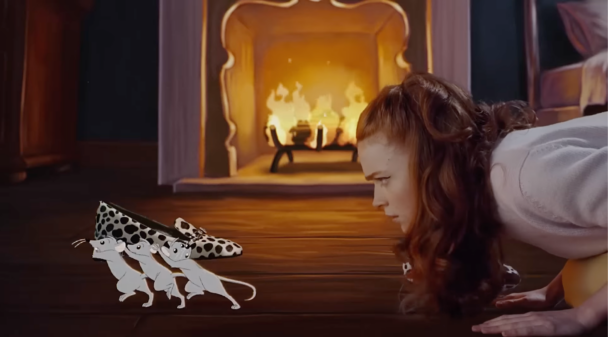
Three mice carry away Sadie Sink’s cheetah-print loafer. A wildcat throws a snowball at Kelvin Harrison Jr.’s leather backpack. A gust of wind dresses the shivering Maya Hawke in a matching navy jacket and skirt.
Prada released their 2026 holiday campaign to great fanfare. “Drawing Prada: Animated by Hand” unites the animated drawings of veteran Disney animator John Pomeroy with the star-studded photography of Glen Luchford. The result is a winter wonderland, in which Prada ambassadors Sink, Harrison, and Hawke, along with Chen Haoyu, roam about, entranced by anthropomorphic animals and snow-covered evergreen trees. In response to the advertisement, viewers (who had previously rebuked Prada for their supposed use of AI in the Spring/Summer 26 collection) praised the brand for turning to human creativity and handmade art amid an increasingly AI-dominated landscape.
Commenters lavished them with praise, relishing the whimsical themes and gentle setting reminiscent of a past era of Disney. (Pomeroy’s portfolio includes work on classic Disney films including “Thumbelina,” “Tinker Bell,” and “Winnie the Pooh”). The ad combines high fashion (Prada’s Shetland wool crew-neck sweater and Shadowplay sunglasses are just two of the items featured) and A-list celebrities with the nostalgia of childhood holiday cartoons. This mix of winter reminiscence and aspirational status is compelling for those willing to drop two grand on a poplin button up.
Two weeks later, Bottega Veneta launched a capsule collection inspired by Moomin, the popular Finnish children’s character. This was preceded by another animated ad, featuring Moomin and his friends among various flowers and trees. While some criticized the collaboration as “against all ideas the Moomin world was created for,” others praised the use of hand-drawn animations in advertising.
And Barbour has continued their tradition of partnering with Wallace & Gromit for their annual Christmas advertisement, once again generating praise from fans of the brand, the show, and the art.
But the reception for Dior’s take on the animation trend was very different. Supposedly created by established animator Sylvain Chomet, Dior published their “Night in Color” ad along with behind-the-scenes videos of Chomet’s work in progress. Within a day of posting their video—the creation story of Christian Dior’s dress for Hollywood star Marlene Dietrich—animation experts called out the brand for using AI in what was presented as a human-made animation. Zeroing in on frames of a hand with six fingers, inscrutable text, and unnatural movements, sleuths accused the brand of using AI and fabricating the behind the scenes video.
The proliferation of hand-animated material from high fashion houses reveals that companies are responding to consumer desires for real human art. As cheap AI content becomes associated with anti-intellectualism, internet “slop,” and inauthenticity, luxury has sought to establish its position on the opposite end of the spectrum. If fast fashion’s automation and uniformity is the clothing equivalent to AI slop, designers may feel incentivized to characterize their products as handmade, thoughtfully crafted pieces.
“An exploration of the stop-motion animation’s tactile spirit of making, which resonates closely with the House’s approach to the handmade,” Loewe said of their collection inspired by Tim Burton’s “The Nightmare Before Christmas.”
In a world where people—from the normies who “Brick” their phones to the celebrities who brag about their laptops having been dead for years—are increasingly leaving online spaces, there is an emerging association between (chronic) onlineness and anti-intellectualist homogeneity. The online content that now finds success is often about real-life hobbies, creativity, and continued education. Moreover, AI’s debilitating environmental and social consequences, as well as the accumulation of slop content, has associated the use of AI with conformity and a lack of social consciousness and intellectual or artistic curiosity.
But Dior’s attempt to circumvent the true artistic process, while still reaping the rewards of public praise betrays companies’ tendencies to cut corners. High fashion’s existence is reliant on craftsmanship, quality, and human art. Mechanizing their content with cheap machines goes against everything that it should stand for. If brands like Dior are turning to AI to churn out their work, what, beyond the price tag, differentiates them from Shein or H&M? And why should the customer pay the high price for the product if the brand won’t pay the artist?
Alexandra Lee is a member of the class of 2029 and can be reached at ahlee@wesleyan.edu.



Leave a Reply