
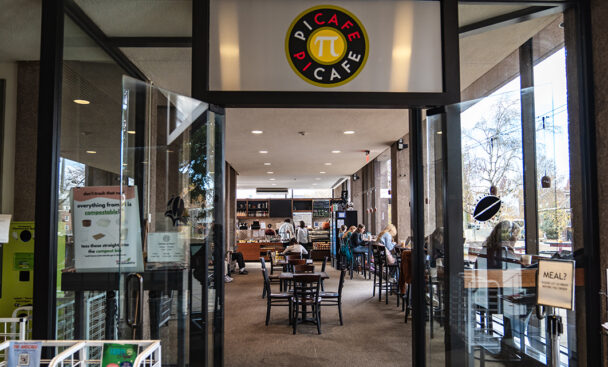
I Miss Pi Cafe, and I’m Sure You Miss It, Too: The Loss of Third Spaces and the Ghost Town-ification of Exley
At the beginning of the semester, I swung by Weshop for a routine grocery stop. As I went to check out, I was greeted by the always lively Miguel Rosa, a man who thousands of students used to associate with their morning coffee runs at Pi Cafe. Now he stations the middle cash register at the campus grocery store.
Even with the new location, he brought the same attitude to Weshop as he did to Pi: hyping up everyone as they went to check out, getting students to take their headphones out and have a conversation, and overall just promoting good vibes. Only instead of being at the most popular coffee spot on campus, it is now at the grocery store, and unfortunately it doesn’t feel the same.
Pi Cafe closed its doors in Exley Science Center last spring, much to the disappointment of many students. It shut down in favor of its successor, the aptly-named Pi2 Cafe in the Casper Life Sciences Building. While the University’s new coffee spot has its perks, it doesn’t hold a candle to the old establishment which made students flock to Exley every day.
The removal of Pi Cafe this year has left the campus without a key third space that brought students together in a way few other locations at the University can. Its absence has sucked the life out of Exley as a whole, as significantly fewer students pack its halls. Pi was a place where students of all class years and areas of the Wesleyan social scene found themselves on any given day.
It provided a great mix of social and academic life, allowing people to use the space in various different ways. I loved going with my friends after class to pick up a chaider or hunkering down at one of the high-top seats to knock out an assignment. Pi wasn’t perfect, but it was ours. It was a unique space that touched every corner of the University. Its crunchiness, for lack of a better term, made it an iconic location, regardless of whether you were a student, professor, parent, or young alum.
Now we have Pi2, which has its perks but also significant drawbacks. Its greatest strengths are expanded options and space, including a larger station that offers increased breakfast options. But the egg sandwiches and crépes that Pi2 provides come at the cost of the community and social environment that Pi cultivated so well. This fact is clear through its seating. Unlike Pi, there is no seating directly inside of the Cafe; instead, the floor space is mostly taken up by a larger kitchen. The tables for Pi2 are in the main second floor area of the building, but those spots feel less like the cafe and more like a part of the building itself. I doubt students associate that area with the cafe more than they do with the new science building.
What makes Pi2’s inadequacies worse is that the skeleton of Pi still remains. If you swing by Exley now, nothing has happened outside of taking down the cafe signs. The furniture is still there, the space behind the counter remains, and the area just sits there, barren and deserted. The Argus reported in February on potential plans to put in some sort of vending machines in September, but the new vending machines that were actually installed only take up space formerly occupied by a broken ATM.
The shift from Pi to Pi2 is in line with a recent nationwide issue with third space, and how a lack thereof is particularly harmful for younger generations. The concept of third spaces was coined by sociologist Ray Oldenburg to describe social environments where people could congregate that weren’t one’s home or workplace. In his book “The Great Good Place,” he discussed how these locations were crucial to Americans’ abilities to foster democracy and civic involvement.
Nowadays, Gen Z is criticized for their lack of desire to go out and socialize, instead opting to stay in and entertain themselves with phones, computers, and television. A strong rebuttal to this critique is that the spaces people used to congregate are slowly being removed or commercialized. So, the question becomes, where are we supposed to go?
Oldenburg identified cafes as a key example of third spaces, but they, too, have fallen victim to gentrification. One of the greatest examples of this is Starbucks, which recently had to face the music for moving away from a community coffee location to a mobile order and drive-thru empire.
In late 2025, Chief Executive Brian Niccol expressed that Starbucks needs to “reclaim the ‘third space.’” The value of coffee shops as a third space is present on college campuses, too, and it extends past these places being just a social environment. Pi Cafe was a study spot, a place to catch up with friends, a chance for student baristas to give peers their much-needed caffeine, and overall a pillar of campus. Plus, its location was vital to it being “the place to be,” as all students would likely find themselves near Exley at some point during their day.
With Pi’s absence, the presence of a third space coffee shop that connects the entire community has largely been taken away. While other coffee shop options on campus are strong, they all miss an element that Pi had mastered. Espwesso doesn’t offer food, its physical space is small, and their meal points concerns make it inaccessible to some students. Red & Black Cafe offers incredible food and drink options, but its distant location is prohibitive for many students who do not live in High Rise or Low Rise. Cohen’s Bagel Company in the Wesleyan RJ Julia Bookstore offers great food options, but similar to RBC, it’s a longer hike. Usdan Cafe has grab-and-go, but due to being right next to the dining hall, it doesn’t foster community in the way Pi did.
The likely unintended consequence of losing Pi Cafe is the impact on Exley as a whole. The building has lost its touch as an active third space for students. The halls are less vibrant as students go about their days. The Science Library, which used to foster an active and rambunctious academic environment, has become more subdued. Exley now serves as a passageway for students to get from the Butterfields or quiet streets to wherever else they need to go that day. The ghost town that Exley has become makes it feel like it’s joining Hall-Atwater in being demolished next year.
I am not a natural science-heavy student, so spend less time in Exley than my peers whose transcripts are filled with NSMs. Nevertheless, I still found myself going to Exley often because it offered refreshment, a place to study, and community. Pi’s absence removes the first of these three appeals, and in doing so, it lost its community in the process. Plus, with its outdated architecture and lack of visual appeal, other study spots on campus are certainly more attractive.
What can be done to ameliorate the lack of life in Exley is unclear. It’s evident, though, that the physical space where Pi used to be needs to serve some purpose. Having it just sit there as a relic of the University’s past reminds students of what we used to have. The best solution, whether it’s in the old space or elsewhere, is a new third space that appeals to students. If they take away a beloved community space in the name of sleek development, they need to have something to give in return. That something doesn’t necessarily have to be food, but it wouldn’t hurt, given that I believe the University significantly underestimates the power of a location with the ability to eat and work.
Part of the beauty of Wesleyan is that students yearn for community and places to socialize. The removal of Pi Cafe makes Exley incapable of accomplishing that. Ultimately, Pi’s absence has generated a sad outcome for Exley, a building that, for me, was integral to my first three years on campus. And while Pi2 offers the same reliable coffee, it does not amplify a sense of community to the extent that our most popular cafe needs to.
Max Forstein is a member of the Class of 2027 and can be reached at mforstein@wesleyan.edu.




Leave a Reply