
From The Argives: Snowstorms on Campus Over 130 Years
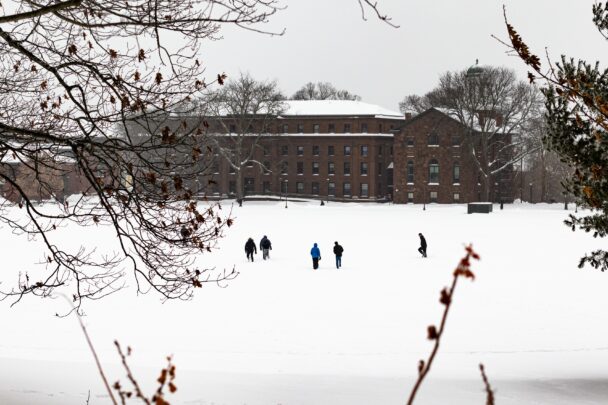
On Sunday, Jan. 25, the University declared limited operations for across campus for the following Monday, after the fierce Winter Storm Fern brought heavy snowfall across many U.S. states, including Connecticut. Over a foot of snow fell on Middletown, and student life was brought to a standstill while the roads and sidewalks were plowed. While the University’s most recent snowstorm certainly impacted students and faculty alike, it is far from the only wild winter weather that has crossed the University’s path, as a long line of Argus reporters have made abundantly clear.
2013: Winter Storm Nemo
The 2013 blizzard known as Winter Storm Nemo blanketed Wesleyan’s campus with over 8 inches of snow. On Feb. 10, 2013, Molly Schiff ’18 reported on the unprecedented snowfall in an article entitled “Nemo Hits Campus, State Hard.”
“This [storm] is one of the worst in memory for me,” then-Director of Public Safety David Meyer said in the article. “We had 36 inches of snow in 34 hours, or whatever it was.”
Since the storm occurred on the night between Friday, Feb. 8, and Saturday, Feb. 9, the weekend allotted enough time to clear the snow so only a single day of classes, Monday, Feb. 11, had to be cancelled.
Some students attempted to go out during the blizzard, but the conditions kept many in their rooms. William Tyner ’13 told The Argus his Friday night plans were affected by the intensity of the blizzard.
“I was throwing a party,” Tyner said. “Very few people came out. It showed me who my real friends were.”
2011: The “Snowpocalypse” Halloween Nor’easter
2011’s winter blizzard had a particularly bad effect on the Wesleyan community, coinciding with Halloween. In the Nov. 3, 2011, article entitled “Halloween Blackout Wreaks Havoc on Wesleyan Campus,” Max Brivic reported on the effects of the snowstorm, referred to as the “Snowpocalypse,” which resulted in a multi-day blackout, in which some students were left without electricity for up to ten days after power originally went out midnight of Oct. 29.
Brivic noted that residents of 200 Church St. and 156 High St. were evacuated due to safety concerns, with some displaced students staying with friends, and others sleeping on the floor of dorm lounges. Students were encouraged to leave campus if possible.
“Physical Plant is hounding [Connecticut Light & Power] to try to have it be sooner rather than later, but it’s out of Wesleyan’s control,” then-Director of Residential Life Fran Koerting said in the article.
1996: Blizzards in January and April
1996 was an eventful year blizzard-wise for Wesleyan. The Blizzard of ’96 dropped 18 inches of snow on Middletown on Jan. 8, according to an Argus article by Elizabeth LeSure ’99 published on Jan. 24 of that year.
“There was so much snow that I was convinced I would come back to campus and not be able to get around,” Liz Garcia ’99 said in the article. “It didn’t seem possible that Physical Plant would be able to clean it up.”
Physical Plant staff worked 14 hour shifts to clear the snow, which, after temperatures rose above freezing on Jan. 12, melted and turned campus into a mudhole.
Another major blizzard took the school by surprise just a few months later, lasting from April 9 to April 10. A blackout, occurring on the morning of April 10, caused students to miss their classes, according to an Argus article by Dan Shotz ’99 published on April 12, 1996.
“Many students did not make it to class on time as they became hypnotized by the flashing of their alarm clocks,” Shotz wrote.
1940: Valentine’s Day Blizzard
The Valentine’s Day Blizzard of 1940 took the lives of 31 people and produced snow drifts across New England measuring 10 feet tall. Winds of 60 mph kept most people indoors: except for the members of Psi U.
The Argus published an uncredited report of the catastrophic event on Feb. 19, 1940.
“Undaunted by blizzard or cold, the Psi Us mushed down town in search of a blond, a cat and a steering gear,” The Argus wrote. “The Delt’s evidently having an unannounced party for which they lacked members of the fairer sex, sent their boys out to get 6 girls. But that isn’t all, they wanted them all over 18 years old and they wanted them quick, in half an hour!”
Surprisingly, others were also out in the storm.
“Bevies of females scattered at the sight of this formidable aggregation,” The Argus wrote. “The frosh were desperate. Time was getting short and they could find no one. When the time was up, they returned home. They had found two girls—each with a date!”
1888: The Great White Hurricane
Remembered as “The Great White Hurricane”, the Blizzard of 1888 is one of the worst snowstorms on record. A whopping 50 inches of snow fell on Middletown between March 11 and March 14 of that year, and snow drifts reportedly reached 38 feet tall in some places.
On March 9, 1888, The Argus reprinted a report from Middletown’s Penny Press detailing the extent of the devastation.
“Main Street was almost impassable,” the Penny Press wrote. “Washington Street was a weird picture where snow wreaths triumphed…. All cross streets were blocked and the wind roared in rage.”
The situation was indeed dire, as in most streets, “the only passage way even for pedestrians is in the middle of the highway, and that is only wide enough for one person.”
An uncredited article published in the March 21, 1888 edition of The Argus described the scene up the hill on campus.
“Wesleyan was desolate and no mistake,” The Argus wrote. “No teams passed through High Street for two days, and the consequence was that provisions ran short.”
The situation reached a point where “the college club were obliged to take to condensed milk, and, as the article is not drinkable, much suffering was caused among the freshmen.”
“Since students were snowed in,” The Argus wrote, “The men in college can now realize what it is to be shut off from the outside world. No New York papers for five days, no mails for a week and no telegraphic communication.”
Though the situation was dire, there was a silver lining: “The overworked men in the college, however, hailed the storm as a blessed relief from work.”
Nathan Yamamoto can be reached at nyamamoto@wesleyan.edu.
Hope Cognata and Maggie Smith contributed to reporting for this article.
“From the Argives” is a column that explores The Argus’ archives (Argives) and any interesting, topical, poignant, or comical stories that have been published in the past. Given The Argus’ long history on campus and the ever-shifting viewpoints of its student body, the material, subject matter, and perspectives expressed in the archived article may be insensitive or outdated, and do not reflect the views of any current member of The Argus. If you have any questions about the original article or its publication, please contact Archivists Hope Cognata at hcognata@wesleyan.edu and Lara Anlar at lanlar@wesleyan.edu.

Leave a Reply