
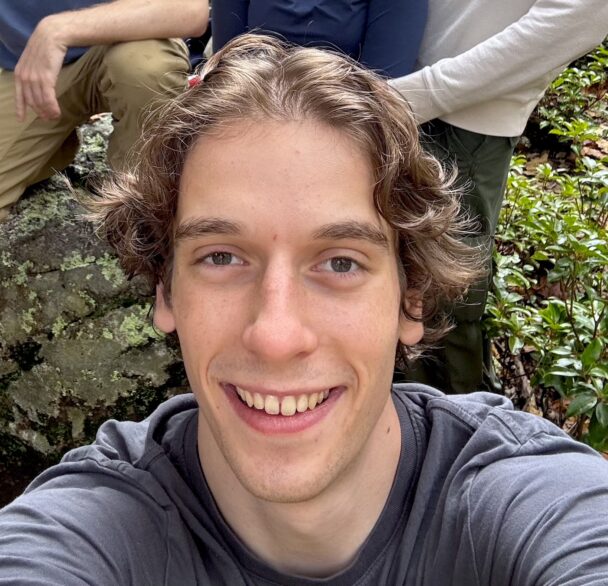
WesCeleb: Greg Joblove on Visual Effects at Wesleyan and Beyond
What do Chappell Roan’s “The Subway,” Halina Reijn’s “Babygirl,” and Diarra Kilpatrick’s “Diarra from Detroit” have in common? Besides being impressive pieces of media, Greg Joblove ’26 has worked on all three. Outside of film, Joblove is an Integrated Design, Engineering, Arts & Society (IDEAS) minor and can be found playing—and losing—Dominion with his housemates. This week, the Argus sat down with Joblove to talk about his experiences with visual effects, the role of filmmaking in contemporary society, and senior year reflections.
The Argus: Why do you think you were nominated for WesCeleb?
Greg Joblove: I feel like I’ve had the opportunity to meet a bunch of people in the film community here, and all of them have been very supportive and great collaborators to work with, so I assume it’s something to do with that.
A: What are you majoring in, and what drew you to those majors?
GJ: I’m a film major and an IDEAS minor with a computer science concentration. The film [major] was kind of a no-brainer for me. I chose to come to Wesleyan based on that. It’s always been my hobby, and I haven’t gotten sick of it yet. I’ve always been drawn to visual arts and visual storytelling, but I also have a technical mind. I’m drawn to technology and how it interacts with art. I think filmmaking was the perfect hybrid for that in my eyes. There are a lot of technical points to master and get good at, but there’s also a more general art to the technical aspects. I picked up the minor because I was worried that spending all my time doing stuff on the computer might get exhausting. I felt like being able to do stuff with my hands and actually build things, which the IDEAS minor is really good at allowing me to do. And so far, it’s been successful.
A: Have the differences in those two disciplines informed each other?
GJ: I should specify [that] my interest in film is visual effects, which is kind of this subset of filmmaking that focuses on creating something that isn’t real or wasn’t actually filmed and manipulating images in a way that makes it look real or just modifies it. That’s always been the more technical, problem-solving side of my brain. I think [there are] actually a lot of similarities between building something physically with your hands and working on one shot and molding it into something you want it to look like. It’s actually a similar thought process.
A: How did you get involved in film and visual effects?
GJ: I genuinely can’t remember when I got into it; I just always kind of was. There are all these home videos of me asking my dad for the camera and just kind of pointing it at people. Then I explored that interest [more]. I remember my mom had this old laptop I’d mess around with iMovie HD on. I started messing around with speeding clips up and reversing clips and that sort of thing. I got into the editing side of things from that. I was really interested in assembling clips and working with them on a timeline. I realized eventually that I enjoyed modifying each clip individually, really zooming into the clip-by-clip scale and making each shot look exactly as I wanted using a variety of digital techniques. It kind of grew from there. During [COVID-19], I learned some new software that I probably wouldn’t have had time to learn otherwise. That kind of snowballed from there.
A: What are some of the projects you have worked on?
GJ: I think a lot of my favorite projects I’ve worked on have been at Wesleyan. I worked on this film called “The Crooner” that John Earling ’27 and [Giovanni Kear ’26] made two years ago. My task was to put the main character inside a microwave and shrink him down. I think it turned out really well, and I had such a fun time with that. I also worked on this thesis project last year called “A Thousand Cranes” which was very satisfying to work on, and I think it helped tell the story really nicely. I always love it when I can do stuff that actually assists the storytelling. Outside of Wesleyan, I’ve also had the privilege of working on a number of really cool projects. I always have to bring up the Chappell Roan video. I was the on-set visual effects supervisor over the summer for the “[The] Subway” music video, which was probably one of the coolest things I’ve ever done. Every project I’ve worked on, I’ve felt grateful to be a part of, and it has allowed me to build my skills while also meeting really cool people.
A: What do you think filmmaking’s role is in society?
GJ: Film has a uniquely powerful way of eliciting emotions from anybody who watches it. I think if done correctly, there are no language barriers. There’s much more of a participatory emotional experience with what you’re watching than with a lot of other media. It’s also kind of the medium of the future. We’re seeing more video content. Everybody is developing media literacy when it comes to watching videos and understanding them, developing opinions from them, and expanding their own sympathetic and emotional experiences with them. Whether it’s a feature film or just a short-form video that you see online, everybody is getting super good at absorbing them or understanding them. It allows people to get to know each other way more efficiently and in way higher numbers than we have before.
A: Do you have any advice for people looking to get involved with the film world?
GJ: I think all film students have very big ideas about where they want to go in the film industry. Everybody is primed to have large aspirations. I’ve found the most success in gaining something of a name for myself when it comes to my own personal network by finding a skill that I can get really good at that not a lot of people have spent time getting good at. Everybody here is taking the same classes. They’re learning, for the most part, the same curriculum. I thought part of the calculation with visual effects is, what is a skill that people are looking for that’s valuable in the film world, [that] not a lot of people spend time learning? Nothing I’ve learned is stuff that other people can’t learn. I’m one of the only people here who does visual effects. It’s not because I’m learning something other people can’t learn, but because I’m learning something I’ve chosen to spend time learning.
In the professional world, I’ve found myself on sets in a way higher position than I think I’m otherwise qualified for. You don’t have to just climb the ladder. You can find these creative ways to go about it. And a lot of the freelance visual effects people that I work for are starting to get directing gigs now because they’ve proven, just by being able to be on set in a leadership role, that they have what it takes to direct. Finding your way on set in these non-traditional methods allows you to move more quickly than the traditional [method].
A: What are you looking forward to during your senior year?
GJ: Being a part of the thesis film stuff has been really cool. I’ve been watching them since I got here, and being able to be involved in the cohort that’s making them is really cool. Living in a house with all my friends has [also] been absolutely incredible. This is a year [that I don’t] take for granted as much as in other years. I’m very aware of each moment, as it’s the end of the four-year era. I’m looking forward to finishing out my time here and doing all of the Wesleyan things with my friends.
A: What have you learned from film and the past four years at Wesleyan?
GJ: I’ve learned the value of thinking big. I think a lot of students here criticize some film classes for being very theoretical and kind of head in the clouds a bit. I was certainly a part of that when I got here. I just thought, give me the practical knowledge, [but] the more I’ve been here, the more I’ve come to find the value in being able to think theoretically and think creatively. Even when I find myself in a class or a lecture that feels a little out there, I have found that there’s still practical value that comes from that.
Approaching creative spaces with humility is something I’ve really found success in doing here. Maybe more in my high school days, I’d find myself being very judgmental based on someone’s technical skills and not on their creative skills. I quickly realized that’s not a valid way of being in the film community or in any artistic community. Being here, I’ve learned so much from people who are much more creative than I am. [Being] kind of a fly on the wall, or part of the creative process in a more technical way, has been really fulfilling.
A: Do you have any parting reflections?
GJ: I think during my time here, I’ve really found that your art and creativity are what you make them. I’ve had doubts about whether relegating myself to visual effects or cornering myself would be something that would come back to bite me, but so far it’s been super fruitful.
Eliza Lampert can be reached at elampert@wesleyan.edu.
Lyah Muktavaram can be reached at lmuktavaram@wesleyan.edu.


Leave a Reply