
Who Really Won the 2026 Midterm Elections?
Submerged in a mix of anxiety and anticipation, Nov. 3 marked the beginning of the post-2024 blue wave. The Democrats swept the 2026 midterms, now leading the Senate by 12 seats, the House by at least 85, and gubernatorial offices by 10.
The extent of the sweep—described by some Republicans as more of a “tsunami” than a wave—came as a shock to the GOP, who saw the diverse coalition that propelled Donald Trump to the White House in 2024 crumble as states as conservative as Mississippi and South Carolina flipped blue.
But despite the Democrats’ landslide victory, the number of seats won or lost reveal little about the underlying hallmarks of this election and the drastic change democracy is experiencing in the modern day.
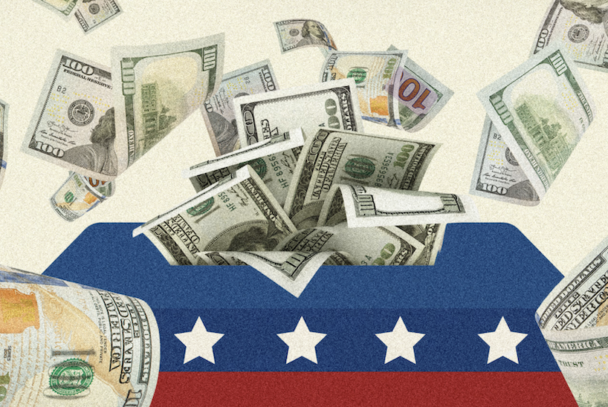
We often overlook the hidden foundation of today’s democratic institutions: money. The lack of institutional protections around campaign finance increases the electoral system’s risk of corruption when large amounts of cash are directly injected by megadonors to promote their candidates.
A recent Supreme Court of the United States (SCOTUS) decision weakened a protection that the electoral system desperately needed: On Jun. 30, 2026, SCOTUS ruled 6-3 in the case of the National Republican Senatorial Committee v. Federal Election Commission, allowing political parties to funnel unlimited money into individual campaigns.
The decision removes a $4,071,800 spending cap for national party committees on individual Senate candidates and a $130,600 cap on individual House candidates. But despite this new standard for Super PACs and other donor groups, individuals are still limited to $3,500 donations. On top of this, the Federal Election Commission (FEC) currently cannot regulate this activity because President Trump has not appointed new members to fill four out of six empty seats on the board, so they fail to meet the quorum to even render any regulation.
As a result, megadonors and Super PACs receive an unfair advantage to flood the cycle, monopolizing elections to represent their interests. Systematically capping individual level participation while allowing unlimited corporate funding is antithetical to representing minority groups and small-dollar donors that don’t stand a chance against a trillionaire like Elon Musk.
This midterm cycle directly suffered from the aftermath of Super PAC spending. By the end of September, Super PACs and other large donors’ independent expenditures reached a record-breaking $2 billion, a 51% increase from the last midterms’ $1.3 billion. The top 40 donors spent more than $2.4 billion in campaign finance contributions through mid-October. More than $1.5 billion went to Republican candidates. With the inclusion of so-called dark money (funding from non-profit organizations that aren’t required to disclose their donors), some analysts even project that the actual money spent in this cycle could be over $12 billion.
What do these numbers tell us about American democracy? When a candidate receives millions from an industry or a corporate-backed Super PAC, they are more likely to have the candidate propose an agenda that suits their taste. For example, flooding the market with AI when the average population desperately needs stable employment, affordable groceries, healthcare, and post-secondary education. Seriously, I’m dying to see a candidate who is willing to discuss how ridiculous Wesleyan’s cost of attendance is!
You will be deeply disappointed to learn that somebody spent over five thousand times more than how much you pay for this education to support the Republicans this midterm! The top donor, Elon Musk, already spent $500 million to elect Republicans, $212 million of which went to Ken Paxton, the Republican nominee for Senate in Texas. His Democratic opponent, James Talarico, received $109 million from the Democratic funding commissions, directly raising more than $158 million.
While the donations that the Democrats received this year do not come close to the amount that the Republicans have received, Super PAC funding still floods Democratic campaigns. Absent from blue-wave celebrations is the fact that most victorious Democratic candidates received financial support from the American Israel Public Affairs Committee (AIPAC) and other pro-Israel commissions.
Currently, 247 out of 262 Democrats in Congress received AIPAC funding. Their obligation to Israel-aligned donors could compete with their personal responsibility to represent constituents who are seeking a reassessment of the US involvement in the conflict between Israel and Gaza as well as the Iran War.
We don’t realize that we as constituents may have cast a ballot for a candidate who isn’t genuinely excited to represent people like us. The election processes that are supposed to represent the public have drastically changed to a game for the elites, transforming the political landscape. If top donations influence election results, what will discourage megadonors from feeding their candidates legalized bribery? Elections in our nation are far from being transparent.
The excitement after the blue wave distracts us from the erosion of our democratic institutions by elite and corporate megadonors with private interests in AI, as well as stocks that inject cash into the public system. Indeed, the Democrats won the midterm elections. But who will address the erosion of democracy?
Grace Lee is a member of the class of 2029 and can be reached at glee01@wesleyan.edu.



Leave a Reply