
South Korean Ambassador On Economic Relations and Military Power at East Asian Studies Talk
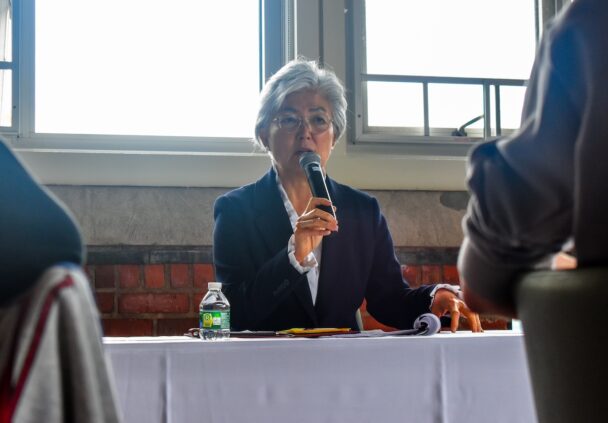
Around 100 students and faculty members crowded into the Allbritton Center for the Study of Public Life on Friday, Sept. 25 to hear South Korean Ambassador to the United States Kang Kyung-wha discuss the future of Korean foreign policy and relations with the United States. The talk, titled “Korea’s Role in a Changing World Order,” covered the evolving U.S.–Republic of Korea (ROK) alliance, inter-Korean relations, Korean soft power, sustainability, and AI initiatives.
The talk was hosted by the College of East Asian Studies and moderated by Associate Professor of East Asian Studies Joan Cho, whose research focuses on social movements, democracy, and authoritarianism in Korea and East Asia.
Prior to serving as ambassador, Kang was the foreign minister of South Korea and held roles in the Korean National Assembly Speaker’s Office, the United Nations, and the Asia Society. She also received graduate degrees in the neighbouring state of Massachusetts, and described this trip to Connecticut as a kind of homecoming.
Kang began the talk by offering a brief historical retrospective, tracing the U.S.–ROK alliance to the Korean War, where the 1953 Mutual Security Defense Treaty legalized the United States’ commitment to protecting South Korea from North Korean aggression. She characterized the security alliance as “one of the highest expressions of that mutual commitment.”
Kang noted, however, that this alliance has notably shifted with South Korea’s growing economic power and military strength. South Korea now contributes more to the alliance than it did in the 20th century, with the South Korean military taking primary responsibility for security on the Korean peninsula.
Aside from the security alliance, Kang stressed the importance of the vibrant trade relationship the two countries share. President Trump recently cut tariffs on South Korea to 15% after raising them to 25% in January, a signal that, despite souring relations with other former allies, the relationship between South Korea and the United States remains vital to mutual development and American economic interests.
“Korea offers a lot that the modern world going into the AI age requires: chips, educated workforce, a local platform that competes with the likes of Google and Microsoft,” Kang said. “There’s Naver. There’s Kakao. So uniquely placed to partner with America’s innovativeness to the mutual benefit.”
Kang also reiterated Korea’s ambitious new economic plan to invest $350 billion dollars in the United States a few days after South Korean Minister of Trade, Industry, and Resources Kim Jung-kwan briefed the National Assembly on the project. The project, which would invest the money into a combined-cycle Texas power plant focused on efficient energy production as well as nuclear power projects and liquefied natural gas development, has yet to receive an official announcement and is pending negotiations. Kang steered away from questions asking about Trump’s influence on Korean-American relations, only suggesting that Trump was taking a “different approach” to economic relations.
The investment aligns with Kang’s emphasis on South Korea’s green growth development and commitment to mitigating the effects of climate change, which she stated would include more nuclear power and renewables.
Kang’s optimism on the future of South Korean defense policy waned on the subject of communication with North Korea, acknowledging the fragility of their relationship, which Kang intimated had deteriorated following the 2019 North Korea–United States Hanoi Summit.
“North Korea has shut its door, gone back, and redefined its relationship with the South as a foreign country, and not just another foreign country, but the number one hostile enemy that it has to guard against, and so there has been zero engagement, zero communication between South and North Korea,” Kang said. “Beyond stability, we want to reengage with the North in dialogue on their nuclear program and peaceful coexistence, though denuclearization is a difficult one because North Korea has stated that they are not interested in denuclearization anymore.”
North Korea’s influence in the Eastern Hemisphere has expanded through an alliance with Russia in its war against Ukraine. Ukrainian President Volodymyr Zelenskyy said on Monday, Sept. 28, that preparations are underway to deploy an additional 10 thousand North Korean troops to Russia. Kang expressed hope that, when the war concludes, North Korean officials will be more receptive to dialogue.
Kang also addressed the recent popularity of Korean cultural exports by noting that Korea has long been a cultural force. She noted that a substantial benefit of South Korea’s soft power is its ability to ease discussion and diplomacy at a human-to-human level. She reflected on instances where partners have mentioned that their kids like BTS, and she was then able to bring them a piece of the K-pop group’s merchandise the next time they met. Kang questioned, however, if Korea’s soft power alone would be able to ensure that their foreign policy goals are met.
“All of this [soft power] is based upon a solid, solid defense posture. The combined defense posture of U.S. forces in Korea and the Korean military is as robust as any deterrent around the world,” she said in response to a question on what benefits soft power could offer that traditional means of diplomacy might not meet.
Students expressed surprise at Kang’s emphasis on hard power compared to portrayals of South Korea in popular media.
“The popularity of the culture is so positive that it drowns out the other stuff that apparently the ambassador cares much more about,” Wyatt Pak ’29 said. “She’s much more interested in her job, frankly, and economy, military, security, and it’s funny because it’s not what you think about anymore when it comes to Korea…. It’s interesting that she has a very different view on what’s important.”
Pak did appreciate the opportunity to hear from an official whose job it is to marry cultural and political objectives between Korea and the United States as a Korean American whose identity was formulated in the United States.
Annabelle Pieyre ’29 agreed that Kang’s role allowed students to receive valuable perspective, particularly from a woman in politics.
“It’s very interesting to get a perspective from a woman who has such a big role to play in international affairs…and it was very interesting to hear how she viewed the relationship between North and South Korea, how it’s changed throughout history, and how it is now,” Pieyre said.
Professor of the Practice in East Asian Studies Hyejoo Back, a Korean language professor and one of the organizers of the talk, believed this event would inspire many of the students in attendance. She noted her hopes that the ambassador’s visit would have a positive effect on everyone, but especially for Korean-related students—the second- or third-generation students who might have already heard about Kang from their family—and female students who could see her as a role model in leadership and politics.
Prior to the talk, Kang attended the United Nations General Assembly in New York, where South Korean President Lee Jae Myung gave a keynote address and met with Governor of Connecticut Ned Lamont and other state business leaders to discuss Korean involvement in Connecticut’s quantum technology development.
“Korea’s Role in a Changing World Order” was postponed from last year.
Aarushi Bahadur can be reached at abahadur@wesleyan.edu.
Abby Lee can be reached at alee04@wesleyan.edu.

Leave a Reply